MMO & BDD Electrode-Enabled Electrochemical Oxidation
Electrochemical Oxidation Systems for Industrial Wastewater — Engineered, Piloted, Proven
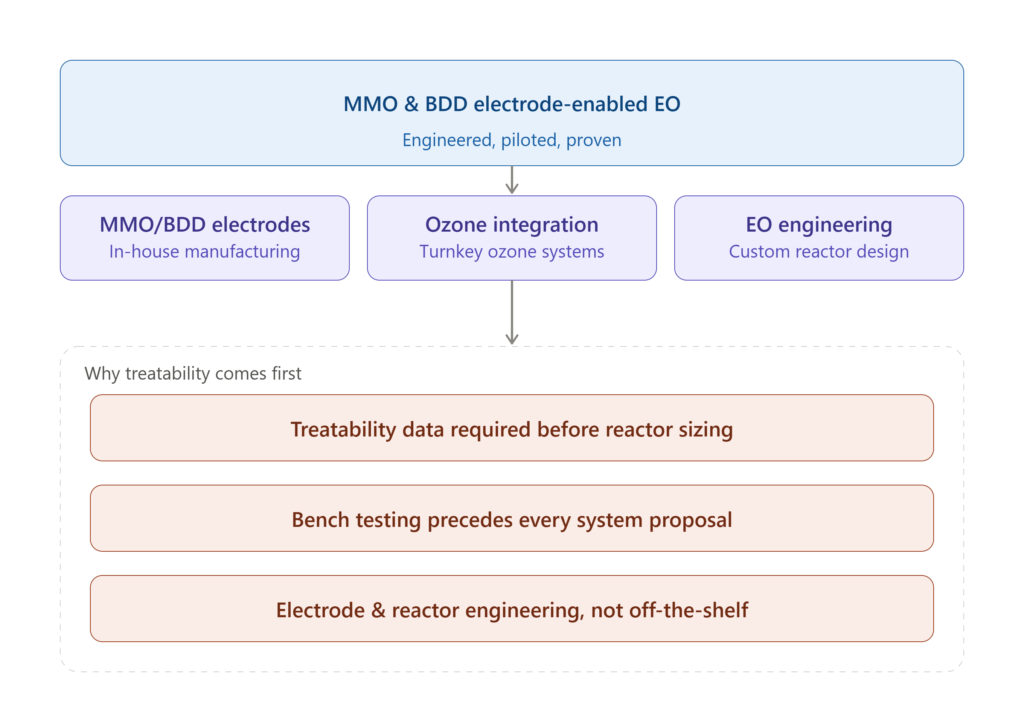
Evoaeo dedicated to design and fabrication of catalyst electrode materials such as MMO and BDD electrode; design, prototyping, and development of EO reactor, modular and skid-mounted fully automatic electro oxidation wastewater treatment system and equipment able to function under ambient temperature and pressure, designed to treat industrial wastewater that biological treatment and activated carbon, and other conventional approaches can not resolve, what is more, Evoaeo offer exclusive treatment train integration, and electro oxidation engineering services. Every recommendation is backed by treatability data before a reactor is sized and years of experiences with our engineering team.
- Trial and bench treatability testing before any system is proposed
- Catalyst electrode fabrication and electrochemical reactor engineering, not off-the-shelf sizing
- Byproduct, energy, and residual disclosure, and beyond
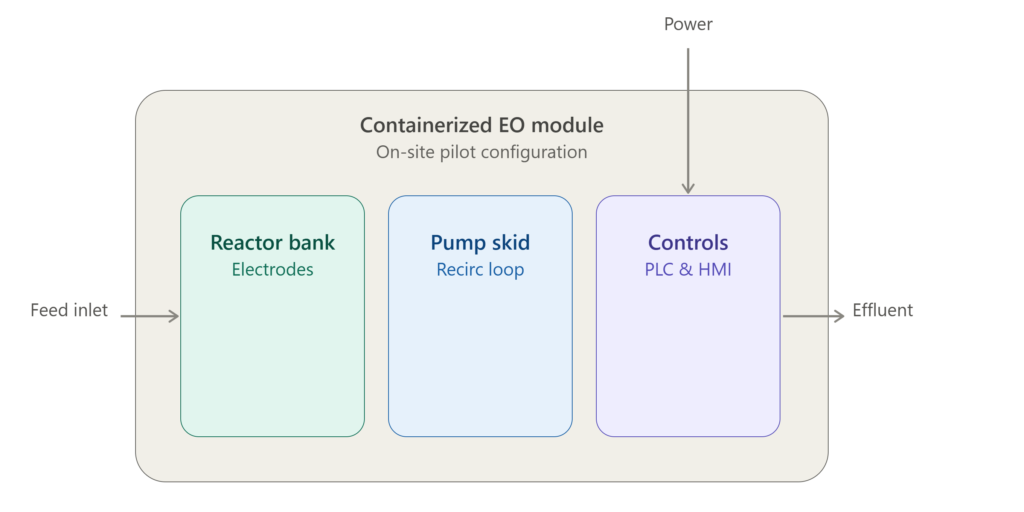
Containerized electrochemical oxidation module, on-site pilot configuration
10+ years
Electrochemical electrode material manufacturing & engineering and EO reactor design, prototyping, deployment experiences.
Up to 5-log
Target-compound reduction demonstrated in bench and pilot testing, site-specific
Zero sludge
No hazardous chemical dosing or secondary solid waste in the EO process itself
On-site first
Treatability testing runs on your actual wastewater before any proposal
Decision Making
Why this decision deserves engineering evidence, not marketing claims
Choosing a wastewater treatment pathway: it affects discharge compliance, regulatory exposure, capital spend, and downstream community and environmental health. We share site-specific test data behind current efficiency, energy consumptions, COD removal rates, and ROI figures. Every technical claim on this page is qualified by the water matrix, testing method, and operating conditions it came from.
A wrong call here shows up as a permit violation, a failed discharge sample, or capital sunk into a system that never hits target. A right call shows up as a compliant discharge, a defensible record for the regulator, and a system sized once instead of twice. That gap is why every claim below is sourced, dated, and scoped to the water it was measured on.
Engineer-reviewed content
Technical pages are drafted and checked by our process and electrochemical engineers before publication, not by marketing staff alone.
Independent testing standard
Performance figures come from bench or pilot testing on real client wastewater, with method and detection limits disclosed on request.
Transparent limitations
We disclose byproducts, energy demand, and water-matrix dependency alongside performance data — not just best-case results.
Dated, source-linked claims
Every performance figure carries the test date and water matrix it came from, and is revised when newer pilot data supersedes it.
Our editorial standard
- Engineer of record reviews technical claims before they are published
- Bench and pilot data are the only basis for a performance figure
- Update history is kept when a figure changes with new test data
What we will not do
- Publish a destruction percentage without the matrix it was measured on
- Promise regulatory compliance before your permit and test data are reviewed
- Recommend a system size before bench or pilot testing confirms it
What we build
Core electrochemical oxidation technologies
MMO and BDD electrodes, reactor engineering, ozone integration, and the design services that connect them into a working treatment train.
MMO Electrodes
Titanium-substrate mixed metal oxide anodes (RuO2/IrO2) for cost-efficient COD, color, and organics oxidation at industrial scale.
BDD Electrode
Boron-doped diamond (BDD) electrode for the highest oxidation potential — refractory organics, PFAS concentrates, and persistent solvents.
EO Reactor Modules
Containerized, skid-mounted electrochemical reactors sized from bench data, not catalog defaults.
Engineering Services
Process design, electrode sizing, reactor configuration, and scale-up validation from an in-house engineering team.
MMO electrode manufacturing for industrial-scale electrochemical oxidation
Mixed metal oxide anodes remain the practical workhorse for high-volume COD and color removal where BDD’s oxidation power isn’t required to hit the treatment target. We manufacture and coat titanium-substrate MMO electrodes in plate, mesh, and tubular formats and size them against your wastewater’s chloride, conductivity, and organic load.
- RuO2 / IrO2 coating selection matched to your target reaction
- Plate, mesh, and tubular formats for retrofit or new-build reactors
- Coating life and replacement interval modeled from your operating current density
Choosing an electrode
MMO or BDD electrode: an engineering comparison, not a sales pitch
Electrode selection should follow your target contaminant and budget, not brand preference. Both are represented honestly here so you can weigh the trade-off yourself.
MMO Electrodes
- Lower capital and replacement cost per unit area
- Strong performance on color, general COD, and moderate-strength streams
- Shorter coating life under high current density or halide-rich water
BDD Electrodes
- Highest oxidation potential available for refractory organics and PFAS
- Minimal fouling and long service life in aggressive matrices
- Higher capital cost and energy demand per unit treated
Engineering service, not only supply
From BDD electrode film manufacturing to wastewater process validation
Evoaeo supports technical buyers with electrode-material selection with various experiment result to choose from bdd electrode, MMO anodes, etc., electrochemical cell configuration with various types of electrochemical reactors, treatability testing, pilot planning, and scale-up assumptions for industrial wastewater streams that are difficult to treat by conventional approaches alone.
- Wastewater profile review: COD, TOC, conductivity, pH, chloride, flow, and target compounds.
- BDD electrode format selection: plate, foam, stack, substrate, active area, and connector design.
- Operating-window screening: current density, residence time, flow rate, and electrode spacing.
- Risk review: energy demand, transformation byproducts, corrosion/fouling potential, and downstream compatibility.
- Pilot pathway: translate lab data into pilot module configuration and reactor integration requirements.
Where it applies
Industrial wastewater applications
Streams where conventional biological or physical-chemical treatment alone has failed to hit discharge or reuse targets.
Pharmaceutical & API
API rinse water and process effluent containing active ingredients and solvents resistant to biological treatment.
Petrochemical & Refinery
High-COD, saline, and phenolic streams from refining and petrochemical processing.
Battery Recycling
Electrolyte and process rinse wastewater with organics and metals requiring combined treatment.
Textile & Dye
Color-intensive effluent where dye molecules resist conventional decolorization.
Landfill Leachate & PFAS
PFAS-impacted leachate and groundwater requiring on-site destruction rather than off-site disposal.
How a project moves forward
Engineering design & services workflow
The same four-stage path applies whether the outcome is an MMO retrofit, a new BDD-based EO module, or an ozone addition. Each stage produces a data package the next stage depends on — none are skipped.
Stage 1 — Characterization
Wastewater profiling, target contaminant identification, and discharge or reuse constraint mapping.
Stage 2 — Bench Testing
Lab-scale EO and/or ozone testing on your actual wastewater to confirm removal rates and byproducts.
Stage 3 — Pilot Validation
Containerized pilot run under real flow conditions to validate energy demand and long-run performance.
Stage 4 — Scale-Up Design
Full-scale reactor sizing, electrode selection, and integration into your existing treatment train.
Project workflow while start with treatment objectives
A safer path from wastewater sample to EO module design
Explore how our engineering team help you to spot the safe path from basic waste stream characteristics, electrode material selecting, treatability testing, bench scale studies, then how to scale up to meet your treatment objectives and electro oxidation wastewater treatment project workflow.
1. Send sample and objective
Share COD, TOC, pH, conductivity, chloride, target pollutants, flow, treatment target, and process constraints.
2. Select electrode format
Match plate, foam, stack, active area, substrate, and connection style to the testing objective.
3. Run treatability test
Screen current density, residence time, removal trend, energy demand, pH drift, and byproduct concerns.
4. Scale with evidence
Use lab and pilot data to define reactor geometry, power supply, hydraulics, maintenance, and integration assumptions.
What engineers ask before approving electrochemical oxidation
Field notes from the process and compliance engineers we work alongside — the practical questions that come up before an EO or ozone system gets signed off.
- Ask for the water-matrix dependency, not just a headline removal number
- Confirm byproduct and residual data, not only influent/effluent COD
- Model energy cost against your actual load profile, not a nameplate figure
Good-fit evaluation signals
- Refractory organics or persistent compounds remain after conventional treatment.
- The stream has enough conductivity or can be evaluated for conductivity adjustment.
- The user can provide real wastewater samples and analytical data.
- The project can compare removal target, energy demand, and byproduct profile.
- EO is being evaluated as pretreatment, polishing, or a targeted advanced oxidation step.
I need a BDD electrode
Compare plate, stack, substrate, active area, connector, and surface-treatment options for electrochemical oxidation cells.
I need to treat complex wastewater
Wastewater composition, target removal, conductivity, flow, and downstream limits before choosing a reactor configuration.
I need proof before investment
Engineering perspectives across the project lifecycle
The questions change at every stage — design, procurement, commissioning, and operation each surface different risks worth naming up front, do not forget to rise these questions before you choose an exact wastewater treatment method.
Design Phase — Process Engineer
"Model energy cost against a full year of load swings, not a single spec-sheet day."
Procurement — Capital Projects Manager
"A treatment-as-a-service quote and a capex quote are not comparable line items — ask each vendor for both."
Commissioning — Controls Engineer
"Sensor redundancy matters more once it's your name on the discharge monitoring report, not the vendor's."
Operations — Plant Manager
"I care about consumables and downtime, not the peak removal number from the pilot report."
Health & Safety — EHS Manager
"Off-gas handling and electrical classification need sign-off before a skid touches the floor plan."
Regulatory — Permitting Specialist
"Bring the byproduct data to the agency meeting yourself. Don't let the regulator discover it later."
Engineering validation note
BDD electrode based electrochemical oxidation performance depends on wastewater chemistry, reactor design, current density, residence time, mass transfer, energy input, and downstream requirements. Evoaeo engineering team recommends bench or pilot validation using the customer’s actual wastewater before full-scale engineering decisions.
Start with evidence
Send Evoaeo your wastewater profile or MMO anode, BDD electrode requirement
Get a practical review of electrode format, test approach, EO module pathway, and the data needed before scale-up.
Include these details
- Wastewater source and target pollutants
- COD / TOC / BOD, conductivity, pH, TDS, chloride
- Flow rate or batch volume
- Treatment target and discharge constraints
- Current process and main failure point
Performance depends on your water, not a marketing average
Every figure below is tied to a specific water matrix and test date — which is exactly why treatability testing happens before design, not after.
- Every reported figure is tied to a specific water matrix and test date
- Pilot data supersedes bench data before final system sizing
- Figures are updated as new pilot results come in — not fixed at launch
Electrochemical oxidation vs. conventional treatment
EO and ozone are not universal replacements for biological or physical-chemical treatment. They are usually the step that handles what conventional treatment can’t. Compare the trade-offs before committing capital.
Destruction vs. capture. Compare breakthrough behavior, spent-media disposal, contaminant fate, energy use, and residuals.
Oxidation-pathway comparison. Compare oxidant demand, water transmittance, byproducts, footprint, and controls.
Power-driven vs. reagent-driven oxidation. Compare chemical handling, sludge generation, pH conditioning, and operating complexity.
Destruction vs. separation/concentration. Compare brine or regenerant handling, residuals, and role in the treatment train.
Before you request a quote
Frequently asked engineering questions
Straight answers to the questions that come up most before a treatability review is scoped.
No guaranteed compliance figure, no universal destruction percentage, and no “zero waste” language without site-specific test data behind it.
Wastewater fingerprint, treatment objective, target analytes, COD/TOC, pH/conductivity, residuals, byproducts, energy demand, and operating window.
Pilot data on your water, the analytical method and detection limits used, a residuals and byproduct review, and maintenance and consumable assumptions.
Bench-scale screening is typically measured in days to a few weeks; pilot validation under real flow conditions is usually several weeks to a few months depending on scope.
Start with a treatability review, not a proposal
Send your wastewater profile or electrode requirement and get a practical, engineer-written review of electrode format, test approach, and the EO or ozone pathway that fits — before any capital commitment.
Include in your inquiry
- Wastewater source and target pollutants
- COD / TOC / BOD, conductivity, pH, TDS, chloride
- Flow rate or batch volume
- Treatment target and discharge constraints
- Current process and its main failure point
All figures on this page are engineering estimates pending site-specific treatability testing and are not a guarantee of performance for any individual wastewater stream.