Engineering Services: Extended Engineering Support
Software & Hardware Update
An EO system sits on the same critical-infrastructure footing as any other treatment process on your site — a rushed or poorly sequenced update can trip a discharge exceedance, damage a rectifier, or put a technician near energized equipment that isn’t behaving the way the manual says it should. This context covers how we sequence an update so none of that happens.
Reviewed for technical accuracy by Janeczka Kowalski, Process / Electrochemical Engineering. Figures and ranges on this page are engineering starting points — verify against your own pilot or vendor data before finalizing a design. Given the truth that our clients are scattered in different countries and regions, therefore our maintenance and repair engineering services are high likely to be offered by remote instructing. The content is created by the Evoaeo engineering team led by Janeczka, All rights reserved.
Compatibility & integration
Confirming the update won't break what's already talking to it
Before a firmware release goes anywhere near a live rectifier, we confirm it holds the same control-loop timing and register mapping the existing PLC logic expects — a charge-dose or current-density control loop that drifts by even a few hundred milliseconds after an update can show up as a real process swing, not just a cosmetic glitch. On sites where the EO skid was added onto existing plant infrastructure, we also confirm the updated firmware still talks cleanly to whatever’s already there over Modbus TCP, PROFIBUS, or EtherNet/IP — the full protocol and network architecture is covered on our System Integration & Automation page, but the update-specific check here is narrower: did this release change a tag structure or register map in a way the SCADA historian or HMI screens weren’t built to expect. A firmware update that silently breaks the data pipeline to SCADA is a known failure mode, and it’s usually invisible until someone goes looking for a data point that stopped updating.
Operational continuity & risk management
Sequencing the update so the plant never loses capacity
Updates get scheduled against your actual low-inflow window, not a generic overnight default — the goal is landing the update where a brief control interruption has the least chance of coinciding with a peak organic or hydraulic load. On installations running more than one reactor train, trains get updated one at a time rather than all at once, the same duty/standby logic that applies to redundant feed pumps: one train stays in service carrying full treatment load while the other receives its update and gets verified before the next one goes down. A documented rollback path back to the last known-good configuration is tested before the update ships, not written up after something goes wrong — if a release doesn’t behave the way it did in staging, the fastest way back to a stable state should already be sitting on the bench, not something someone has to improvise at 2 a.m.
Engineering note
A full backup of historical operating data and the current working configuration happens before anything else touches the system — not as a best practice, as a precondition. If an update goes sideways and there’s no clean backup to roll back to, a bad afternoon turns into a bad month, and on a system tied to a discharge permit that gap can become a compliance problem on top of an operational one.
Regulatory & environmental compliance
Recalibrating before the system goes back to normal operation
Any firmware release that touches charge-dose or current-density control logic gets a recalibration check against your actual compliance parameter before the system returns to unattended operation — a control-loop update that’s functionally correct in isolation can still shift where the process actually lands relative to your COD, nitrogen, or byproduct limit if the underlying setpoints or scaling weren’t carried over exactly. The continuous, tamper-evident logging your discharge permit depends on has to survive the update intact as well: confirm the historian didn’t drop a gap in the record during the changeover, since an unexplained hole in compliance logging can raise questions with a regulator independent of whether the water quality during that window was actually fine.
Cybersecurity & data integrity
Patching the network-connected parts without opening a new gap
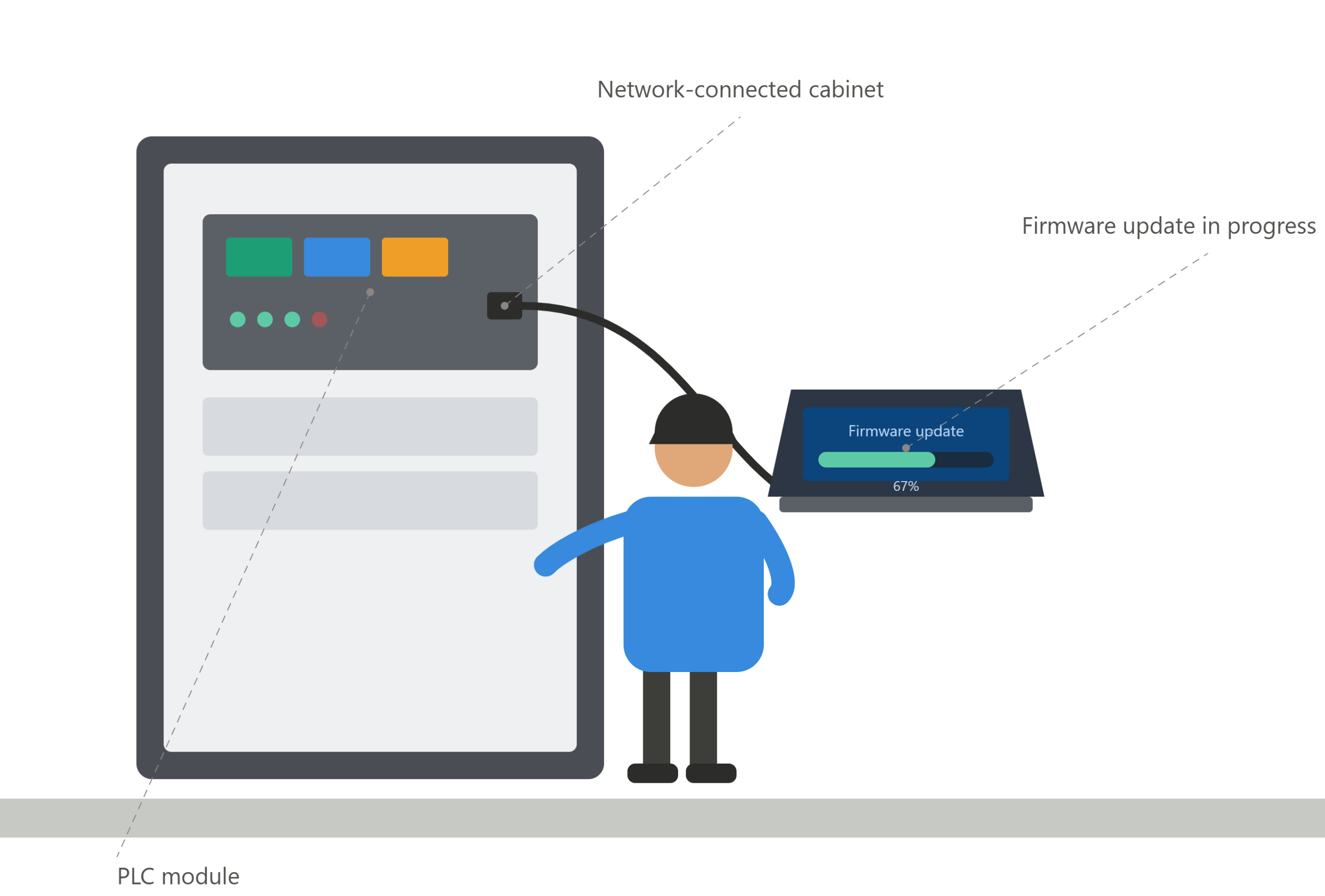
Network-connected components — remote monitoring gateways, IoT-style sensor transmitters, anything reachable from outside the immediate control cabinet — get patched against known vulnerabilities on the same release cycle as the core PLC firmware, consistent with the IEC 62443-aligned network segmentation covered on our automation page. User permissions and multi-factor authentication settings get re-verified after every update rather than assumed to have survived unchanged — a firmware or OS-level update occasionally resets an access control list to a default state, and the first time anyone finds that out shouldn’t be when someone unauthorized already has.
Application note
Facilities integrating our control system into a broader plant SCADA environment should confirm update compatibility with their own IT change-management process before scheduling — we coordinate timing rather than pushing updates independent of a facility’s own maintenance windows.
Physical hardware factors
What changes on the bench, not just in the code
Any new or firmware-updated pH, ORP, or conductivity probe gets a fresh baseline calibration against a known lab sample before it’s trusted for process control — a sensor that reports correctly on a bench test can still read differently once it’s back in a live, chloride-bearing stream, and that difference matters when the reading is feeding a control loop. Replacement hardware going into the rectifier or control cabinet has to meet the same NEMA 4X or IP67 rating as what it’s replacing, since the hydrogen and chlorine off-gas an EO cell generates will find any enclosure that doesn’t hold up to it, corrosion doesn’t announce itself until it’s already a problem. Power supply and surge protection on any new component get matched to the site’s actual voltage and phase, the same sizing discipline covered in depth on our Power Supply & Electrical Integration page — a hardware refresh is the wrong time to assume the new part’s tolerances match what the old one shipped with.
- pH and ORP probes: typical 12–18 month replacement interval depending on duty
- HMI touchscreens: commonly 5–7 years before display degradation warrants replacement
- Rectifier control boards: generally serviceable for the system's full operating life barring a specific fault
- Any replacement enclosure or cabinet: matched to the original NEMA/IP rating, not a lower-cost substitute
Training & documentation
Updating the paper trail before the system goes back to the operators
Plant SOP documentation gets revised to reflect any HMI layout change, new or renamed alarm trigger, or altered manual-override sequence before the system is handed back to routine operation — an operator working from an outdated screenshot during an actual alarm is a bad place to discover the interface changed. The operating and maintenance team gets briefed on what’s different before go-live, not left to find out during the first shift after the update; the full curriculum for building that competency in the first place is covered on our Training Programs page, and an update briefing is the shorter, targeted version of that same discipline — covering only what actually changed, not re-running the whole course.
Questions About Software & Hardware Update of Electro Oxidation Equipment?
Have a firmware or hardware update question, or need help sequencing one? *All engineering services shall be subject to the terms, conditions, and schedules set within your contract with Evoaeo.