Comparison: EO vs UV/AOP
EO vs Advanced Oxidation Processes
UV/H₂O₂, UV/persulfate, and photocatalysis generate hydroxyl radicals through different inputs. This comparison identifies where EO’s electrochemical approach outperforms optical AOP and where UV-based systems are the right choice.
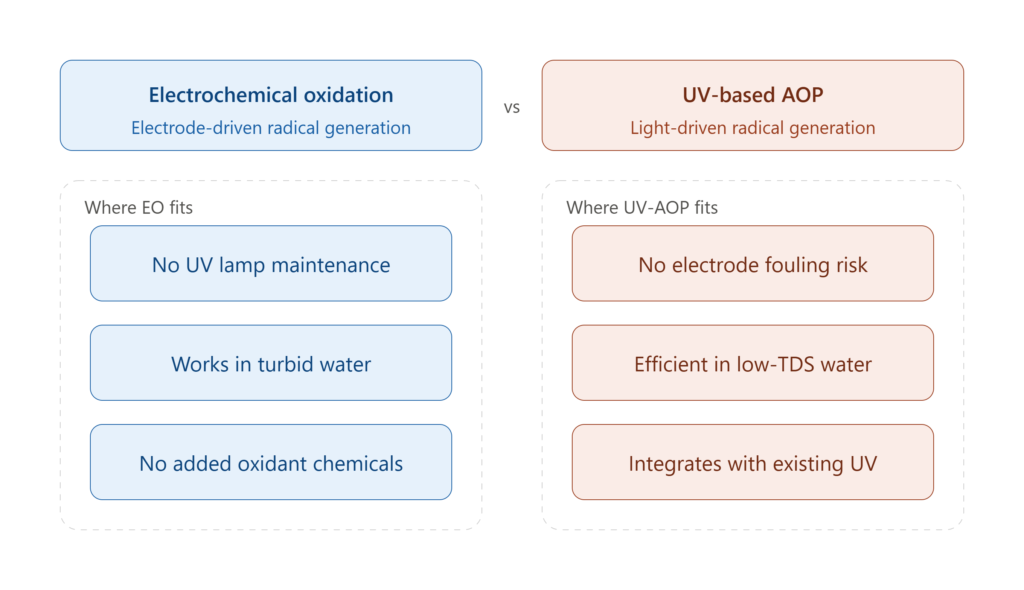
Shared mechanism, different matrix sensitivity
The turbidity problem separates UV-AOP from EO
UV/H₂O₂ and UV/persulfate generate hydroxyl radicals through photolysis — a UV photon initiates the H₂O₂ or persulfate dissociation that releases •OH. Electrochemical oxidation generates •OH through water oxidation at the anode surface. Both processes achieve the same oxidant at sufficient concentration to treat recalcitrant organics. The fundamental difference is that UV photolysis requires the UV light to reach the oxidant precursor — it is attenuated by turbidity, colour, and absorbing compounds in the matrix. EO generates oxidants at a physical surface; the photon path length is irrelevant.
Quick verdict
Which one actually fits your stream
Choose EO when
- Water is turbid, coloured, or has high UV absorbance — conditions that cripple UV-based AOPs before they can deliver dose
- You want to avoid ongoing reagent purchase, storage, and dosing (peroxide, persulfate, or catalysts)
- Continuous, unattended operation matters more than the fastest possible reaction kinetics
- You don't want a sulfate residual in the treated effluent, which persulfate-activated AOPs can leave behind
Choose a reagent- or UV-based AOP when
- Water is already clear and low in suspended solids, so UV transmission isn't a limiting factor
- The target is trace-level micropollutants (pharmaceuticals, PFAS at low concentration, taste-and-odour compounds) rather than higher-strength COD
- You need extremely fast reaction kinetics for a compact contact time
- Existing infrastructure already includes UV disinfection you can layer peroxide dosing onto cheaply
Where EO outperforms UV/AOP and where UV/AOP wins
Matrix optical properties are the primary decision variable
The matrix’s UV transmittance (UVT) is the first question to answer when comparing EO and UV/AOP.
✓ EO is likely a fit when:
- Low UVT matrix (<60%): colour, humic acids, suspended solids all reduce UV dose — EO has no UVT dependency
- Turbid industrial streams: textile effluent, leachate, produced water — UV ineffective, EO performs normally
- PFAS as the primary target: UV/H₂O₂ does not achieve PFAS defluorination; UV/persulfate can but requires very high UV dose and persulfate addition
- No infrastructure for UV lamp maintenance and replacement at site
- Continuous H₂O₂ addition and residual quench is a site operational constraint
- High-chloride matrix: EO generates active chlorine synergistically; UV/chlorine systems have specific disinfection byproduct concerns
✕ EO is likely not a fit when:
- Clean, high-UVT matrix (>80%): UV/H₂O₂ energy efficiency is excellent in clean polishing applications
- Large municipal WWTP with established UV infrastructure: UV/AOP operates at competitive capital and energy cost
- Target compounds are UV-sensitive: certain pharmaceuticals and dyes have high UV absorption coefficients that improve UV/AOP efficiency
- Continuous chemical supply (H₂O₂) is manageable and the chemical cost is budgeted
- UV/persulfate is being evaluated for 1,4-dioxane where site has existing UV infrastructure and persulfate supply
The UV/persulfate-PFAS boundary
When UV/persulfate is viable for PFAS and when EO is the only option
UV/persulfate generates sulfate radical anion (SO⁴•⁻), which has sufficient oxidation potential to activate the C-F bond in PFAS structures under optimal conditions. This makes UV/persulfate a genuine EO alternative for PFAS in clean, high-UVT matrices with low competing organic carbon. The conditions where UV/persulfate performs adequately for PFAS are specific: low TOC (<5 mg/L), high UVT (>80%), low turbidity, and persulfate doses that are economically feasible (typically 50–200 mg/L persulfate for mg/L-range PFAS). For matrices outside those conditions — landfill leachate, produced water, semiconductor wastewater with co-present organics — UV persulfate efficiency drops sharply and EO via BDD is the more practical choice.
- UV/persulfate viable for PFAS: low TOC, high UVT, clean groundwater or membrane permeate conditions
- EO via BDD preferred when: co-present organics >5 mg TOC/L, UVT 2 NTU
- Persulfate activation in dark (electro-persulfate activation): some hybrid configurations exist but are not commercially standard
- Residual persulfate requires quench before discharge — add to operating cost comparison
- EO requires no UV energy input and no persulfate supply chain — simpler operating profile for complex industrial matrices
Not always either/or
Can they work together?
Common questions
EO vs AOP FAQ
Yes — electrochemical oxidation is classified as an electrochemical advanced oxidation process (EAOP) in the academic literature. The distinction between ‘AOP’ and ‘electrochemical oxidation’ in this comparison is practical rather than categorical: the comparison page uses ‘AOP’ to refer to UV-driven processes specifically, because those are the systems most commonly shortlisted alongside EO in industrial applications. Electrochemically, EO is in the AOP family.
In clean, high-UVT municipal effluent, UV/H₂O₂ typically consumes 0.1–0.5 kWh/m³ for pharmaceutical micropollutant removal at UWWTD-relevant targets. EO for the same application in clean effluent: 1–5 kWh/m³. UV/H₂O₂ is more energy-efficient for clean-matrix pharmaceutical polishing at large scale. EO becomes competitive when the matrix UVT is low enough that UV dose at the same scale would require 1–3 kWh/m³ to compensate for attenuation — which is common in real secondary effluent with significant humic content or colour.
If you’re seriously considering a UV-based AOP, yes — UV transmittance (or absorbance) at 254 nm is one of the first numbers that determines whether that route is even viable on your stream.
EO generally carries the least reagent-handling risk since it doesn’t require storing or dosing hydrogen peroxide, ozone, or persulfate on site — though it introduces its own handling considerations around the rectifier and, in chloride-bearing streams, byproduct monitoring.
UV-informed framing
The comparison treats UV/AOP as a genuine alternative in the conditions it was designed for — not a technology to be dismissed.
Persulfate-PFAS boundary stated
The specific conditions where UV/persulfate is viable for PFAS are stated with the same precision as the conditions where EO is required.
Energy comparison qualified
The energy comparison is stated with the matrix conditions that produce each figure — not as a universal claim.
Level 1 Decision Gate
Where does this take you next?
Every page in the Decision Layer routes to one of three outcomes. Choose the path that matches where you are.
→ Yes — EO is a fit
Your contaminant is recalcitrant, your regulatory driver requires destruction, and the matrix is compatible. Move to treatability testing.
→ Not sure yet
You have answered some of the fit questions but not all. Use the Go / No-Go Checklist to work through the remaining decision variables.
→ No — EO is not the right fit
The contaminant is biodegradable, the scale is too large, or the driver does not require destruction. Review the alternatives.