EO Science & Mechanisms: Byproducts
Byproduct Chemistry Overview
Chlorate, perchlorate, bromate, and AOX show up as caveats across nearly every page on this site. This page is where that shared chemistry actually gets explained — each Application and Treatment Objective page links here rather than re-deriving it.
Reviewed for technical accuracy by Janeczka Kowalski, Process / Electrochemical Engineering. Figures and ranges on this page are engineering starting points — verify against your own pilot or vendor data before finalizing a design. The content is created by the Evoaeo engineering team led by Janeczka, All rights reserved.
Chlorate and perchlorate formation
Why chloride-rich streams need byproduct monitoring
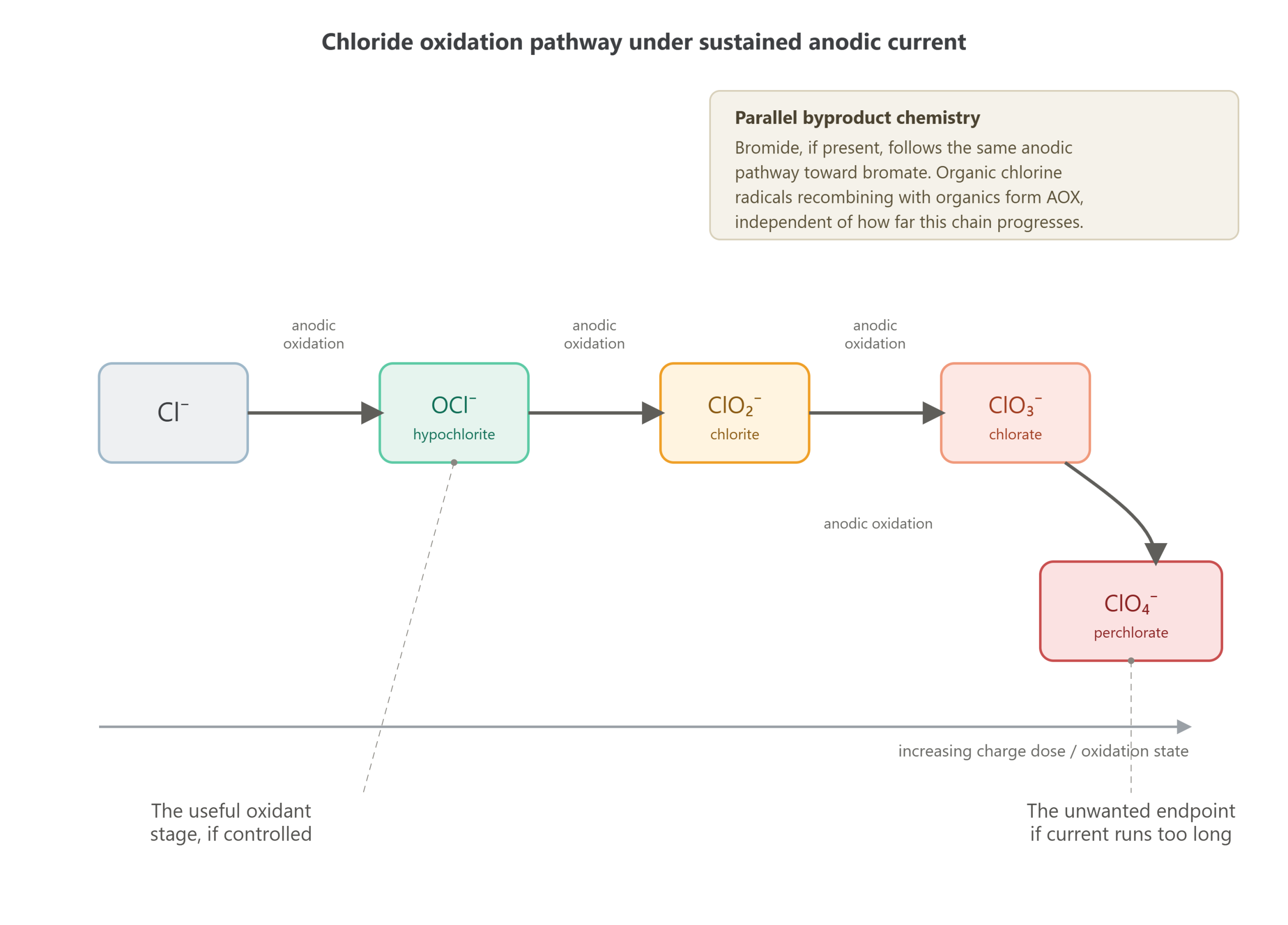
When chloride is present, active chlorine species generated at the anode — hypochlorite and related forms — are the working oxidant behind much of the chlorine-mediated oxidation pathway. The same electrochemical conditions that generate that active chlorine can drive it further: hypochlorite can be sequentially oxidized at the anode into chlorate, and chlorate can be oxidized further still into perchlorate, particularly at higher current density and longer residence time in the electrochemical cell. Both compounds are persistent and regulated in many jurisdictions, which is why any chloride-bearing stream needs byproduct monitoring built into the treatment design rather than added as an afterthought once a removal target looks good.
This formation pathway is a matter of degree, not an on/off switch — lower current density and shorter residence time reduce chlorate/perchlorate formation but also reduce the chlorine-mediated oxidation rate the process may be relying on, which is exactly the tension every chloride-rich stream’s process design has to resolve.
Application note
Each of our Industry Applications pages notes where this pathway is a specific concern for that stream’s chloride level — this page explains the underlying mechanism once; the industry pages apply it to their specific matrix rather than re-explaining the chemistry.
Bromate formation
The less common but higher-stakes analog
Bromide, where present, follows a broadly analogous oxidation pathway to chloride but forms bromate at meaningfully lower current density and shorter exposure than the equivalent chlorate/perchlorate pathway requires — bromate is more readily formed and is regulated at far lower concentration thresholds in most jurisdictions, given its classification as a probable human carcinogen. Streams carrying even modest bromide alongside chloride warrant bromate-specific monitoring even when the chloride-driven byproduct risk alone looks manageable.
AOX formation
When partial oxidation halogenates organics instead of destroying them
Adsorbable organic halides (AOX) form when active chlorine species react with organic compounds in the bulk solution through halogenation rather than complete oxidation — producing chlorinated organic byproducts instead of mineralizing the parent compound to CO2 and water. This is a genuine risk specifically on chloride-mediated pathways, and is one of the reasons a bench trial measuring only COD or TOC removal can look successful while still generating a regulated byproduct that a discharge permit’s AOX limit would catch. AOX screening alongside chlorate/perchlorate is standard practice on any bench program for a chloride-bearing stream, covered as part of our Wastewater Characterization & Treatability Studies process.
Working through a chloride- or bromide-bearing stream's byproduct risk?
Send us your stream data and we’ll respond with an engineering read — no obligation.