Engineering Services / System Development /System Integration & Automation
Electro Oxidation System Integration & Automation
EO system that requires constant manual adjustment isn’t finished. Automation is what turns a working reactor into a plant that runs a shift without an operator standing over it. This context tell you how Evoaeo deploy the whole control architectures, distribute data and reporting, and beyond.
Reviewed for technical accuracy by Janeczka Kowalski, Process / Electrochemical Engineering. Figures and ranges on this page are engineering starting points — verify against your own pilot or vendor data before finalizing a design. The content is created by the Evoaeo engineering team led by Janeczka, All rights reserved.
Control architecture
What the PLC actually manages
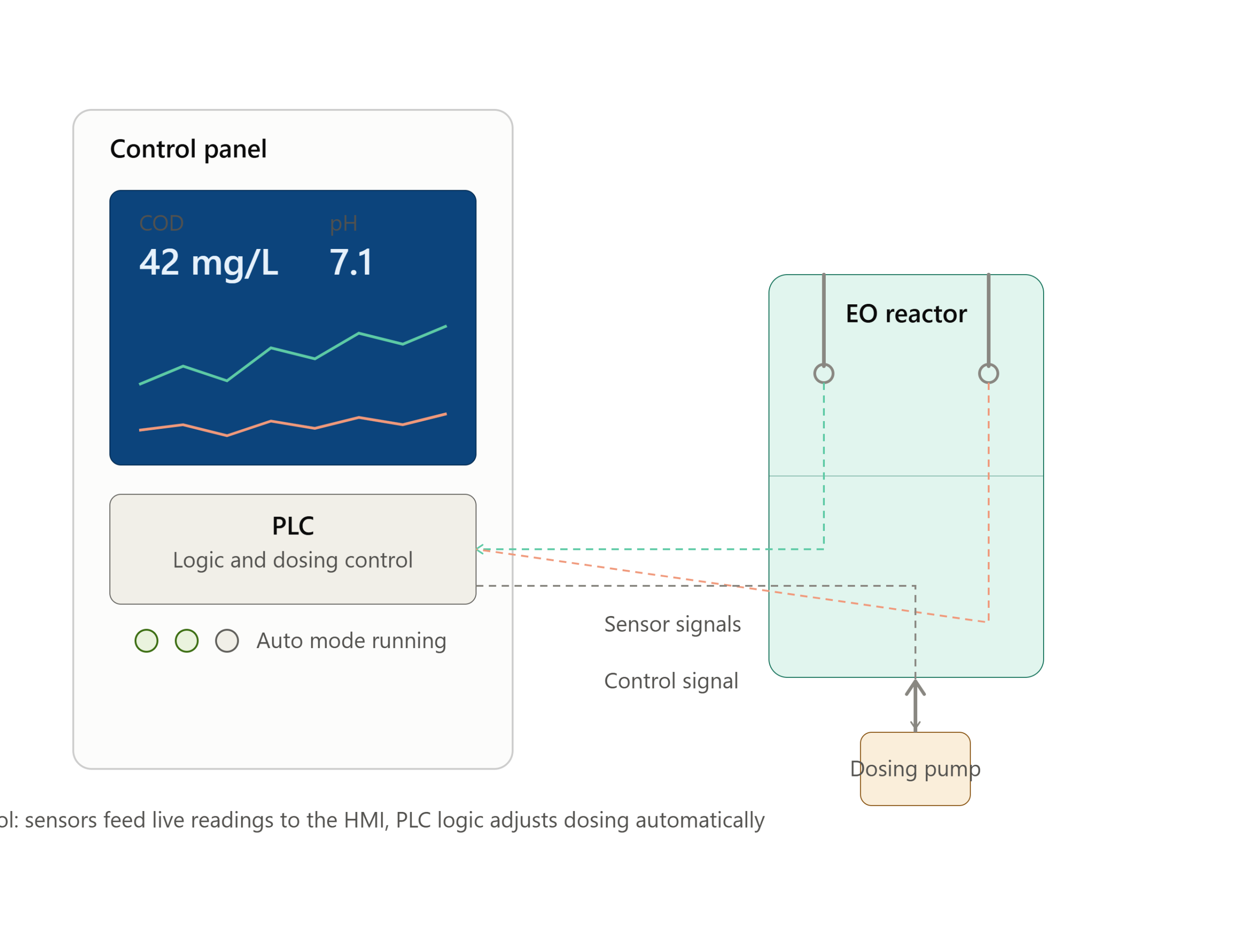
A standard build includes real-time conductivity, pH, and ORP monitoring feeding into PLC logic that adjusts current or flow to hold the system at its target operating point, plus automated polarity reversal scheduling to limit cathode scaling without operator intervention. Alarming on low flow, high cell voltage, or off-target pH gets tied into the same logic so a developing problem trips a notification before it becomes a shutdown.
Alarm setpoints are established from the treatability study’s baseline data, not a generic default — a high-cell-voltage alarm set from a stream’s own normal operating range catches genuine drift far earlier than a fixed threshold borrowed from an unrelated installation.
Data and reporting
Logged data that supports a permit, not just a dashboard
Every automated system logs the parameters a discharge permit actually asks for — flow, pH, and the compliance parameter itself where continuous monitoring is specified — in a format that exports cleanly for a compliance report rather than requiring manual transcription from a screen. Communication runs over Modbus TCP or OPC-UA depending on what the facility’s existing SCADA environment already speaks, so integration doesn’t require a proprietary protocol bridge on top of standard industrial infrastructure.
For facilities running SCADA across multiple treatment assets, we integrate into the existing historian rather than standing up a separate system, matching whatever tag-naming and data-retention convention the facility already uses.
Engineering note
PLC and SCADA hardware connected to a plant network is an attack surface like any other industrial control system. We design network segmentation and access control to align with IEC 62443 principles by default, and can work within a facility’s existing OT security policy rather than assuming one doesn’t exist.
Remote access
Diagnostics without a site visit
Units built with the PLC/HMI option support remote diagnostics — our engineering team can review a trending alarm or a drifting parameter without waiting for a site visit, which shortens the loop between a developing issue and a fix considerably. A typical remote review, once granted access under the facility’s own network policy, can identify whether an alarm reflects a genuine process issue or a sensor calibration drift within the same working day, well ahead of the response window most support contracts commit to for a site visit.
Questions About Electro Oxidation System Integration & Automation?
Need automation scoped for a new or existing system? Ask our engineering team for a direct anwser.