Electrode Material Comparison for Treatability Testing
BDD vs. MMO: Selecting an Anode for Treatability Testing
Before a bench test starts, the anode decision has already been made — or it should have been. This page covers how to choose which electrode to test first, and the design domains that determine whether a lab result actually scales.
Define the duty before the electrode
What actually happens inside an electrochemical oxidation cell
Current crosses the cell, oxidation begins at the anode, transport through the bulk solution determines how much of that applied charge actually does useful work, and reduction occurs at the cathode as the necessary counter-reaction. Every treatability test is really asking one question across these four steps: how much of the current applied at the anode is converted into destruction of the target compound, versus lost to competing reactions.
Choosing which anode to test first
BDD-led, MMO-led, or side by side
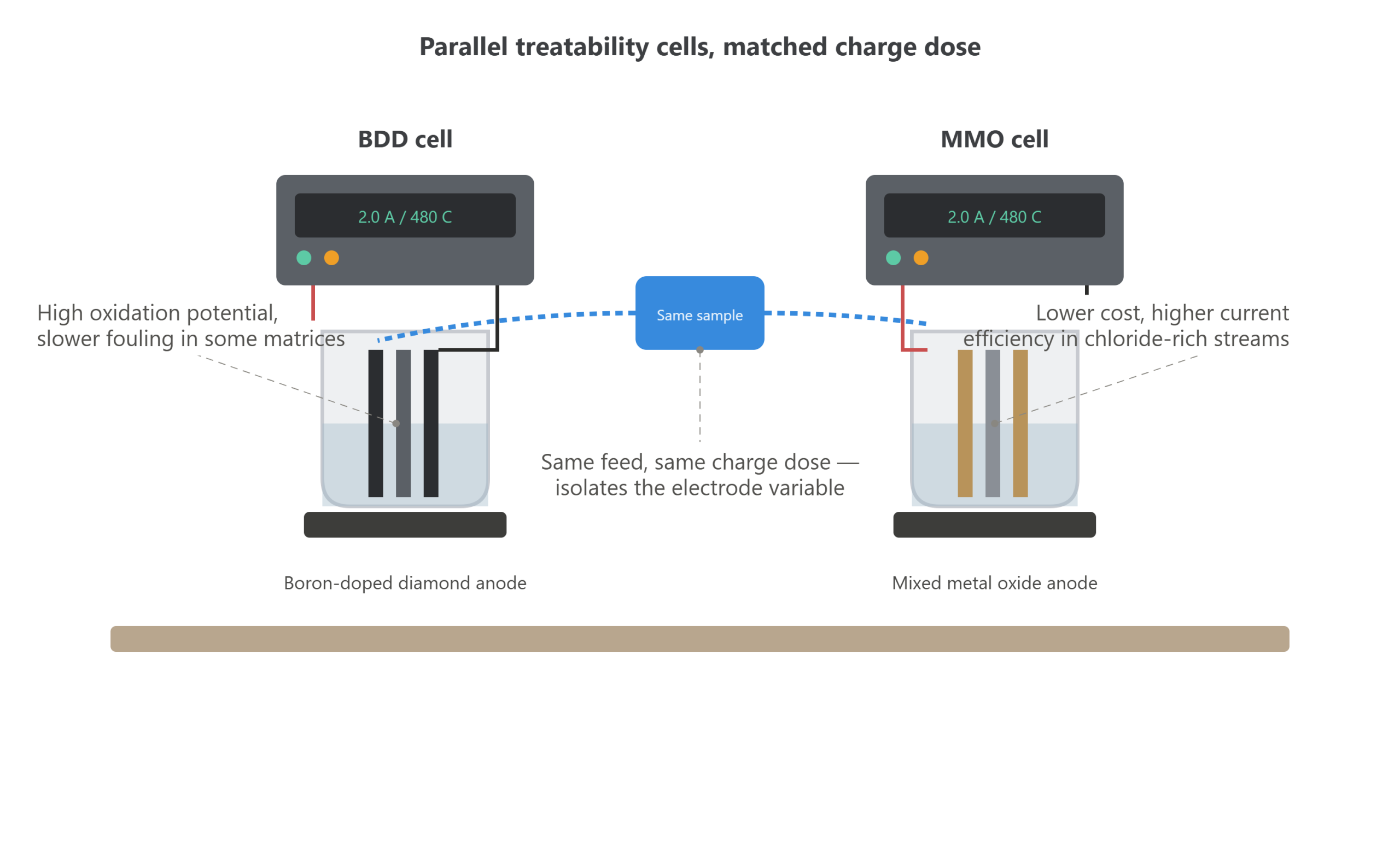
A BDD-led test path makes sense when the target compound is known to be genuinely refractory — PFAS, complex chelating agents, compounds that have already resisted biological treatment — since BDD’s non-selective hydroxyl radical pathway is the more likely candidate to reach full destruction. An MMO-led test path makes sense when the matrix carries meaningful chloride and the treatment objective is disinfection, decolorization, or a bulk COD reduction where chlorine-mediated chemistry is doing the real work. Where neither is clearly favored by the matrix or the target compound, testing both anodes under equal charge dose is the only way to get a genuine comparison rather than an assumption.
Engineering note
Testing both under equal charge, not equal time, is the detail that matters most here — oxidation is driven by charge passed through the cell, not elapsed minutes, so a fair BDD-vs-MMO comparison has to control for charge dose specifically or the result will be misleading.
What controls whether a lab result scales
Six design domains that determine scale-up
A bench result that looks strong can still fail to scale if any of six design domains weren’t accounted for in the test design: hydraulics and mass transfer (how well the bulk solution actually reaches the electrode surface at commercial flow versus bench flow), the electrical basis (current density and cell voltage behavior as electrode area scales up), the water-chemistry envelope (whether the bench sample’s pH, conductivity, and chloride level actually represent the full range the commercial system will see), the reaction endpoint (what specific compliance or removal target defines “done”), byproduct and gas control (chlorate, perchlorate, and hydrogen off-gas management at commercial scale), and electrode lifecycle (whether the bench test ran long enough to say anything credible about coating consumption or substrate degradation over real operating hours).
- Hydraulics and mass transfer — does bench-scale flow behavior represent commercial-scale reactor geometry
- Electrical basis — current density and cell voltage behavior as electrode area scales
- Water-chemistry envelope — does the bench sample represent the full range of matrix variability
- Reaction endpoint — what specific target defines treatment as complete
- Byproduct and gas control — chlorate/perchlorate risk and hydrogen off-gas management at scale
- Electrode lifecycle — whether bench duration says anything credible about real service life
Where EO earns a place, and where it doesn’t
An honest fit assessment before pilot design
Electrochemical oxidation earns its place on a treatment train when the target compound is genuinely resistant to biological or physical treatment, when the matrix carries the conductivity to support efficient current transfer, and when the destruction (not just relocation) of the pollutant is the actual requirement — a discharge permit, a downstream biological process being poisoned by the compound, or a liability concern about a concentrated waste stream. Another treatment step usually belongs first when the bulk of the organic load is readily biodegradable (EO becomes an expensive way to do a cheap job), when suspended solids or oil and grease would foul the electrode before ever reaching the target compound, or when the actual problem is a dissolved-solids or salinity issue EO was never built to solve.
Application note
This fit assessment is the same logic behind our Feasibility Assessment Tool and Go/No-Go Screening Checklist — this page provides the electrode-selection and design-domain detail behind that same decision, once the answer is a genuine “maybe” rather than a clear yes or no.
Ready to design a treatability test sequence, or still deciding which anode to test first?
Send us your stream data and we’ll respond with an engineering read — no obligation.