Engineering Services / Bench, Pilot & Commercial System Design
Electrochemical Oxidation System Scale Up
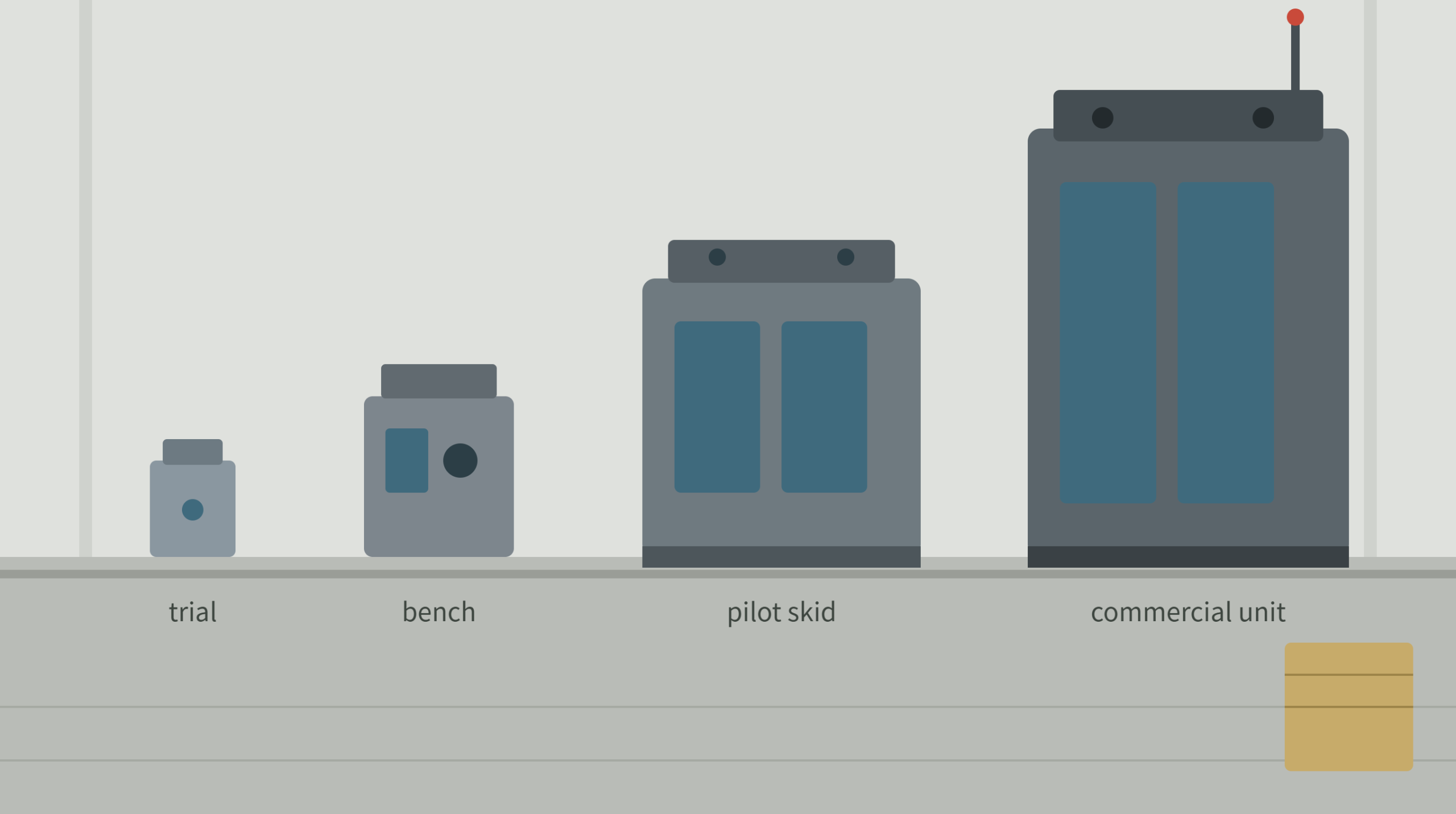
Electrochemical oxidation wastewater treatment systerm scale up isn’t a jump from a bench-top unit to a full plant. It’s a continuous path, and each stage exists to answer a specific question the previous one couldn’t.
Reviewed for technical accuracy by Janeczka Kowalski, Process / Electrochemical Engineering. Figures and ranges on this page are engineering starting points — verify against your own pilot or vendor data before finalizing a design. The content is created by the Evoaeo engineering team led by Janeczka, All rights reserved.
Bench scale
Proving the chemistry
A bench module runs at 0.5–5 L/min and exists to answer one question: does this compound respond to electrochemical oxidation at a workable charge dose, and which electrode material gets there most efficiently. A bench program typically runs 2–4 weeks depending on how many electrode materials and operating conditions need screening. Bench data alone isn’t a design basis — it’s a screening result, and treating it as anything more is how commercial-scale energy and cost projections go wrong.
Engineering note
Bench current and run time are not a scale-up recipe you multiply directly. A bench run at a given current for two hours tells you about removal kinetics at that specific current density, not the exact current a full-scale electrode stack will need.
Pilot scale
Validating under real flow conditions
Pilot modules run 10–50 L/min in a skid-mounted, mobile format, deployed on-site to capture the flow-rate and composition variability a bench sample can’t replicate. A pilot program typically runs 6–12 weeks on-site, long enough to span more than one production cycle on most facilities. This stage generates the CAPEX/OPEX projection data a facility actually budgets from — electrode life under real operating conditions, energy consumption across production variability, and confirmation that the treatment train holds up outside a controlled lab environment.
The stage-gate decision from pilot to commercial design is triggered by three specific thresholds: removal performance within the target range across at least 80% of the pilot run’s operating conditions, electrode wear tracking within the projected life curve rather than accelerating unexpectedly, and no unresolved byproduct or fouling issue identified during the run. Falling short on any one of these doesn’t necessarily end the project — it usually means a specific pretreatment or operating-condition adjustment, followed by a shorter confirmation run, rather than a full restart.
Commercial scale
Full-flow deployment
Commercial systems are built to design-basis flow, with automated PLC/SCADA control, polarity reversal scheduling to manage cathode scaling, and heat management sized to continuous operation. The design carries forward every parameter validated at pilot scale — nothing changes between pilot and commercial except throughput, which is the entire point of running a pilot first.
As a rough cost-band reference: bench testing typically represents a small fraction of total project cost, pilot programs a moderate fraction reflecting the equipment rental and on-site time involved, and commercial system capital cost scales with design flow and required removal — the actual figures for your project come out of the treatability and pilot data, not a generic per-liter estimate, which is why we don’t publish a fixed price table here.
- Bench: 0.5–5 L/min, 2–4 weeks, chemistry screening and electrode selection
- Pilot: 10–50 L/min, 6–12 weeks on-site, skid-mounted, validation under real flow
- Commercial: full design-basis flow, automated control, continuous duty
- Each stage's data becomes the next stage's design input — nothing is re-derived from scratch
Application note
Facilities running multiple product campaigns through shared effluent infrastructure should validate pilot performance across the composition range the plant actually produces, not just the sample collected on the day of testing — single-product dischargers can often skip this step.
Questions About Electrochemical Oxidation System Scale Up?
Ready to scope your next stage of testing? Have questions about operating conditions,dosing, treatment efficiency, removal performances,? Ask our engineering team for a direct anwser.