About Evaeo
About us: Leading EO Wastewater Treatment Solutions
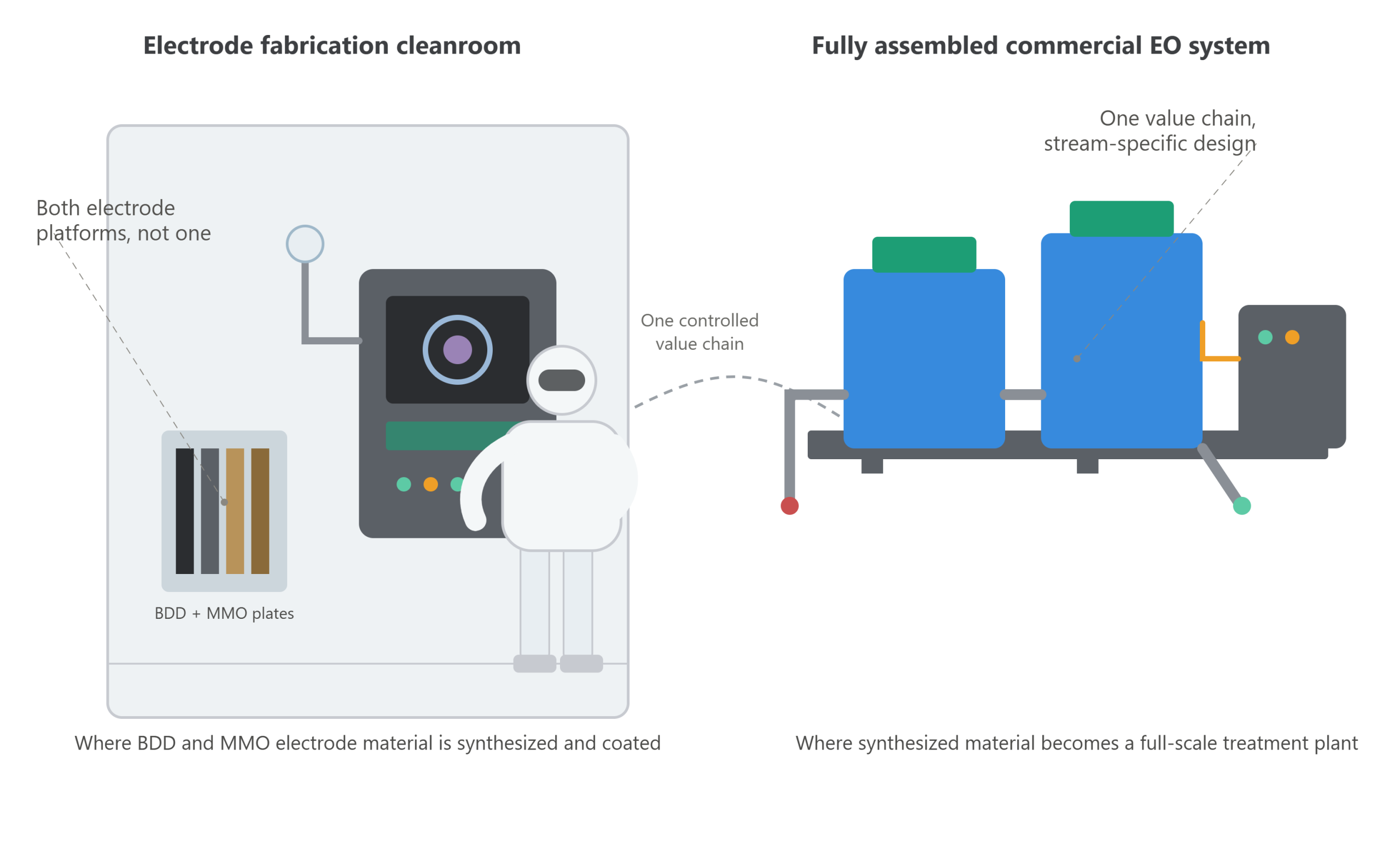
At the intersection of advanced materials science and industrial environmental stewardship, we operate as a specialized manufacturer and engineering firm working across both major electrode platforms used in electrochemical oxidation — boron-doped diamond (BDD) anode for genuinely refractory compounds like PFAS, and mixed metal oxide (MMO) for chloride-mediated and disinfection-driven applications. Unlike generalist equipment vendors, our foundation is built on the precise electrochemical behavior of both material classes, not a single platform stretched to cover every application. Our work bridges the gap between laboratory electrochemistry and the rugged demands of industrial wastewater management — by controlling the full value chain, from electrode synthesis and coating through the hydraulic design of full-scale treatment plants, we deliver systems designed around your specific stream, not a catalog default
Our core competencies
Precision electrode fabrication, across both platforms
Specialized in research, development, comprehensive performance optimization of reactive electrode such as MMO and boron doped diamond (BDD) electrode as basic component/electrode materials to deliver highly efficient electrochemical oxidation wastewater treatment solution for complex industrial effluents. We operate dedicated production capability for both anode classes. MMO electrode fabrication focuses on coating morphology and the ratio of IrO₂, RuO₂, and Ta₂O₅ to achieve the oxygen evolution overpotential and catalytic stability a given application requires; BDD electrode fabrication is covered in full technical depth on our Electrode Chemistry Fundamentals and Reactor Engineering & Electrode Design pages, including substrate selection and coating optimization for genuinely refractory targets.
Substrate integrity
Grade 1 and Grade 2 titanium substrates selected for corrosion resistance and extended lifespan in harsh matrix conditions.
Custom geometry
Expanded mesh, solid plates, and tubular configurations engineered for the specific electrochemical cell design your application requires.
Beyond the electrode
Electro oxidation wastewater treatment system engineering
We don’t just manufacture and supply electrodes — we build the systems where they operate at different scenarios: Customizable EO trial testing gears and electrochemical reactors built with boron doped diamond (BDD) anodes are ready for direct anodic oxidation of persistent organic pollutants (POPs), Our modular electrochemical oxidation systems are engineered specifically to handle the fraction of industrial waste that resists conventional treatment: persistent organic pollutants and recalcitrant COD that biological treatment can’t touch, not just partial degradation, it’s complete on-site removal of PFAS, polychlorinated biphenyls (PCBs), organochlorine phenols, halogenated aromatics, organochlorine pesticides, pharmaceuticals, industrial solvents, etc.
Modular EO units
Scalable designs carried through from pilot trials to full-scale integration — see our Bench, Pilot & Commercial System Design page for the full stage-gate process.
Treatment process automation
Proprietary power management that optimizes current density while protecting electrode longevity — see System Integration & Automation for the control architecture behind it.
Matching the pathway to the matrix
Industrial wastewater solution consulting
Every waste stream is a unique chemical fingerprint. Our engineering team determines the most effective electrochemical pathway for your specific matrix — whether that’s direct oxidation at the anode surface or indirect oxidation via hydroxyl radicals and active chlorine species. The full mechanism comparison is covered on our Direct vs. Indirect Oxidation page; here’s the short version of what that decision actually depends on.
Direct anodic oxidation
The pollutant reacts at the electrode surface itself — favored for non-active (BDD) electrode chemistry and matrices where mediating species aren’t available or desirable.
Indirect oxidation via reactive oxidants
Hydroxyl radicals, active chlorine, and other in-situ generated species carry the oxidation into the bulk solution — the dominant pathway on chloride-rich matrices treated with active (MMO) electrode chemistry.
Manufacturing scale, not just engineering capability
Inside the facility
Electrode fabrication, product prototyping, and equipment assembly all happen under one roof — a 20,000 square meter facility housing over 100 pieces of production and testing equipment across five dedicated assembly lines. That integration matters for a practical reason: electrode fouling, mass transfer limitations, and the experimental testing and simulation work needed to validate a design change can all be addressed on-site, without the lag of shipping components between separate fabrication and assembly facilities.
This scale is what supports the full range of equipment we deliver — from trial-scale cells built for lab treatability work through to fully assembled commercial systems — without relying on third-party fabrication for any stage of that range.
Partnering with Evoaeo
Whether you’re looking for a reliable OEM partner for replacement BDD or MMO anodes, or a turnkey solution for a complex industrial effluent challenge, our team provides the technical rigor and manufacturing transparency industrial applications require.
Beyond electrode manufacturing
Supporting your project end to end
Electrode fabrication is the foundation, not the whole relationship. A project with us moves through wastewater characterization, process design, and reactor engineering, into system development and installation, and continues through training and long-term support — delivered as one accountable scope under our Custom EPC Delivery model where you’d rather not coordinate separate engineering, procurement, and construction contracts yourself.
Full engineering process
Twelve phases from initial characterization through commissioned, operating equipment — see our Engineering Services pages for the complete sequence.
Custom EPC delivery
Design, equipment procurement, and installation under one contract and one accountable team — not a design handed off to separate parties.
Compound and technology depth you can verify
Eleven pollutant-specific pages and fourteen head-to-head technology comparisons — the same rigor we apply to your project is documented publicly, not just claimed.
Real deployments, not just capability claims
Named case studies across pharmaceutical, electroplating, landfill leachate, and more — see what electrochemical oxidation has actually achieved on real industrial effluent.
Free Electrochemical Oxidation Technology Appraisal
Send us your wastewater profile and we’ll assess treatability, recommend an electrode platform, and scope the right next step — bench trial, pilot, or full system design.