Home › Research Cooperation
Research Partnerships
Partner With Evoaeo on the Next Generation of Electrochemical Oxidation
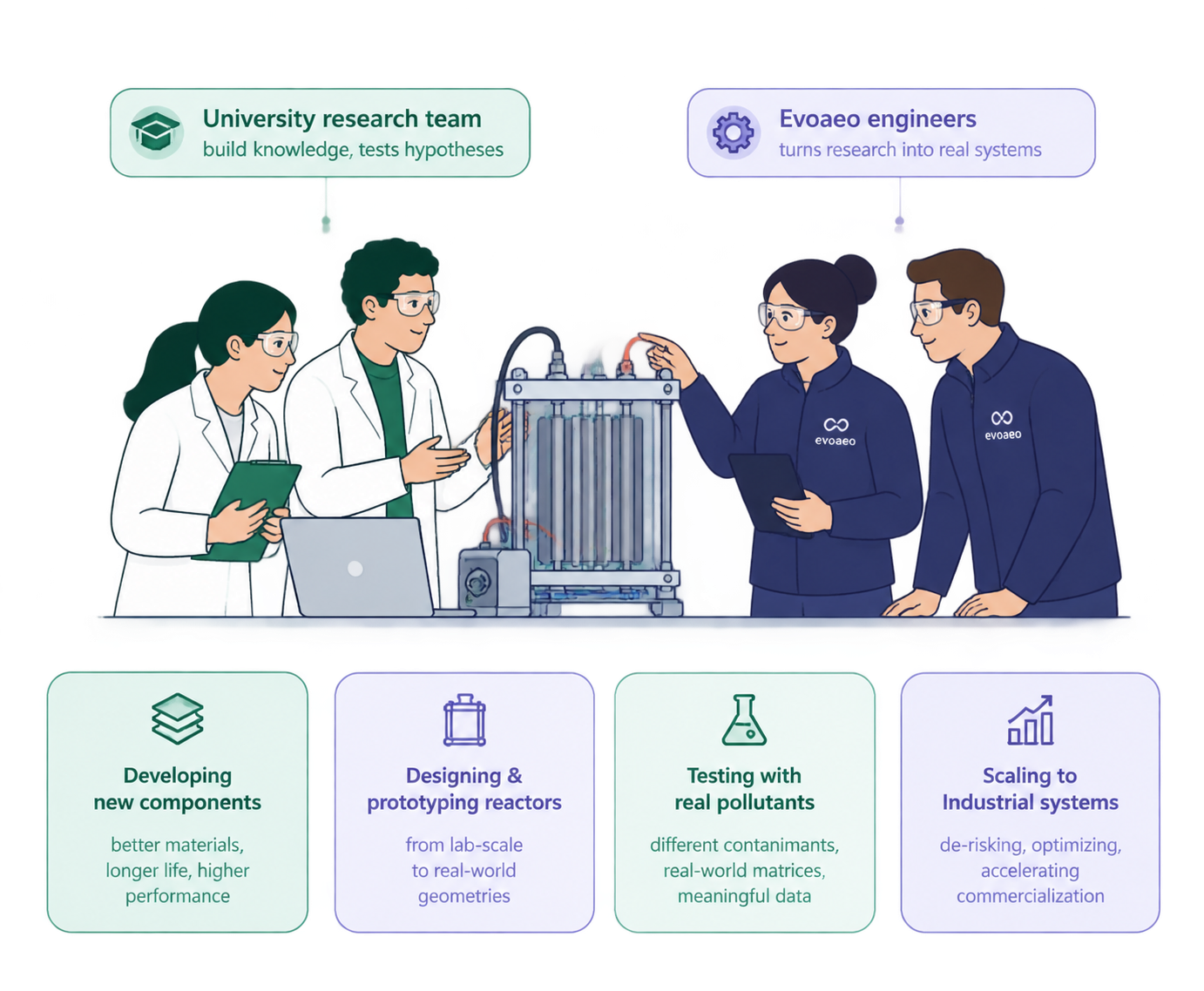
Evoaeo has built an interdisciplinary technical team of professors, researchers, and engineers that forms the foundation of our R&D work in boron-doped diamond electrodes and advanced oxidation processes. What started with two researchers has grown into a team of over 20 engineers, wastewater treatment specialists, and lab technicians, backed by an in-house integrated laboratory and manufacturing facility.
We already work closely with universities and research institutes as part of how we develop core technology — this page is an open invitation to extend that relationship further.
Reviewed for technical accuracy by Janeczka Kowalski, Process / Electrochemical Engineering. Figures and ranges on this page are engineering starting points — verify against your own pilot or vendor data before finalizing a design. The content is created by the Evoaeo engineering team led by Janeczka, All rights reserved.
An Interdisciplinary Team Built for Collaboration
Evoaeo has built an interdisciplinary technical team of professors, researchers, and engineers that forms the foundation of our R&D work in boron-doped diamond electrodes and advanced oxidation processes. What started with two researchers has grown into a team of over 20 engineers, wastewater treatment specialists, and lab technicians, backed by an in-house integrated laboratory and manufacturing facility.
We already work closely with universities and research institutes as part of how we develop core technology — this page is an open invitation to extend that relationship further.
Research Tracks Open for Collaboration
These aren’t the only questions worth investigating — if your team has a research question that doesn’t fit neatly into one of these, propose it anyway.
Electrode & Materials R&D
New BDD doping strategies, alternative substrate materials, diamond film growth optimization, and comparative studies against MMO and other anode chemistries.
Reactor Engineering & Prototyping
Novel reactor geometries, CFD-modeled flow fields to eliminate dead zones, and 3D-printed prototype configurations — filter-press, tubular, or entirely new designs.
Pollutant & Matrix Treatability Research
Testing EO performance against compounds our Pollutants hub hasn’t characterized yet, or against real industrial matrices rather than synthetic single-compound proxies.
Process Control & Automation
Machine-learning-driven real-time optimization of current density and polarity reversal timing, and digital twin modeling of EO reactors under variable influent conditions.
Byproduct & Environmental Fate Studies
Perchlorate and chlorate formation risk modeling, disinfection byproduct characterization, and ecotoxicology assessment of treated effluent.
Techno-Economic & Scale-Up Modeling
CAPEX/OPEX modeling across scales, energy consumption optimization, and comparative economic studies against conventional treatment trains.
Hybrid Process & System Integration
Synergy studies combining EO with biological treatment, membrane processes, or adsorption — and renewable-energy-powered EO systems for off-grid or remote sites.
Standardized Testing Protocols
Electrochemical oxidation still lacks the kind of universal treatability-testing standards conventional treatment has had for decades — help us build them.
Open Performance Database
Contributing to a shared, citable benchmarking dataset across pollutant classes and matrices — building the reference data this field doesn’t yet have in one place.
What a Research Partnership Actually Provides
Access most academic labs can’t easily get on their own:
Real industrial matrix samples
Actual industrial wastewater, not a synthetic single-compound proxy — the same real-matrix-versus-synthetic distinction our own bench methodology treats as essential.
Equipment access at preferential terms
Trial and Bench Module access on discounted or subsidized terms for qualifying proposals — terms discussed directly with your team.
Direct technical support
Access to our in-house electrode fabrication and process engineering team while your research is underway, not just equipment shipped and left alone.
A path to publication and citation
Data-sharing terms that support your own publication, with co-authorship or acknowledgment discussed upfront — not claimed by default.
Real industrial matrix samples
Industrial wastewater, not a synthetic single-compound proxy—the same real-matrix-versus-synthetic distinction our bench methodology treats as essential.
Equipment access at preferential terms
Trial and Bench Module access on discounted or subsidized terms for qualifying proposals — terms discussed directly with your team.
Direct technical support
Access to our in-house electrode fabrication and process engineering team while your research is underway, not just equipment shipped and left alone.
A path to publication and citation
Data-sharing terms that support your own publication, with co-authorship or acknowledgment discussed upfront — not claimed by default.
A real, visible outcome, not just a data point
Your Findings Become Public, Attributed Reference Material
Where your work fits depends on the track: pollutant or matrix research that clears our differentiation bar — genuine case data, a distinct mechanism story, a real electrode recommendation — earns its own dedicated page on our Pollutants hub, exactly like PFAS, cyanide, and dyes do today. Reactor, materials, or process-control research becomes a published Case Study or technical note. Either way, findings that don’t clear a dedicated page still find a home in a category cluster page, credited and cited — your work becomes public reference material, not a private dataset that disappears into an internal file.
How a partnership actually starts
From Proposal to Published Findings
1. Propose a question
Tell us which compound, component, reactor concept, or process question you want to investigate — including why current data or designs fall short.
2. We scope the partnership together
Equipment access terms, sample logistics, and data-sharing agreement get worked out before any testing starts.
3. Run the research with our support
Bench or trial-scale testing, prototype fabrication, or modeling work proceeds with direct access to our engineering team.
4. Publish and get credited
Findings get published on your own terms, with attribution — and where they clear our bar, on a dedicated site page too.
Where This Connects on the Site
See our Pollutants hub for the current fit-rating landscape your research could extend, our Technology Research page for where our own team’s priorities currently sit, our Reactor Engineering & Electrode Design page for the engineering side of a prototyping partnership, and our Trial Modules product page for the equipment tier most partnerships start with.
Have a Compound, Component, Reactor Concept, or Question You Want to Investigate?
Tell us what you’re trying to answer and what stage your team is at — we’ll respond with what a partnership could realistically look like.