Pollutants – PFAS
PFAS Chemicals
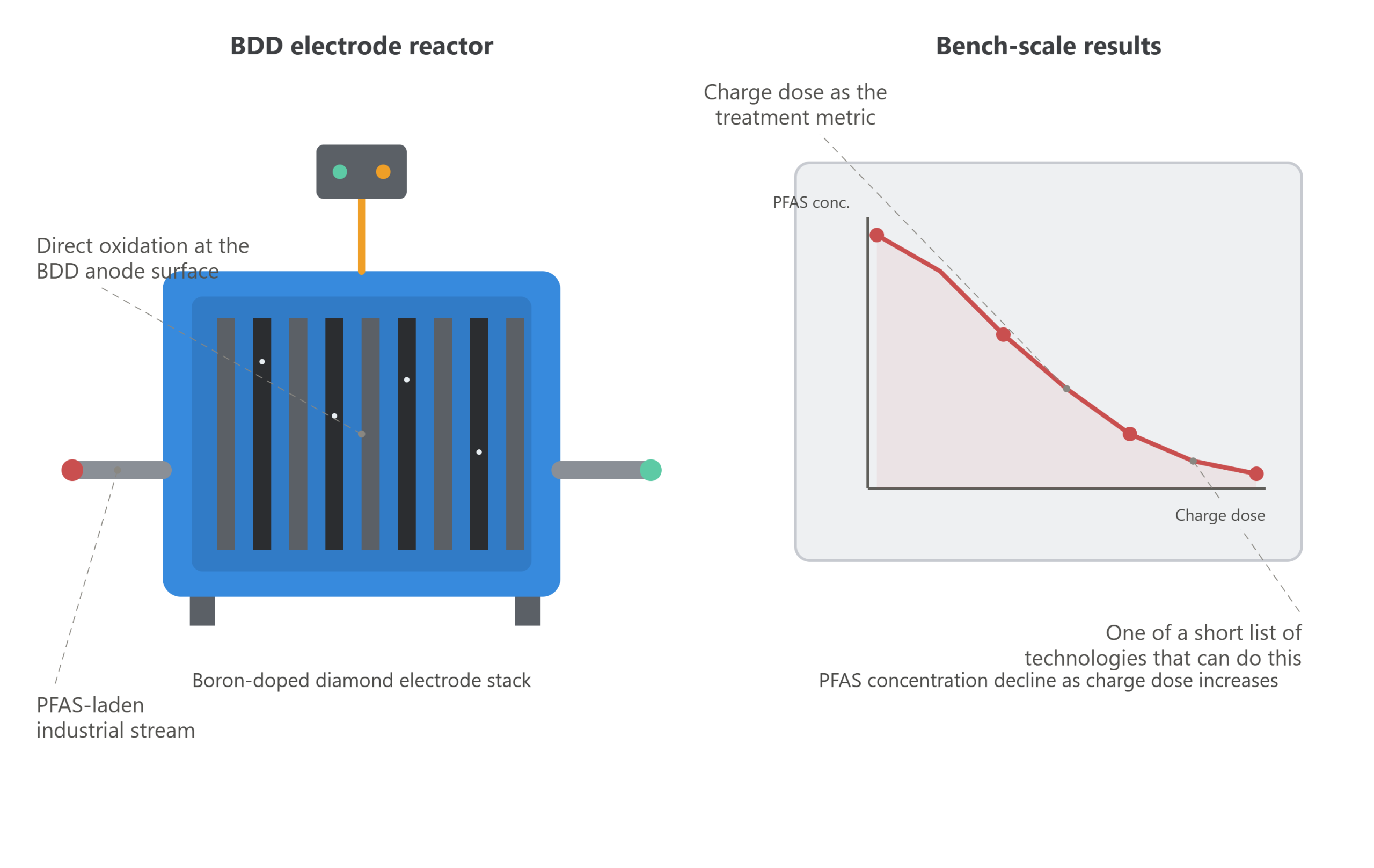
PFAS chemicals is a collection of pollutants most responsible for renewed interest in electrochemical oxidation across the industrial wastewater sector – a carbon-fluorine bond stable enough to have earned the nickname “forever chemical” needs an oxidation pathway aggressive enough to break it directly, and that’s a short list of technologies.
Reviewed for technical accuracy by Janeczka Kowalski, Process / Electrochemical Engineering. PFAS is an active and rapidly evolving regulatory area. Performance figures on this page reflect bench and published data ranges. Specific discharge targets depend on your permit jurisdiction. Verify current limits with your permitting authority. Figures and ranges on this page are engineering starting points — verify against your own pilot or vendor data before finalizing a design. The content is created by the Evoaeo engineering team led by Janeczka, All rights reserved.
Why PFAS resists everything else
The carbon-fluorine bond is the whole story
The carbon-fluorine bond in PFAS compounds is among the strongest single bonds in organic chemistry, which is exactly why PFAS resists the biological, and most chemical, oxidation approaches that handle other industrial pollutants without difficulty. Conventional chemical oxidants – permanganate, chlorine dioxide – simply don’t carry enough oxidizing power to attack that bond at all, regardless of dose. Non-active electrode chemistry, specifically boron-doped diamond’s hydroxyl radical pathway, is one of a genuinely short list of technologies capable of direct attack on the bond itself rather than working around it.
Chain length changes the difficulty of removing PFAS chemicals
Long-chain, short-chain, and concentrated foam waste
PFAS isn’t one compound with one removal curve – chain length and the specific matrix it arrives in both shift the charge dose required for destruction meaningfully.
| Chain Length | Example Compounds | Removal Difficulty | Electrode Notes |
|---|---|---|---|
| Long-chain | PFOA, PFOS | High, but the most-studied case | BDD is the established standard; direct anodic attack on the C-F bond is required |
| Short-chain | PFBS, GenX-type replacements | Higher than long-chain – poor adsorption on carbon media, and shorter chains resist electrochemical attack differently | BDD required; charge dose typically needs to run higher than long-chain equivalents for comparable destruction |
| AFFF concentrate (mixed, high-strength) | Firefighting foam waste | Very high – concentrated, mixed-chain, surfactant-laden matrix | BDD required at commercial scale; SCWO is the alternative at very small, very high-hazard volumes |
Regulatory context
A moving target across jurisdictions
PFAS discharge limits are tightening across multiple jurisdictions on an active, ongoing basis, and requirements differ meaningfully depending on whether the discharge target is a surface water permit, a reuse specification, or a hazardous-waste destruction standard for concentrated foam waste. Confirming which specific PFAS compounds and which specific limit apply to your situation before design work begins matters more here than on almost any other pollutant on this site, given how quickly the regulatory landscape is moving.
Application note
See our BDD Electrode Conversion for PFAS Destruction case study for a real deployment example, and BDD vs. MMO Electrode for why MMO’s active-electrode chemistry generally can’t reach the same destruction result on this specific compound class.
Why EO for PFAS
Four reasons EO is the primary destruction technology for PFAS
C-F bond activation
BDD electrodes drive direct anodic electron transfer at potentials sufficient to attack the strongest bond in organic chemistry — the C-F bond that makes PFAS resistant to everything else. Hydroxyl radicals generated at the electrode surface further mineralise the breakdown by-products.
No secondary PFAS waste
Mineralisation in-situ. No spent carbon, no concentrate, no PFAS-containing secondary stream requiring separate disposal.
Destruction-based compliance
CERCLA designation (upheld by the D.C. Circuit, August 2026) and EPA Destruction and Disposal Guidance signal destruction as the regulatory preference, not capture. EO is directly responsive to that direction.
Scalable from bench
The bench-to-pilot-to-commercial pathway is well-characterised for PFAS. Current density, charge density, and energy requirements are established from bench data specific to your PFAS profile.
Bench testing
What a PFAS bench test establishes
PFAS bench testing for EO covers more than removal rate. It establishes: the operating current density for your specific PFAS profile (short-chain compounds require higher charge density than long-chain), defluorination efficiency (are you achieving mineralisation or partial degradation to shorter-chain PFAS?), byproduct profile, energy consumption per litre at target removal, and matrix effects from co-contaminants. Do not size a PFAS system from published literature figures — the PFAS profile and matrix of your specific stream will differ. See Engineering Process
- Current density vs. removal rate curve for your PFAS profile
- Defluorination efficiency — partial vs. complete mineralisation
- Byproduct monitoring including shorter-chain PFAS intermediates
- Energy consumption at target removal
- Matrix effects from co-contaminants (chloride, COD, suspended solids)
Key parameters
Operating parameters for PFAS electrochemical treatment
Short-chain PFAS (C4 and below) require significantly higher charge density than long-chain compounds. A stream with a mixed PFAS profile must be sized to the most recalcitrant compound present. BDD electrode area is the primary sizing variable — determined from bench current density and target flow rate. Energy consumption for PFAS is higher than for most other EO applications. See Engineering Process
- BDD electrode material — non-negotiable for PFAS
- Charge density (Ah/L) is the primary sizing parameter, not just current density
- Short-chain PFAS require 2-4× higher charge density than PFOA/PFOS
- High conductivity matrices (high chloride or TDS) reduce resistive losses — favourable
- Pre-treatment for suspended solids protects electrode surfaces and reduces competing oxidant demand
Regulatory context
A moving target across jurisdictions
EPA’s CERCLA hazardous substance designation of PFOA and PFOS (finalized April 2024 and upheld by the D.C. Circuit in August 2026 after an industry legal challenge) creates liability exposure for facilities that concentrate or transfer PFAS rather than destroying it. The EPA Destruction and Disposal Guidance (updated annually) explicitly evaluates electrochemical oxidation as a destruction technology. EU member states implementing the UWWTD micropollutant provisions are also tracking PFAS destruction technology. These are not speculative signals — they are the active regulatory backdrop for PFAS treatment investment decisions. See Regulatory Watch
PFAS discharge limits are tightening across multiple jurisdictions on an active, ongoing basis, and requirements differ meaningfully depending on whether the discharge target is a surface water permit, a reuse specification, or a hazardous-waste destruction standard for concentrated foam waste. Confirming which specific PFAS compounds and which specific limit apply to your situation before design work begins matters more here than on almost any other pollutant on this site, given how quickly the regulatory landscape is moving.
Application note
See our BDD Electrode Conversion for PFAS Destruction case study for a real deployment example, and BDD vs. MMO Electrode for why MMO’s active-electrode chemistry generally can’t reach the same destruction result on this specific compound class.
Related pollutants
Common questions
Electrochemical Oxidation for PFAS Treatment FAQ
Does EO destroy all PFAS compounds?
EO is effective across a wide range of PFAS structures. Short-chain compounds (C4 and below) require higher charge density. Bench testing with your specific PFAS profile — not just PFOA/PFOS — is essential. If your stream contains PFBS, PFHxS, or GenX, those must be tested at the bench alongside the regulated compounds.
What happens to the fluoride released during destruction?
Defluorination releases fluoride ion (F⁻) into the treated water. Fluoride is a regulated parameter in most discharge permits. Its concentration in treated effluent depends on the initial PFAS concentration and completeness of defluorination — bench testing includes fluoride monitoring. In most PFAS treatment scenarios, the fluoride concentration produced is within discharge limits, but this must be confirmed for your specific matrix and permit.
Can EO treat the NF/RO PFAS concentrate stream?
Yes — this is a common deployment configuration. NF/RO concentrates PFAS into a smaller volume side-stream; EO then destroys the concentrated PFAS. This combination is often more cost-effective than treating the full volume by EO alone. See the PFAS glossary entry for how GAC, IX, RO, and EO fit together as a removal-then-destroy strategy.
BDD-specific
PFAS destruction requires BDD electrode material. This page does not describe MMO or generic EO — it describes the specific configuration validated for PFAS.
Profile-specific bench testing
PFAS is not one compound. Bench testing covers your specific PFAS profile, not a generic PFOA/PFOS proxy.
Regulatory-current
PFAS regulatory content on this page is reviewed at least annually against EPA and EU agency sources.
Have a PFAS-bearing stream to evaluate?
Send us your stream data and we’ll respond with an engineering read — no obligation.