Practical Tool: A rational way to decide if EO fits you
Electrochemical Oxidation Go / No-Go Checklist
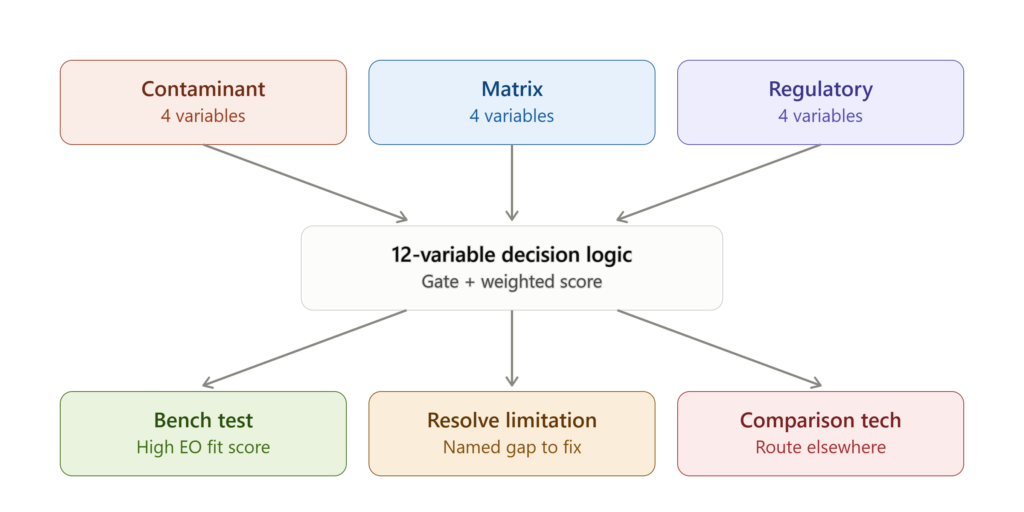
Work through twelve decision variables across three domains — contaminant, matrix, and regulatory — to determine whether electrochemical oxidation (EO) is a defensible technology choice for your stream. Each variable is drawn from the electrochemistry that governs EO performance: charge-transfer mechanism, competing current demand, and byproduct formation risk. The output is a specific recommendation — proceed to bench test, resolve a named limitation first, or route to a comparison technology — not a generic score.
How this checklist works
Twelve variables. Three domains. One outcome.
The twelve variables below are divided into three domains: contaminant compatibility (four variables), matrix compatibility (four variables), and regulatory and operational fit (four variables). Each variable has a Yes/No framing with specific criteria. Track your Yes and No answers through the checklist. The outcome guidance at the end of each domain tells you whether to continue or route to a different resource. A strong Yes across all three domains is the condition for a bench test recommendation.
Domain 1 of 3
Contaminant compatibility — four variables
Answer these four questions about your target contaminant. All four should be Yes for a strong contaminant fit. One or more No answers does not eliminate EO — it identifies the variable that needs further investigation.
C1 — Is the contaminant recalcitrant to biological treatment?
YES if: PFAS, 1,4-dioxane, pharmaceutical APIs, cyanide, recalcitrant dyes, specialty industrial organics.
NO if: readily biodegradable COD/BOD, compounds with known biological degradation pathways at your concentration and temperature.
C2 — Does the contaminant fail activated carbon adsorption?
YES if: 1,4-dioxane (Koc <10), short-chain PFAS below C6, highly water-soluble organics with low log Kow.
NO if: high log Kow compounds that adsorb effectively to GAC — EO may still be the choice for destruction-based compliance, but GAC is a viable alternative.
C3 — Does the discharge permit or compliance driver require destruction?
YES if: CERCLA PFAS designation applies, UWWTD quaternary treatment with verified removal required, AMR policy requires destruction documentation, permit specifically prohibits concentrate discharge.
NO if: removal to a threshold is all that is required and no secondary liability exists for the removed material.
C4 — Is the contaminant present at a concentration that makes treatment energy viable?
YES if: concentration is above approximately 0.1 µg/L for PFAS, above 1 µg/L for pharmaceuticals, above 10 µg/L for 1,4-dioxane — concentrations where the charge density required for treatment does not produce prohibitive energy consumption.
NO if: concentration is so low that the energy cost per unit contaminant destroyed is economically prohibitive for the project.
Domain 2 of 3
Matrix compatibility — four variables
Answer these four questions about your wastewater matrix. Matrix variables affect operating cost and pre-treatment scope — they rarely eliminate EO outright, but they change the economics significantly.
M1 — Is the matrix conductivity above 500 µS/cm?
YES if: industrial wastewater, landfill leachate, produced water, process streams with dissolved salt content. Favourable — lower cell resistance, lower energy consumption.
NO if: clean groundwater, surface water, low-TDS process streams. Electrolyte addition may be required — add to operating cost estimate and check discharge compatibility.
M2 — Is the bulk COD or TOC below 500 mg/L?
YES if: the stream entering EO has been pre-treated by biological treatment, or the stream is inherently low in biodegradable COD.
NO if: raw high-strength industrial wastewater without biological pre-treatment. High competing COD increases charge density requirement and energy cost for target compound removal — biological pre-treatment strongly recommended before EO.
M3 — Is the suspended solids concentration manageable by pre-filtration?
YES for virtually all industrial streams — pre-filtration to below 50 mg/L TSS is standard practice upstream of EO. The question is whether the pre-treatment capital and operating cost is acceptable.
NO only if: the stream is a slurry or semi-solid that cannot be practically filtered before the EO stage — in which case EO is not the applicable treatment technology.
M4 — Are the chloride concentration and bulk organic load manageable for the target byproduct profile?
YES if: chloride <1,000 mg/L or high chloride with low TOC, or permit does not limit chlorinated organic byproducts.
NO if: high chloride (>2,000 mg/L) AND high bulk TOC (>200 mg/L) AND permit limits AOX or THMs. Bench test must include full byproduct profile. See Chloride Byproduct Risks page for mitigation options.
Domain 3 of 3
Regulatory and operational fit — four variables
These four variables determine whether the project context supports EO deployment — regulatory driver alignment, site capabilities, timeline, and commercial fit.
R1 — Is there a defined compliance deadline or liability trigger for this stream?
YES if: CERCLA PFAS designation creates existing liability, permit renewal with new conditions is imminent, UWWTD implementation timeline applies, state-level PFAS groundwater standard has been adopted.
NO if: no current or anticipated regulatory pressure — EO evaluation is speculative rather than requirement-driven. Not a disqualifier, but reduces project urgency.
R2 — Can the site accommodate bench testing within the project timeline?
YES if: 4–8 weeks for bench testing is compatible with the decision timeline.
NO if: a compliance decision must be made in less than 4 weeks without existing bench data. In this case, contact us directly — the trial screen (1–3 days) may provide sufficient directional data for an early decision.
R3 — Is the flow rate and treatment objective within EO's competitive range?
YES if: industrial side-stream or full-flow below ~500 m³/hr for non-PFAS targets; any flow rate if the target is PFAS and destruction is required.
NO if: full-flow municipal secondary effluent above 2,000 m³/hr with a non-PFAS micropollutant target. Ozone and UV/AOP should be evaluated at this scale and flow.
R4 — Is the site capable of operating an electrochemical system?
YES for most industrial sites with existing wastewater treatment operations — EO requires DC electrical supply, basic chemical monitoring, and periodic electrode inspection. Not more demanding than other industrial treatment technologies.
NO if: remote unmanned site with no operational capability for periodic maintenance and monitoring. Remote monitoring via telemetry reduces but does not eliminate the operational requirement.
Checklist outcome
How to interpret your answers
All or most Yes → Proceed to bench test
A strong Yes across all three domains means the contaminant, matrix, and project context are all compatible with EO. The next step is a bench test on your actual matrix — not a system specification, not a capital budget. The bench test produces the data that answers all remaining questions about operating cost, sizing, and byproduct management.
Mixed Yes/No → Address the No answers first
Specific No answers point to specific issues: high bulk COD (add biological pre-treatment), low conductivity (evaluate electrolyte addition), byproduct concern (scope the bench test to include byproduct profiling). Resolve these variables through the relevant limitation page before committing to a bench test programme.
Multiple No answers → Review alternatives
Multiple No answers across two or more domains typically indicate that EO is not the right primary technology for this stream at this time. Navigate to EO vs Alternatives for the technology comparison relevant to your specific treatment challenge.
Supporting tools
Go deeper on any checklist variable
Feasibility Assessment Tool
Interactive tool that applies the checklist variables to your specific matrix and produces a scored outcome.
Wastewater Compatibility Score
Score your wastewater against the EO compatibility criteria and get a ranked readiness assessment.
Pilot Test Requirements
What a pilot test requires — sample volume, duration, instrumentation, and the deliverables it produces.
Engineering Process
The full bench-to-commercial sequence — what happens after a positive checklist outcome.
Common questions
Go / No-Go Checklist FAQ
Yes, particularly for Domain 2. Boron-doped diamond (BDD) anodes generate hydroxyl radicals with high current efficiency and a wide operating window before oxygen evolution dominates, which is why they’re the usual choice for PFAS and other hard-to-oxidise targets. Mixed-metal-oxide (MMO/DSA) anodes cost less and hold up well in high-chloride matrices, but lean more heavily on indirect chlorine-mediated oxidation — which is exactly what raises the byproduct questions in M4. The checklist assumes a bench test will select and confirm anode material against your matrix; it isn’t a substitute for that comparison.
Twelve-variable completeness
The checklist covers all three decision domains with four variables each — contaminant, matrix, and regulatory fit.
Outcome-routed
Every outcome — strong Yes, mixed, or strong No — routes to the appropriate next step rather than leaving the user without direction.
Bench-gates the outcome
A positive checklist outcome is a recommendation to invest in a bench test — not a system approval. The bench test is the required next step.
Level 1 Decision Gate
Where does this take you next?
Every page in the Decision Layer routes to one of three outcomes. Choose the path that matches where you are.
→ Yes — EO is a fit
Your contaminant is recalcitrant, your regulatory driver requires destruction, and the matrix is compatible. Move to treatability testing.
→ Not sure yet
You have answered some of the fit questions but not all. Use the Go / No-Go Checklist to work through the remaining decision variables.
→ No — EO is not the right fit
The contaminant is biodegradable, the scale is too large, or the driver does not require destruction. Review the alternatives.