EO Application: Battery Recycling Wastewater
EO for Battery Recycling Wastewater Treatment
Lithium-ion battery recycling generates some of the most chemically complex effluent in industrial wastewater treatment — dissolved transition metals, fluoride from electrolyte salt hydrolysis, and recalcitrant organic carbonates in the same stream. This page covers the specific EO application framework for battery recycling and black mass processing.
Reviewed for technical accuracy by Janeczka Kowalski, Process / Electrochemical Engineering. Figures and ranges on this page are engineering starting points — verify against your own pilot or vendor data before finalizing a design. The content is created by the Evoaeo engineering team led by Janeczka, All rights reserved.
How this page is maintained
The contaminant classes, treatment train, and operating ranges on this page are drawn from published bench and pilot literature for battery recycling and black mass matrices, cross-checked against internal treatability data where available. Every figure that could vary by site — charge density, current density, energy consumption, electrode life — is presented as a range from that literature, not a guaranteed outcome, and is explicitly marked as requiring bench confirmation before it goes into a design. Regulatory references are reviewed against current text at each scheduled page update; where a rule is under active revision, that is noted rather than presented as settled. This page does not report specific vendor performance guarantees or client results, because none of those transfer reliably between recycling processes without a stream-specific bench test.
Verify before you rely on this
Contaminant profile, treatability study, and pilot testing pages linked throughout this page exist so any figure here can be checked against your own stream before it informs a decision.
The battery recycling EO case
Why Lithium-ion battery recycling effluent resists conventional treatment
Lithium-ion battery recycling wastewater is generated across pre-treatment, hydrometallurgical leaching, and electrolyte handling — each stage contributing a different contaminant class to a stream that often ends up combined before treatment. Dissolved transition metals from leaching sit alongside organic carbonate electrolyte residues and, in almost every case, fluoride released when the LiPF6 electrolyte salt hydrolyses on contact with moisture. Biological treatment handles none of these well: the metals are toxic to biomass at the concentrations typical of leachate, the organic carbonates and NMP solvent carried over from binder removal are poorly biodegradable, and fluoride passes through a biological step unchanged. Conventional physical-chemical treatment removes the metals and solids but leaves the organic load and fluoride largely untouched.
What EO addresses
Target contaminants and typical Lithium-ion battery reycling wastewater matrix characteristics
Primary target contaminants
- Dissolved transition metals: cobalt, nickel, manganese, copper, and lithium from hydrometallurgical leaching
- Fluoride and phosphorus oxyfluoride released by LiPF6 electrolyte salt hydrolysis on contact with moisture
- Organic carbonate electrolyte residues and degradation products: EC, DMC, DEC, and EMC
- N-Methyl-2-pyrrolidone (NMP) carried over from PVDF binder dissolution during electrode processing
- Residual leaching acids and bases: sulfuric, hydrochloric, and citric ac
- Elevated chloride and sulfate from leaching reagents and neutralisation salts
- Suspended black mass fines: graphite, binder fragments, and metal oxide particulatesid; sodium hydroxide neutralisation streams
Typical matrix characteristics
- COD: variable — 300 to >8,000 mg/L depending on process stage and electrolyte carryover
- BOD:COD ratio: typically below 0.15 — organic carbonates and NMP are poorly biodegradable at process concentrations
- Fluoride: 10 mg/L to several hundred mg/L in electrolyte-contacted streams — the compound class most distinct to this sector
- pH: wide range — strongly acidic hydrometallurgical leachate (pH 1–3) to alkaline precipitation supernatant (pH 9–11)
- Suspended solids: variable — black mass fines require filtration before EO
- Conductivity: typically high — leaching salts and neutralisation reagents raise ionic strength
- Dissolved metals must be characterised before EO, not only checked at final discharge
The metals pre-treatment question
Why metal precipitation has to happen before EO, not after
Battery recycling wastewater carries dissolved cobalt, nickel, manganese, and copper at concentrations that would foul a BDD anode within a single shift if the stream reached EO unprecipitated. Unlike the conditional biological pre-treatment step common on other EO applications, metal precipitation ahead of EO is not optional for a leachate-derived stream — it is a standing requirement, and the question is only how far to precipitate before the residual metal load falls below the anode’s fouling threshold.
Treatment train
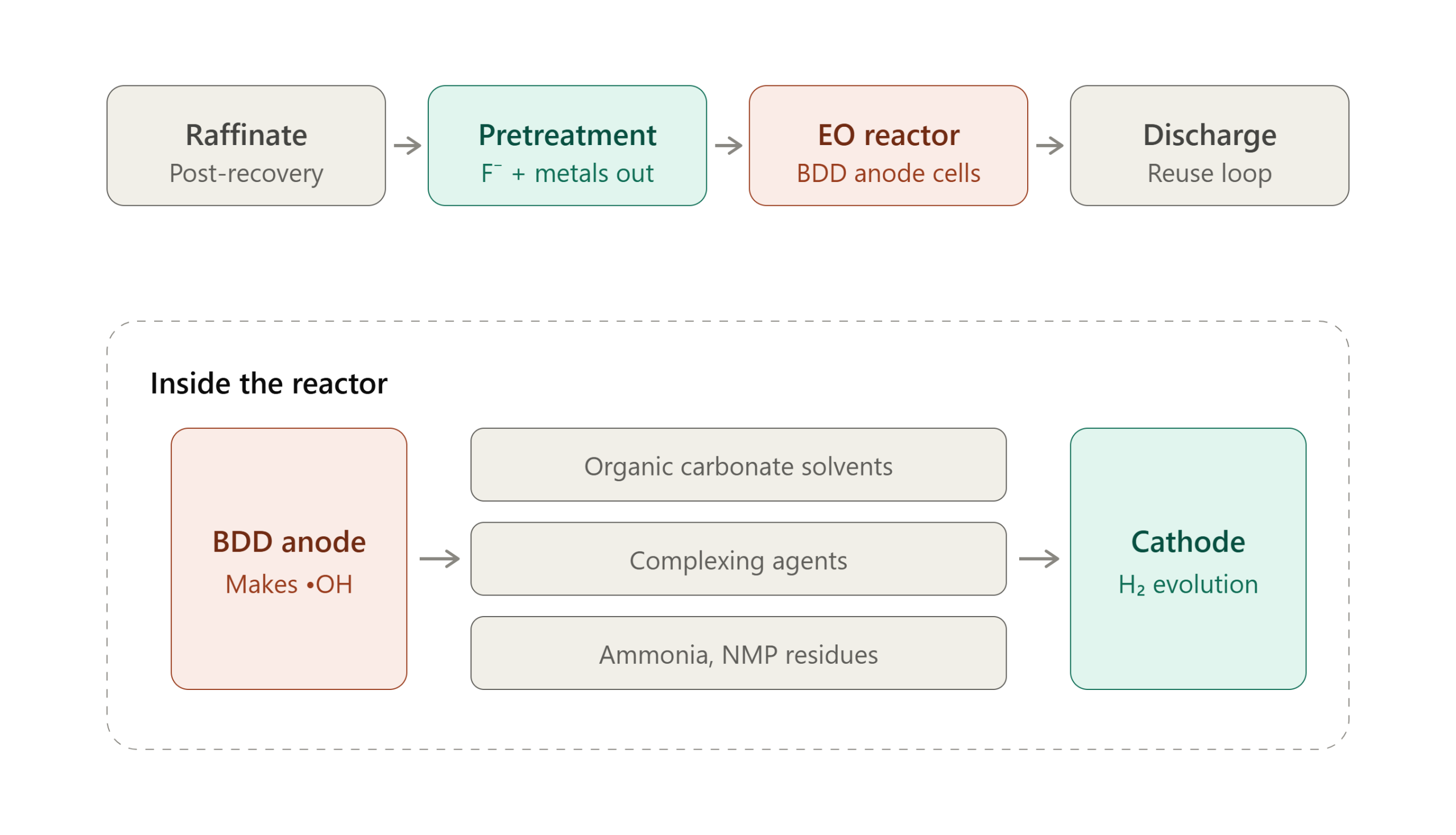
Typical EO treatment train for Lithium-ion battery recycling wastewater
Pre-treatment
Filtration to remove black mass fines and colloidal solids to below 50 mg/L TSS. pH adjustment to operating range (pH 5–9).
Metal precipitation & recovery
Hydroxide or sulfide precipitation of cobalt, nickel, manganese, and copper ahead of EO. Recovered metal hydroxide cake can often feed back into the hydrometallurgical recovery circuit.
Electrochemical Oxidation (BDD)
BDD electrode for organic carbonate and NMP destruction. Operating current density 20–70 mA/cm². Charge density established by bench test. Fluoride mass balance tracked alongside organic removal.
Effluent monitoring
Inline COD/TOC for process control. Residual fluoride and dissolved metals at required frequency. Chlorate/perchlorate profiling where HCl-based leaching is used.
Discharge
Treated effluent to receiving water, municipal sewer, or an internal reuse loop per permit conditions.
Electrolyte and organic byproducts
Electro oxidation for organic carbonate electrolyte residues and NMP in battery recycling wastewater
Organic carbonate electrolyte solvents — ethylene carbonate, dimethyl carbonate, diethyl carbonate, and ethyl methyl carbonate — carry through into pre-treatment rinse and electrolyte-handling wastewater. They are poorly biodegradable at the concentrations typical of recycling effluent and are not efficiently captured by activated carbon. EO via BDD generates hydroxyl radicals at sufficient potential to break down the carbonate structures through a combination of direct surface oxidation and bulk •OH attack, progressing through smaller organic acid intermediates toward CO₂.
NMP, used to dissolve PVDF binder during electrode processing, is fully water-miscible and persistent — it is not effectively removed by filtration or GAC alone, and its presence in a stream is a strong signal that EO is treating a genuine organic load rather than mostly suspended solids. The bench test should track TOC/COD mass balance rather than a single target-compound measurement, since partial oxidation to smaller organic acids is a real intermediate outcome, not a failure of the process.
Refractory pollutants with Lithium-ion battery recycling wastewater we detected:
- Ethylene carbonate, dimethyl carbonate, diethyl carbonate, ethyl methyl carbonate: poorly biodegradable at process concentrations
- NMP (N-Methyl-2-pyrrolidone): fully water-miscible, persistent, not effectively removed by filtration or GAC alone
- PVDF binder fragments: largely removed by filtration pre-treatment rather than by EO
- Carbonate hydrolysis products: ethylene glycol and methanol tracked as intermediate species in bench byproduct profiling
- Bench test must include TOC/COD mass balance, not target-compound removal alone, to confirm mineralisation vs partial oxidation
Fluoride and LiPF6 hydrolysis
Fluoride — the compound class battery recycling streams share with almost no other sector
LiPF6, the electrolyte salt used across most commercial lithium-ion chemistries, hydrolyses in the presence of trace moisture to hydrogen fluoride and phosphorus oxyfluoride. This is a chemistry inherent to the process, not a contamination event, and it means fluoride shows up in electrolyte-contacted streams at concentrations most other EO applications never encounter. Fluoride does not oxidise or mineralise at the anode — EO reduces the organic load carried alongside it but does not remove the fluoride itself.
Fluoride removal is handled separately, typically through calcium precipitation as CaF2, positioned either upstream or downstream of the EO stage depending on where fluoride would otherwise interfere with other unit operations. The treatability study needs to report fluoride concentration through the full proposed train, not only at raw influent, so it is clear where in the sequence it actually gets addressed.
EO is limited to remove Flouride, treatment train is required.
- LiPF6 hydrolyses in the presence of trace moisture to HF and POF3 — inherent to the process, not a contamination event
- Free fluoride at low pH is corrosive to some BDD electrode substrates through pinhole attack under the diamond film
- Fluoride does not oxidise or mineralise at the anode — EO addresses the organic load around it, not the fluoride itself
- Fluoride removal is typically handled by calcium precipitation upstream or downstream of EO, not by the EO stage
- Bench test must report fluoride through the full treatment train, not only at raw influent
Electrode behaviour
What actually limits a BDD anode in battery recycling service
Three failure modes show up repeatedly in battery recycling EO installations and rarely get discussed until someone hits them. None is a reason to avoid the technology — all three are reasons to bench test with the real matrix rather than a synthetic surrogate, and to build monitoring for the right byproducts from day one.
Electrode fouling and scaling
Metal hydroxide precipitates, calcium and magnesium carbonate scale, and black mass fines build up on the diamond surface where upstream filtration or precipitation is incomplete. Cell voltage drifts upward at constant current — the first sign fouling is eating into current efficiency. Acid cleaning intervals should be established in the bench or pilot phase against actual precipitation-stage carryover, not a clean synthetic sample.
Diamond film degradation
Boron-doped diamond delaminates from the substrate under prolonged high current density or fluoride-rich matrices attacking the underlying niobium or titanium substrate through pinhole defects in the diamond film. This failure mode is more relevant in battery recycling service than in most other EO applications, because fluoride is close to universal in electrolyte-contacted streams. Electrode lifetime is matrix-specific and should be tracked from the pilot stage.
Perchlorate and chlorate formation
Where hydrochloric acid is used as a leaching reagent, chloride carried into the EO stage can be converted through hypochlorite and chlorate to perchlorate at the BDD anode — a regulated contaminant in its own right. Formation increases with current density, chloride concentration, and treatment time. Bench testing on HCl-leached streams must include perchlorate and chlorate analysis.
Why this matters for fluoride-rich battery recycling wastewaters specifically
Fluoride is close to unavoidable in electrolyte-contacted battery recycling streams, at concentrations well above what most EO installations in other sectors ever see. The practical response is not to avoid EO on these streams — it’s to run the bench test at the actual fluoride concentration, confirm electrode substrate compatibility before committing to a commercial electrode configuration, and track voltage drift as a leading indicator of substrate attack rather than waiting for an outright electrode failure to signal the problem.
Regulatory context
Battery recycling EO regulatory drivers
Battery recycling EO deployment is driven by multiple overlapping regulatory frameworks — not a single mandating requirement. The primary drivers in 2025–2026 are: the EU Battery Regulation (EU) 2023/1542, which sets recycling efficiency and material recovery targets for lithium, cobalt, nickel, and copper that indirectly drive metal-loss and wastewater control across the recycling process; national hazardous waste characterisation rules for spent lithium-ion batteries and black mass that extend into process wastewater handling and discharge classification; and fluoride discharge limits under local industrial pretreatment programmes, which are typically among the tightest single-parameter limits a battery recycling facility will face.
- EU Battery Regulation (EU) 2023/1542: recycling efficiency and material recovery targets for Li, Co, Ni, and Cu
- National hazardous waste characterisation rules for spent lithium-ion batteries and black mass, extending to wastewater handling
- Fluoride discharge limits under local industrial pretreatment programmes — typically among the tightest single-parameter limits in this sector
- Metal discharge limits for cobalt, nickel, manganese, and copper under municipal pretreatment or direct-discharge permits
- Emerging PFAS-adjacent scrutiny of fluorinated process chemistries as regulators extend fluorine-focused permit conditions
Battery recycling EO operating parameters
What published bench and pilot data shows for battery recycling matrices.
Typical operating ranges by stream type
Electrode: BDD. Current density: 25–70 mA/cm². Charge density: 15–60 Ah/L depending on residual organic load. Energy: 8–35 kWh/m³ in high-conductivity leachate. Pre-treatment: metal precipitation to below fouling threshold is mandatory, not optional.
Electrode: BDD. Current density: 20–60 mA/cm². Charge density: 10–40 Ah/L for carbonate and NMP removal. Note: fluoride mass balance tracked through the full train; EO does not remove fluoride itself.
Electrode: BDD with substrate compatibility confirmed for fluoride exposure. Key bench test output: electrode voltage drift over time as a proxy for substrate attack, alongside organic removal. Calcium precipitation for fluoride typically sits outside the EO stage.
Filtration to remove suspended solids is the controlling pre-treatment step. EO charge density on well-filtered wash water is typically at the lower end of the range; unfiltered streams foul the anode faster than they lose organic load.
Reaction kinetics
Why charge density does not scale linearly with removal
Bench data consistently shows two kinetic regimes in a single EO run, and reading a bench curve without recognising the transition between them is the most common way commercial-scale projections go wrong.
Scale-up pathway
Bench to full-scale for a mixed-feedstock battery recycling facility
Battery recycling facilities processing mixed feedstock — different cell chemistries such as NMC, LFP, and LCO arriving in the same intake stream — need an extra validation step that single-chemistry processors can often skip: confirming performance holds across the metals and fluoride range the plant actually processes, not just the sample collected on the day of testing.
Bench
0.5–5 L batch cells. Establishes charge density, current density, and byproduct profile per feedstock chemistry. Multiple chemistry samples tested separately if the intake mix varies significantly.
Pilot
Continuous-flow skid, typically 0.5–20 m³/day. Confirms bench parameters hold under continuous operation and validates electrode fouling rate against real precipitation-stage carryover over weeks, not hours.
Demonstration
Extended pilot run across a representative range of intake chemistries where feasible. The step most often skipped on cost grounds and most often responsible for underperforming full-scale systems when it is.
Full-scale
Commercial system sized against the demonstration-confirmed operating envelope, with monitoring instrumentation carried through from pilot rather than specified fresh at handover.
Cost framework
What actually drives EO operating cost on a battery recycling stream
Energy consumption for battery recycling matrices spans a similarly wide range to other recalcitrant industrial streams — roughly 8–35 kWh/m³ in high-conductivity post-precipitation leachate versus considerably more in dilute, low-conductivity rinse water. That spread is not noise; each of the following moves the number within it, and none of them can be estimated without a matrix-specific bench result.
- Conductivity of the stream — high-conductivity leachate generally passes current more efficiently than dilute rinse water
- Whether metal precipitation removes fouling species before EO sees the stream
- Removal target — the mass-transfer-limited tail described above disproportionately affects cost at high removal targets
- Electrode replacement interval, which is matrix-specific — fluoride exposure in particular only becomes reliable after pilot-scale run time
- Local electricity cost per kWh, which the bench test cannot tell you and must be supplied separately
- Notes: On cost estimates: any CAPEX or OPEX figure quoted before a bench test is a rough order-of-magnitude planning number, not a design basis. Treat pre-bench cost estimates the same way you would treat a pre-bench removal efficiency claim — useful for a go/no-go screen, not for a capital approval.
Common questions
Battery Recycling EO FAQ
Variable feedstock chemistry is common where a facility processes mixed NMC, LFP, and LCO intake through shared effluent infrastructure. The EO system should be designed against the worst-case characterisation — highest metal and fluoride load, lowest conductivity, highest organic concentration — with operating flexibility to adjust current density within the bench-established range as the intake mix changes. Equalisation tankage upstream of precipitation and EO to buffer composition variation is strongly recommended.
No, not directly. EO oxidises organic load — it does not mineralise or remove fluoride ion itself. Fluoride is addressed separately, typically by calcium precipitation as CaF2, positioned upstream or downstream of the EO stage. The treatability study should map fluoride concentration through the full proposed train so it’s clear which stage is actually responsible for meeting the discharge limit.
Yes. Bench testing does not depend on published data for a specific leaching or recovery process — it measures performance on the actual sample at defined conditions. The bench protocol establishes charge density and energy consumption for your specific stream empirically, regardless of whether the process chemistry is published. Non-disclosure agreements are standard for proprietary process streams.
Chemistry-specific
The contaminant classes covered — dissolved metals, fluoride from LiPF6 hydrolysis, organic carbonates — reflect actual battery recycling treatment challenges.
Bench-gated
All operating parameter ranges are presented as bench test outputs, not as specifications.
Regulatory-current
EU Battery Regulation, hazardous waste characterisation, and fluoride discharge context are described with their current direction of change.
Next steps for battery recycling wastewater assessment
Continue building your battery recycling EO evaluation
Wastewater Characterisation
The analytical set required before a bench test can be designed for a battery recycling stream.
Biodegradability Classification
How to define the recalcitrant fraction — critical for streams carrying NMP and organic carbonate residues.
Pilot Testing
Join engineering team of Evoaeo to find out how a pilot program is designed for variable-feedstock battery recycling streams.
Electrode Materials Comparison
How to choose Substrate and coating options relevant to fluoride- and metal-bearing streams.
Start with the wastewater and the required endpoint
Request a Battery Recycling Wastewater EO Review
Provide the recycling process stage, wastewater source, feedstock chemistry mix, target contaminants, COD/TOC, pH, conductivity, chloride, fluoride, dissolved metals (Co, Ni, Mn, Cu, Li), suspended solids, temperature, flow pattern, current treatment, and required discharge, reuse, or pretreatment endpoint. Mixed feedstock chemistries, leaching reagents, and precipitation byproducts must be reviewed before electrochemical oxidation performance or equipment requirements can be defined.
Submitting this form does not schedule testing or establish treatment performance. Uploaded files are used to review application fit and define the next technical step. Replace the placeholder email, webhook, privacy-policy link, and retention settings before publication.