Technology Comparison:Ion Exchange
Eelectro Oxidation vs. Ion Exchange
Ion exchange is selective and precise for specific ions. It’s also, in one specific case, the technology that cleans up after a byproduct electro oxidation itself can generate.
Reviewed for technical accuracy by Janeczka Kowalski, Process / Electrochemical Engineering. Figures and ranges on this page are engineering starting points — verify against your own pilot or vendor data before finalizing a design. The content is created by the Evoaeo engineering team led by Janeczka, All rights reserved.
Selective removal vs. broad destruction
How ion exchange actually works
Ion exchange resin swaps a target ion in solution for a different ion held on the resin — removing specific anions or cations (nitrate, perchlorate, certain heavy metal ions, hardness) with high selectivity and no chemical transformation of the target species. Like activated carbon, it’s a separation technology with a finite capacity: the resin eventually exhausts and needs regeneration, producing a concentrated regenerant brine that itself requires further treatment or disposal. EO doesn’t compete directly with ion exchange for simple, non-oxidizable ionic species — hardness minerals and many metal ions aren’t meaningfully affected by an oxidation process, so ion exchange remains the right tool for that specific job regardless of what else is on a treatment train.
A genuine point of interaction
When ion exchange cleans up after EO
One specific overlap is worth calling out directly: perchlorate, a byproduct that can form on chloride-rich streams under EO treatment (see Byproduct Chemistry Overview for the formation mechanism), is itself a target that ion exchange removes efficiently and selectively. On a stream where EO’s chloride-mediated pathway carries meaningful perchlorate risk, an ion exchange polishing stage downstream of EO is a genuine, practical pairing — not a redundant one — giving a documented removal step for exactly the byproduct the upstream process can generate.
Where regenerant treatment closes the loop
Treating what ion exchange concentrates
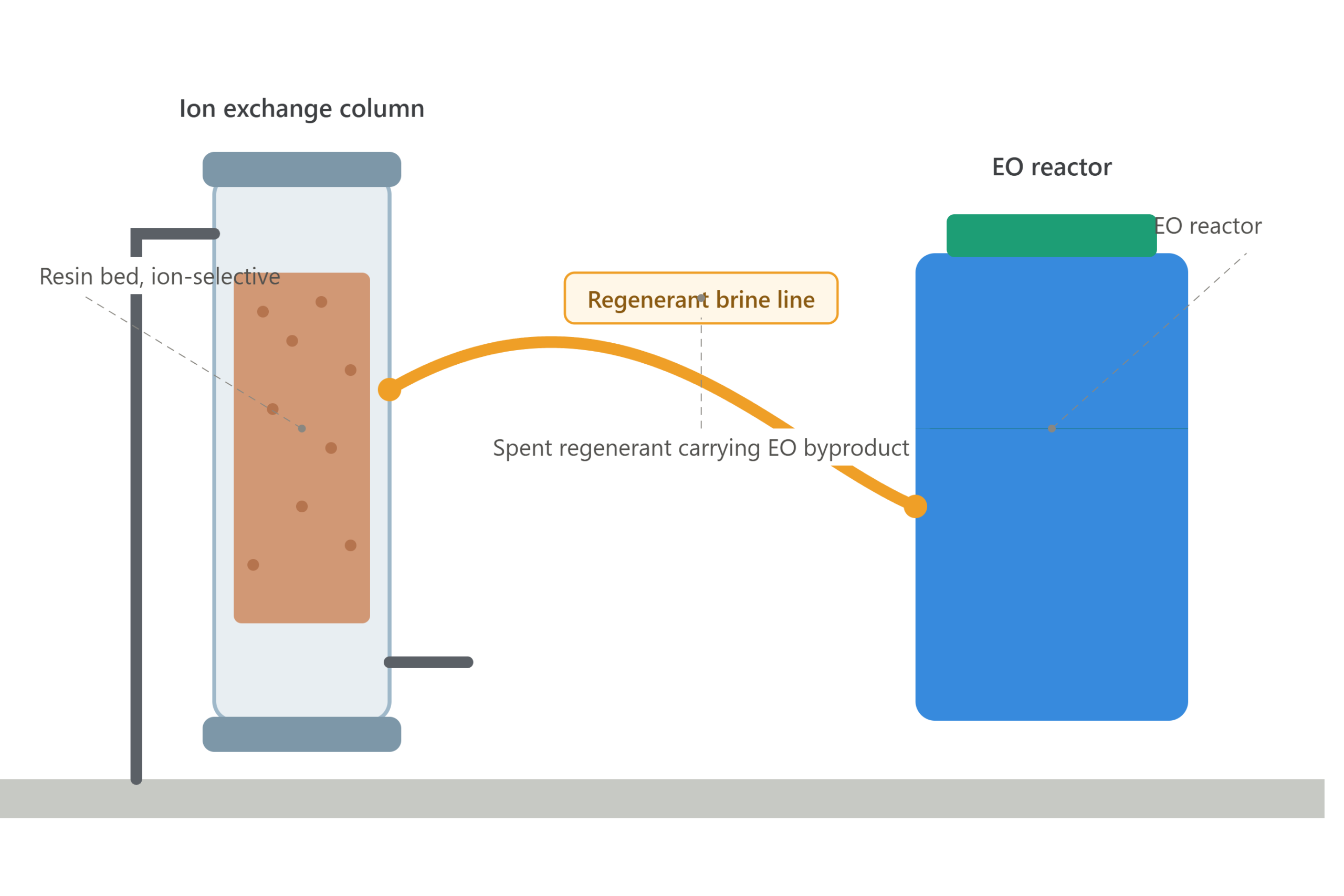
The concentrated regenerant brine produced when an ion exchange resin is regenerated is a genuine waste stream in its own right, and disposal cost or discharge limits on that brine can become a meaningful driver of total system cost. Where the regenerant carries organic co-contaminants alongside the target ion, EO applied to the regenerant stream specifically — rather than the full original flow — can reduce that waste stream’s organic load before disposal, similar in principle to how EO is applied to RO concentrate in a reuse train.
- Ion exchange remains the right tool for simple ionic species (hardness, specific metals) that EO doesn't meaningfully affect
- Consider ion exchange downstream of EO specifically where perchlorate byproduct risk is present
- Consider EO applied to ion exchange regenerant brine where that stream carries organic co-contaminants
Pollutant-by-pollutant comparison
How EO and Ion Exchange perform on the pollutants that matter
Ratings reflect typical performance patterns reported across industrial-scale applications, not a substitute for bench testing on your specific matrix.
| Pollutant | EO | Ion Exchange | Engineering take |
|---|---|---|---|
| Perchlorate | Can generate as a byproduct — does not remove | Excellent | A genuine case where IX cleans up after EO rather than competing with it |
| Nitrate | Limited | Excellent | IX remains the standard tool for straightforward nitrate removal |
| PFAS (anionic forms) | Excellent — destruction | Good — concentrates onto resin, doesn’t destroy | Resin fouling and regenerant disposal are real IX limitations EO doesn’t share |
| Hexavalent chromium | Indirect only | Good | IX is well suited here; EO isn’t the natural first choice |
| Hardness (calcium/magnesium) | Not applicable | Excellent | A job EO was never meant to do — IX or softening remains correct |
PFAS spotlight
Ion exchange resin is genuinely effective at capturing anionic PFAS species, but like activated carbon, it’s a concentration technology, not a destruction one — the resin eventually saturates and regeneration produces a concentrated PFAS-laden brine that still needs to go somewhere. EO applied to that regenerant stream, rather than the full original flow, is an increasingly common way to close that loop: IX does the selective capture at scale, EO destroys what gets concentrated. Watch for the reverse relationship too: on chloride-rich streams, EO can generate perchlorate as a byproduct, and IX downstream is one of the more reliable ways to capture it.
Related comparisons
Where this decision connects to others
Grounded in the literature
This comparison reflects published research, not just our own field data
The mechanisms and performance patterns described on this page are consistent with the peer-reviewed environmental engineering literature — journals including Water Research, Chemosphere, the Journal of Hazardous Materials, Environmental Science & Technology, and the Chemical Engineering Journal regularly publish comparative studies on electrochemical and competing treatment technologies. Our engineering team tracks this literature as part of how we validate bench and pilot results against the broader research base, and can provide specific citations relevant to your stream on request.
Sorting out where ion exchange and EO fit in your treatment train?
Send us your stream data and we’ll respond with an engineering read — no obligation.