Technology Comparison:EO vs. Activated Carbon
Eelectro Oxidation vs. Activated Carbon
Activated carbon moves a pollutant out of the water. Electrochemical oxidation gets rid of it. That difference matters more than it sounds once disposal liability enters the picture.
Reviewed for technical accuracy by Janeczka Kowalski, Process / Electrochemical Engineering. Figures and ranges on this page are engineering starting points — verify against your own pilot or vendor data before finalizing a design. The content is created by the Evoaeo engineering team led by Janeczka, All rights reserved.
Adsorption vs. destruction
Where the pollutant actually ends up
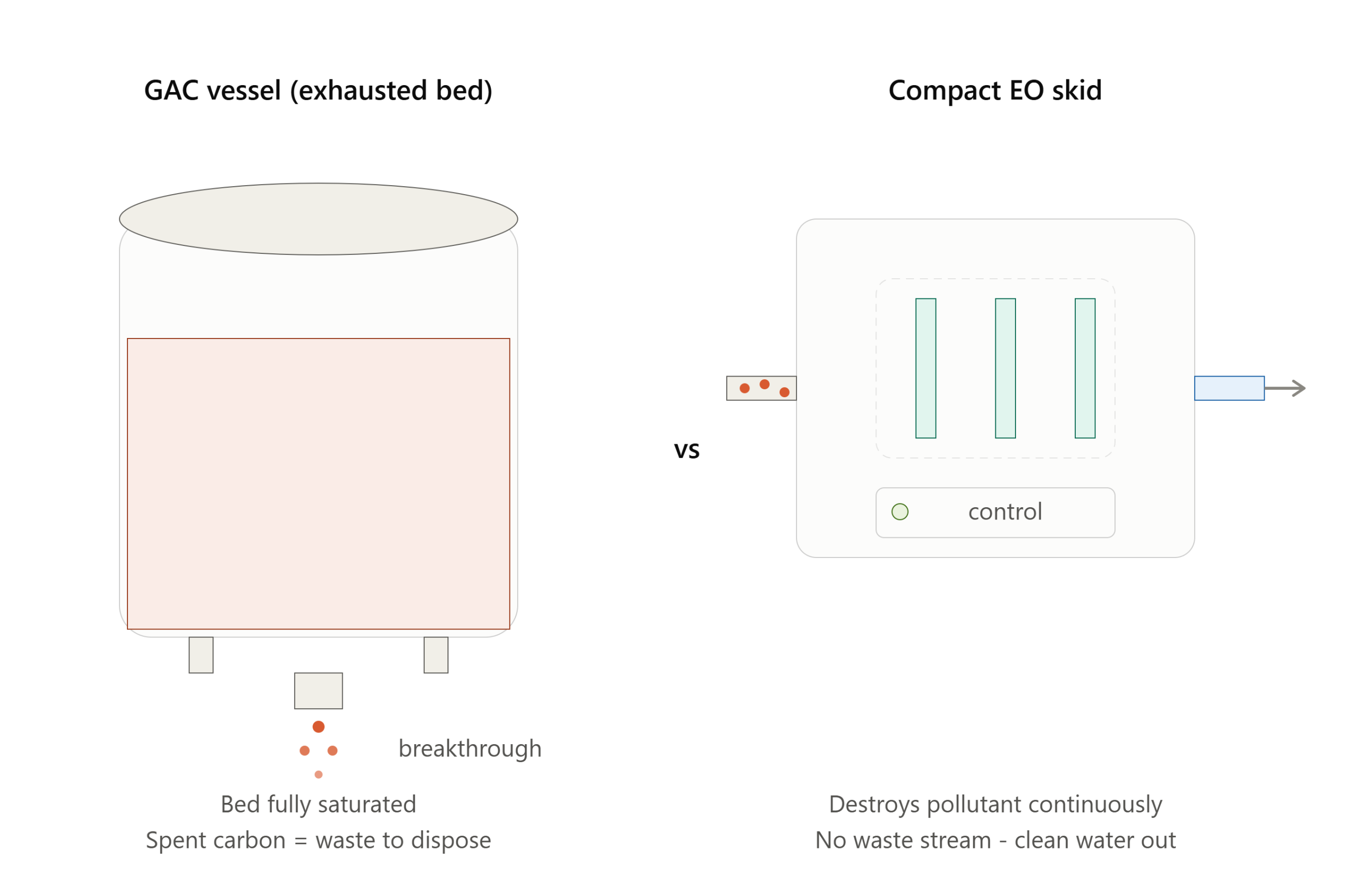
Granular or powdered activated carbon (GAC/PAC) removes contaminants by physical adsorption onto the carbon surface — an effective, well-understood technology, but one with a finite capacity. Once the carbon’s adsorption sites saturate, it has to be regenerated (thermally, at real energy cost) or disposed of and replaced, and for persistent compounds like PFAS, spent carbon carrying adsorbed contaminant is itself now a waste stream carrying disposal restrictions that are only getting tighter. Electrochemical oxidation, by contrast, destroys the pollutant on a continuous basis rather than storing it — there’s no saturation point and no spent-media disposal liability building up over time.
Where activated carbon still wins
Dilute streams and low-flow economics
For low-flow, dilute contaminant streams, activated carbon’s upfront capital and operating cost is often lower than an EO system sized for the same flow — EO’s energy cost scales with the organic load being oxidized, and on a very dilute stream that energy cost per unit of contaminant destroyed can be disproportionately high. This is why activated carbon remains the default for many drinking water and low-concentration polishing applications where flow is high but contaminant concentration is genuinely low.
Where the two are increasingly paired
Concentration plus destruction, not either/or
A growing pattern, particularly for PFAS, pairs the two technologies rather than choosing one: activated carbon (or ion exchange) concentrates a dilute contaminant load out of a large flow, and EO then destroys the concentrated regenerant or spent-media eluate rather than sending it to landfill or long-term storage. This keeps the electrochemical energy cost on a much smaller, more concentrated volume than treating the full original flow with EO directly would require.
Application note
If your current process uses activated carbon and disposal cost or regulatory risk on spent media is becoming the real driver of total cost, that’s the signal to evaluate EO — either replacing the carbon stage entirely or destroying what the carbon stage concentrates.
Pollutant-by-pollutant comparison
How EO and Activated Carbon perform on the pollutants that matter
Ratings reflect typical performance patterns reported across industrial-scale applications, not a substitute for bench testing on your specific matrix.
| Pollutant | EO | Activated Carbon | Engineering take |
|---|---|---|---|
| PFAS — long-chain (e.g. PFOA, PFOS) | Excellent (BDD) | Good — adsorbs well | GAC performs reasonably here but generates PFAS-laden spent media requiring disposal |
| PFAS — short-chain | Good to excellent depending on charge dose | Limited — poor adsorption, early breakthrough | This is GAC’s clearest weak point and a genuine differentiator for EO |
| Pesticides / herbicides | Good | Good | Roughly comparable; selection often comes down to cost and disposal logistics |
| Taste & odor compounds (geosmin, MIB) | Good | Excellent | GAC remains the standard for this specific application |
| Pharmaceutical residues | Good to excellent | Moderate — varies widely by compound | EO’s performance is more consistent across a broad compound range |
PFAS spotlight
Short-chain PFAS compounds — increasingly common as manufacturers move away from long-chain formulations under regulatory pressure — adsorb poorly onto conventional GAC, leading to earlier breakthrough than long-chain PFAS would suggest. EO’s destruction mechanism doesn’t depend on chain-length adsorption affinity the way carbon does, which is why facilities transitioning to short-chain PFAS-bearing streams are increasingly evaluating EO rather than relying on GAC alone. Where GAC capacity already exists, pairing it with EO to destroy the spent-media regenerant is often more practical than replacing the carbon stage outright.
Related comparisons
Where this decision connects to others
Grounded in the literature
This comparison reflects published research, not just our own field data
The mechanisms and performance patterns described on this page are consistent with the peer-reviewed environmental engineering literature — journals including Water Research, Chemosphere, the Journal of Hazardous Materials, Environmental Science & Technology, and the Chemical Engineering Journal regularly publish comparative studies on electrochemical and competing treatment technologies. Our engineering team tracks this literature as part of how we validate bench and pilot results against the broader research base, and can provide specific citations relevant to your stream on request.
Weighing activated carbon adsorption against destruction for a dilute or PFAS-bearing stream?
Send us your stream data and we’ll respond with an engineering read — no obligation.