Produced Water: Application-Specific
Produced Water From Hydraulic Fracturing: Why Shale Operations Need a Different Design Basis
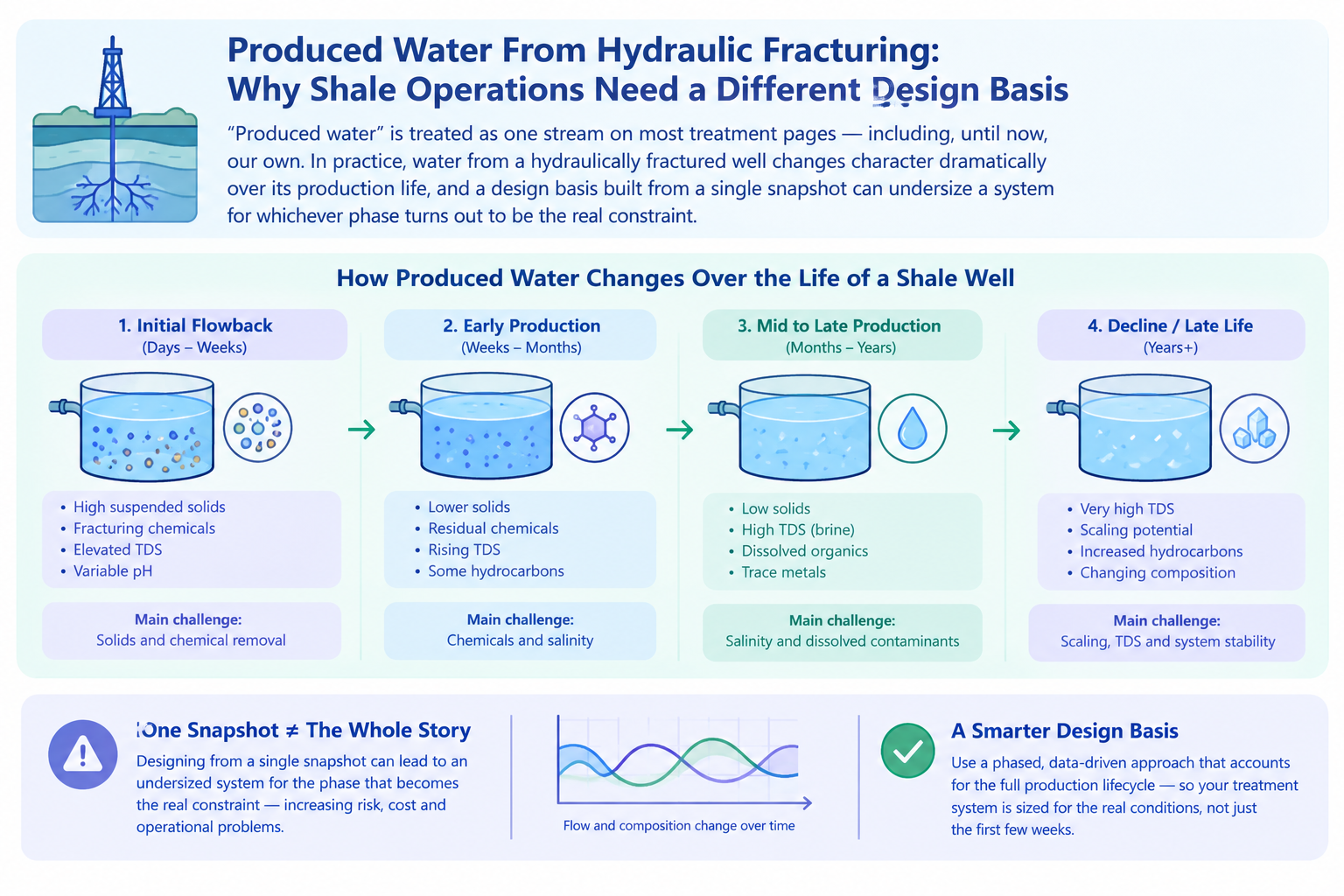
“Produced water” is treated as one stream on most treatment pages — including, until now, our own. In practice, water from a hydraulically fractured well changes character dramatically over its production life, and a design basis built from a single snapshot can undersize a system for whichever phase turns out to be the real constraint.
Reviewed for technical accuracy by Janeczka Kowalski, Process / Electrochemical Engineering. No specific TDS/salinity numbers by production phase were invented here — these vary significantly by basin (Permian vs. Marcellus vs. Bakken, for instance). Figures and ranges on this page are engineering starting points — verify against your own pilot or vendor data before finalizing a design. The content is created by the Evoaeo engineering team led by Janeczka, All rights reserved.
Flowback vs. Long-Term Produced Water: Two Different Streams
Flowback (early)
Returns in the days and weeks after fracturing. Carries a high concentration of the chemical additives injected during the fracturing process itself — friction reducers, biocides, scale inhibitors — alongside formation water beginning to mix in.
Produced water (long-term)
Returns over the well’s producing life, months to years. Chemical-additive content drops; naturally occurring salinity, TDS, and formation-derived constituents (including NORM) rise as a share of the total load.
Why This Matters for System Sizing
A system sized only against early flowback chemistry can be mismatched against the salinity and NORM profile of water the well produces a year later — and the reverse is just as true. Our Produced Water Treatment page already covers why high salinity favors EO and how PFAS from drilling fluid enters the stream; this page is specifically about accounting for how the stream itself changes over a well’s life, not re-explaining why EO suits produced water generally.
Operating in a shale basin?
Tell us where your well is in its production life — the right bench test depends on which phase you’re actually sampling.