Technology Comparison: WAO
Eelectro Oxidation Processes vs. Wet Air Oxidation
Wet air oxidation occupies a specific middle ground — streams too concentrated for biological treatment but not concentrated enough to justify incineration. Here’s how it compares to electro-oxidation in that same zone.
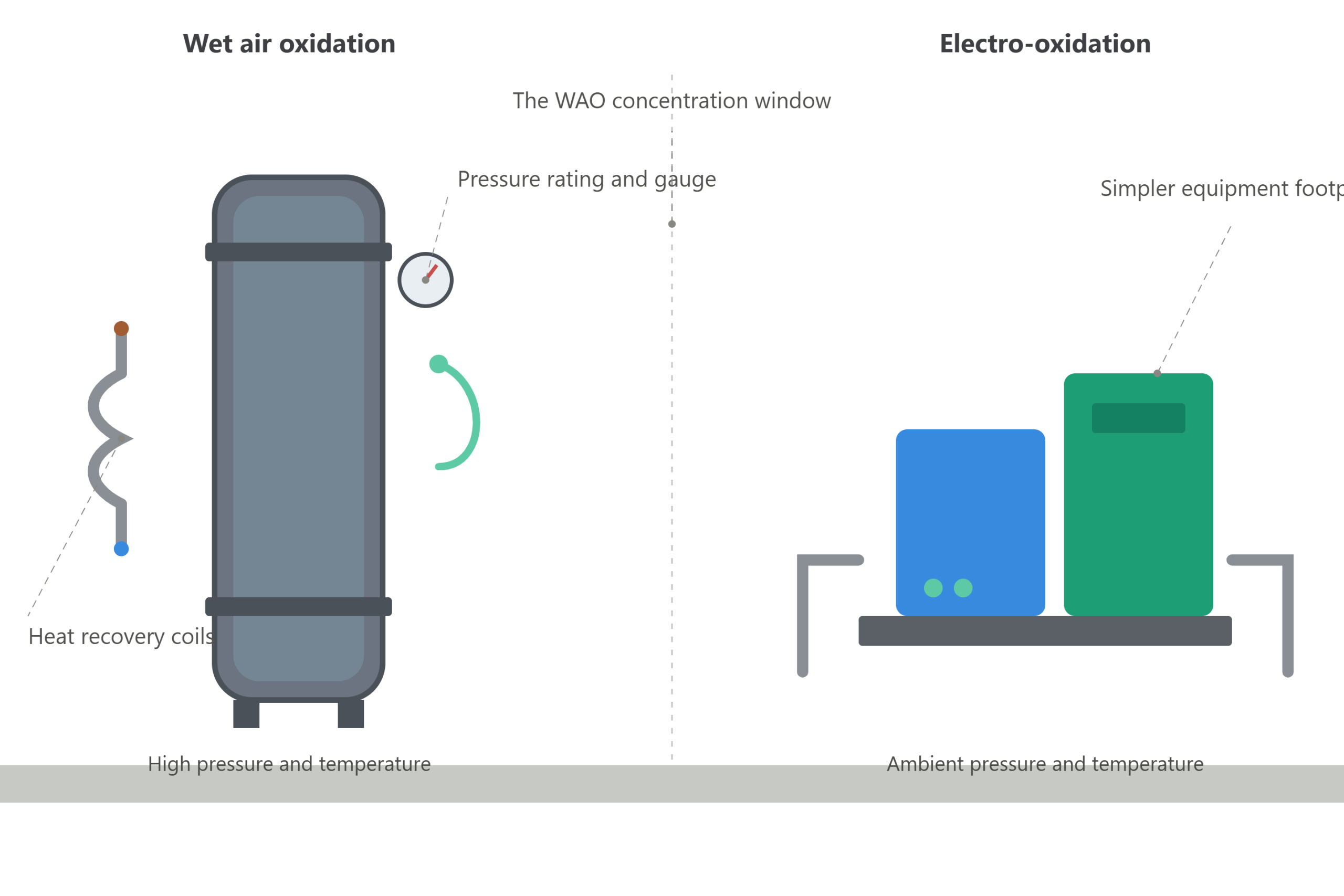
Reviewed for technical accuracy by Janeczka Kowalski, Process / Electrochemical Engineering. Figures and ranges on this page are engineering starting points — verify against your own pilot or vendor data before finalizing a design. The content is created by the Evoaeo engineering team led by Janeczka, All rights reserved.
How wet air oxidation works
Thermally accelerated oxidation under pressure
Wet air oxidation (WAO) oxidizes organic load in the liquid phase at elevated temperature (roughly 150–320°C) and pressure, using injected air or oxygen, without an open flame — a thermally driven rather than electrochemically driven oxidation process. It’s specifically suited to high-strength streams, often in the tens of thousands of mg/L COD, that are too concentrated or too toxic for biological treatment but too dilute (mostly water) to make incineration’s fuel requirement economically sensible.
Capital and energy trade-offs
Where each technology's economics favor it
WAO requires a pressure vessel rated for its operating conditions, heat exchange equipment, and an oxygen or air supply system — a higher capital investment than a comparably sized EO system, but one that can become partially or fully energy self-sustaining at very high COD concentrations, since the oxidation reaction itself is exothermic enough to offset heating costs. EO’s capital cost is generally lower, but its energy cost scales roughly linearly with organic load, which makes it comparatively less economical than WAO at the very high end of the COD range WAO is built for.
Completeness of treatment
Neither one always finishes the job alone
WAO frequently doesn’t achieve full mineralization on its own — short-chain organic acids such as acetic acid are notably resistant to wet air oxidation conditions and often remain in the effluent, requiring a biological polishing stage afterward. This mirrors a pattern seen with EO on the opposite end of the concentration spectrum, where a biological pretreatment or polishing stage is frequently paired with EO rather than EO handling the entire organic load alone.
- Consider WAO for very high-COD streams (tens of thousands of mg/L) where EO's energy cost would scale unfavorably
- Consider EO for low-to-moderate COD streams where WAO's capital cost and pressure-vessel complexity aren't justified
- Plan for a biological polishing stage after either technology if short-chain organic acid residuals are a concern
Pollutant-by-pollutant comparison
How EO and Wet Air Oxidation perform on the pollutants that matter
Ratings reflect typical performance patterns reported across industrial-scale applications, not a substitute for bench testing on your specific matrix.
| Pollutant | EO | Wet Air Oxidation | Engineering take |
|---|---|---|---|
| High-strength COD (tens of thousands mg/L) | Good but energy-intensive at this concentration | Excellent — WAO’s specialty range | WAO’s economics genuinely favor it at the very high end of the COD spectrum |
| Short-chain organic acids (e.g. acetic acid) | Good | Limited — notably resistant to WAO conditions | A biological polishing stage is often needed after WAO for exactly this residual |
| Pharmaceutical / API residues | Excellent | Good | Both handle this reasonably; EO scales down to lower concentrations more economically |
| Spent caustic streams | Limited — not the natural fit | Good to excellent | WAO’s high-temperature, high-pressure regime suits this waste category well |
| Cyanide | Excellent | Good | Comparable performance; selection usually comes down to concentration and capital budget |
PFAS spotlight
Standard wet air oxidation operating conditions — typically 150 to 320°C — generally aren’t sufficient to reliably break PFAS’s carbon-fluorine bond, though research into higher-temperature WAO variants for PFAS destruction is ongoing. For facilities with a PFAS-specific compliance driver, EO’s demonstrated PFAS destruction capability at commercially deployed conditions remains the more established option today.
High-strength waste spotlight
Wet air oxidation’s real signature application is waste too concentrated or too biologically toxic for any conventional aqueous treatment to handle economically — spent caustic streams, certain pulp and paper liquors, and industrial sludges running into the tens of thousands of mg/L COD. At that concentration, WAO’s partially self-sustaining exothermic reaction becomes a genuine economic advantage that EO’s roughly linear energy-cost scaling can’t match. EO becomes the more sensible choice once that same stream has been diluted or partially treated down into a range a conventional aqueous system can handle.
Related comparisons
Where this decision connects to others
Grounded in the literature
This comparison reflects published research, not just our own field data
The mechanisms and performance patterns described on this page are consistent with the peer-reviewed environmental engineering literature — journals including Water Research, Chemosphere, the Journal of Hazardous Materials, Environmental Science & Technology, and the Chemical Engineering Journal regularly publish comparative studies on electrochemical and competing treatment technologies. Our engineering team tracks this literature as part of how we validate bench and pilot results against the broader research base, and can provide specific citations relevant to your stream on request.
Evaluating treatment options for a high-strength industrial stream?
Send us your stream data and we’ll respond with an engineering read — no obligation.