Electrochemical Oxidation / Commerical & Support / EO System Cost Estimator
Electrochemical Oxidation System Cost Estimator
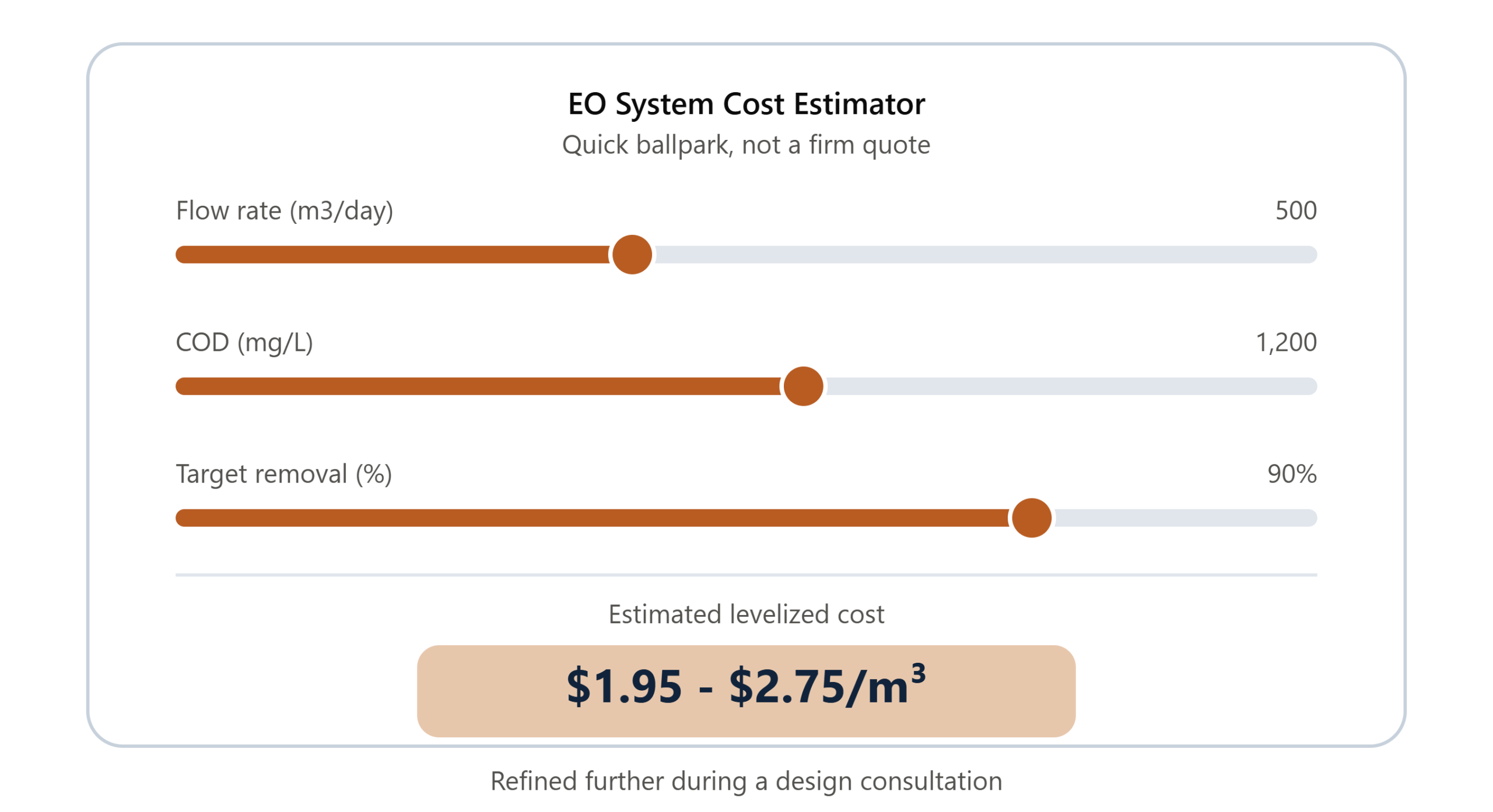
Tell us your application parameters and we return an indicative capital and operating cost range within 2 business days, a quick ballpark on levelized cost per cubic meter, built from three inputs. Useful for an early gut-check, not a substitute for a firm quote. — formatted for feasibility studies and capital appropriation.
Why This Matters
Before a pilot test or a design consultation, most people want a rough number: is this even in the right range for the budget. This estimator gives that number from a small set of inputs, using the same cost logic covered in the full operational cost modeling reference, simplified for a fast first pass.
It is intentionally conservative about what it claims. The output is a ballpark range, not a quote — the disclaimer on this page is not boilerplate, it is the actual scope of what three inputs can tell you.
What the estimate is and what it is not
A feasibility-stage range — not a number to put in a commercial contract
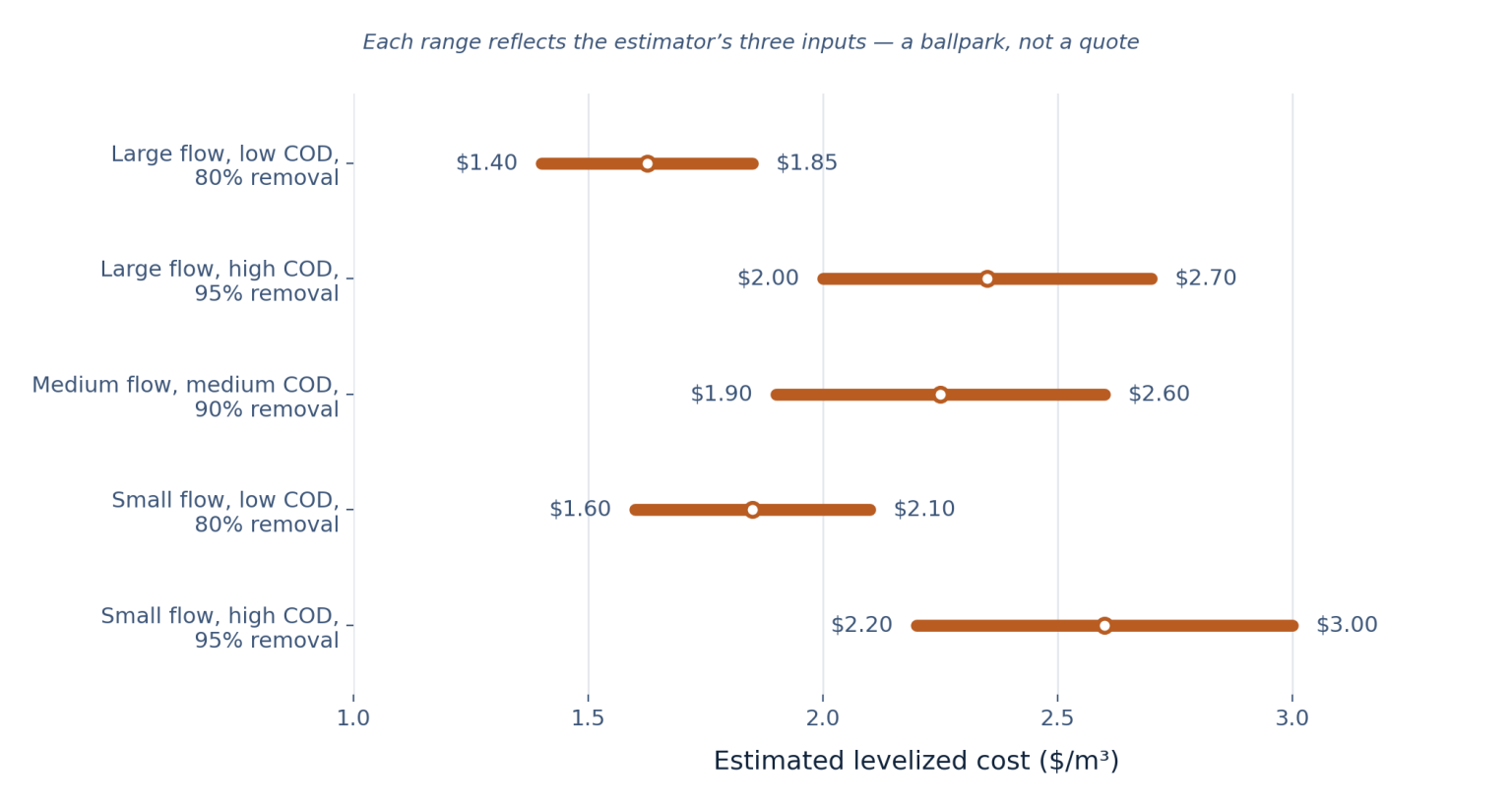
An indicative cost estimate gives you the order of magnitude and range you need to determine whether EO is in scope for your capital programme. It tells you whether you are looking at a £500k system or a £5M system — a distinction that matters enormously for project feasibility but cannot be determined from published cost-per-litre figures without knowing your specific matrix parameters. The estimate is intentionally conservative — it will not understate the cost to win your interest. A cost estimate that surprises you upward when a firm quotation arrives is a cost estimate that was not useful.
Submit your cost estimate request
Provide your application parameters
Provide as much of the following as you have. We will produce a tighter estimate range with more data, and flag assumptions clearly in the document where data is missing. No data is too incomplete to start.
How the estimate works
How the estimate is produced
3 Inputs to Start
Flow rate, influent COD/TOC, and target removal percentage produce a first ballpark range
Instant Ballpark Range
A $/m³ range based on typical industrial assumptions, not your specific matrix
Full Model Available
The complete levelized cost methodology is covered in the operational cost modeling reference
Contact name and organisation *
Preferred Email Address and contact number *
Application type *
Design flow rate *
Target contaminant and removal requirement *
Matrix conductivity
Matrix chloride and COD
Bench or pilot charge density
Site electricity cost
Preferred output currency
Use of the estimate
Estimate document returned within 2 business days. The document states all assumptions, the data gaps that widen the range, and the steps required to narrow it.
Your data is secure
We do not share your information with third parties. Submission triggers a direct response from our engineering team — not a sales sequence.
Response within 2 business days
Every submission is reviewed by an engineer, not a sales representative. You will receive a substantive response — not a product brochure.
NDA available on request
For proprietary matrix compositions or undisclosed site locations, we are happy to sign an NDA before you share characterisation data.
How the estimate works
How the estimate is produced
1
Application type and flow rate
Places your project against comparable bench-validated projects for that contaminant class and sets the initial order-of-magnitude range.
2
Charge density assumption
Pending your own bench data, a validated charge-density range from comparable streams is applied instead of a single assumed number.
3
Energy and reagent cost model
The kWh/m³ range is converted to an annual OpEx range using your site electricity cost, or a published grid rate if none is given.
4
Capital and installation allowance
Electrode and power-supply hardware cost plus a regional installation allowance, expressed as a range rather than a single figure.
Indicative cost ranges
Where EO systems typically sit for common application types
Note: these are illustrative ranges for order-of-magnitude context only. Your actual estimate will be based on your specific parameters. Ranges vary widely within each application type depending on matrix conductivity, flow rate, and removal target.
PFAS destruction (BDD, post-biological leachate, 50 m³/hr)
Indicative installed capital: $600k–$1.4M. Annual OpEx: $400k–$700k. Unit cost: $0.90–$1.60/m³. Energy fraction: 75–85%.
Pharmaceutical micropollutant polishing (BDD, clean secondary effluent, 500 m³/hr)
Indicative installed capital: $1.8M–$4.5M. Annual OpEx: $800k–$1.8M. Unit cost: $0.17–$0.37/m³. Energy fraction: 65–75%.
Textile decolorisation (DSA/MMO, high-chloride reactive dyeing effluent, 100 m³/hr)
Indicative installed capital: $250k–$700k. Annual OpEx: $150k–$450k. Unit cost: $0.17–$0.51/m³. Lower capital than BDD; lower energy due to active chlorine pathway in high-Cl⁻ matrix.
Cyanide destruction (MMO, electroplating rinse stream, 10 m³/hr)
Indicative installed capital: $80k–$220k. Annual OpEx: $40k–$120k. Unit cost: $0.46–$1.37/m³. Small system, low flow — cost per m³ higher due to fixed system costs at low volume.
Why the ranges are wide
±40% is the correct uncertainty range for feasibility-stage estimates without bench data. The primary uncertainty drivers are: (1) matrix conductivity — a 10× conductivity difference produces a 5–8× energy cost difference; (2) electrode service life — 5 vs 8 years changes the electrode annuity by 60%; (3) installation cost — site-specific civil, structural, and electrical work can range from 20% to 60% of equipment cost.
How to narrow the range
Every additional data point provided at the estimate request stage tightens the range. Matrix conductivity alone narrows the energy cost estimate from ±40% to ±20%. A confirmed bench charge density narrows the electrode area estimate from ±35% to ±15%. A pilot programme narrows the capital estimate to ±15–20% — the range appropriate for a capital appropriation request.
After the estimate
If the estimate range is within your project budget, the next step is a bench programme to establish the actual charge density and energy consumption for your matrix. If the range is already outside your budget, the estimate document will identify whether parameter changes (biological pre-treatment, electrolyte addition, different electrode configuration) could bring it within scope.
Go deeper before finalizing a number via EO system cost estimator
The full levelized $/m³ methodology this estimator simplifies, including sensitivity analysis
Confirm the underlying feasibility case before you build a budget around this estimate.
See how this ballpark compares against other treatment technologies for the same target.
Common questions
Cost Estimator FAQ
From cost estimate to next steps
Where does this take you next?
Estimate looks promising
Replace the assumed inputs with real data from your own matrix.
Need firm numbers now
Skip to a design consultation if you already have enough data to size a system.
Comparing technologies
See how EO’s ballpark stacks up against other options before committing further.
Ready for an indicative cost range?
Use the estimate request form above. We will return a document within 2 business days — with all assumptions stated, all data gaps identified, and the range clearly bounded. Or you can simply send us your flow rate, matrix details, and target removal, and we will build a tighter cost range than the quick estimator can provide on its own.
Minimum inputs for a useful estimate
- Application type and target contaminant
- Design flow rate (m³/hr)
- Matrix conductivity (µS/cm) — the most important single parameter for energy cost
- Site electricity cost if known — or country for published grid rate reference
Cost estimates produced through this page are indicative — appropriate for feasibility studies and capital budget modelling. They are not firm quotations, not engineering designs, and not procurement documents. A firm quotation requires a completed bench test, pilot data, and a full system design. Estimates are based on current market pricing for BDD electrodes and industrial electricity rates — both of which change. The estimate document states all assumptions explicitly. Reviewed for technical accuracy and engineering aspects by Janeczka Kowalski, Process / Electrochemical Engineering Director with Evoaeo.