Electrochemical Oxidation / Engineering & System Design / System Integration
Integrating EO with Upstream and Downstream Processes
Electrochemical oxidation rarely stands alone in a treatment train. What comes before it protects the electrodes; what comes after it manages what EO produces as a side effect of treatment.
.png)
Why This Matters
Electrochemical oxidation is most cost-effective as a polishing or targeted-removal step, not as a standalone treatment for high-strength or high-solids wastewater. Positioning it correctly in a treatment train, with the right pretreatment ahead of it and the right handling downstream, has more influence on total system cost than almost any reactor-level design decision.
Our engineering team found out that the two failure patterns are mirror images of each other: under-protecting the electrodes with inadequate pretreatment, and under-managing what the process generates — chlorine byproducts, hydrogen gas, heat — once it leaves the reactor.
Pretreatment Requirements
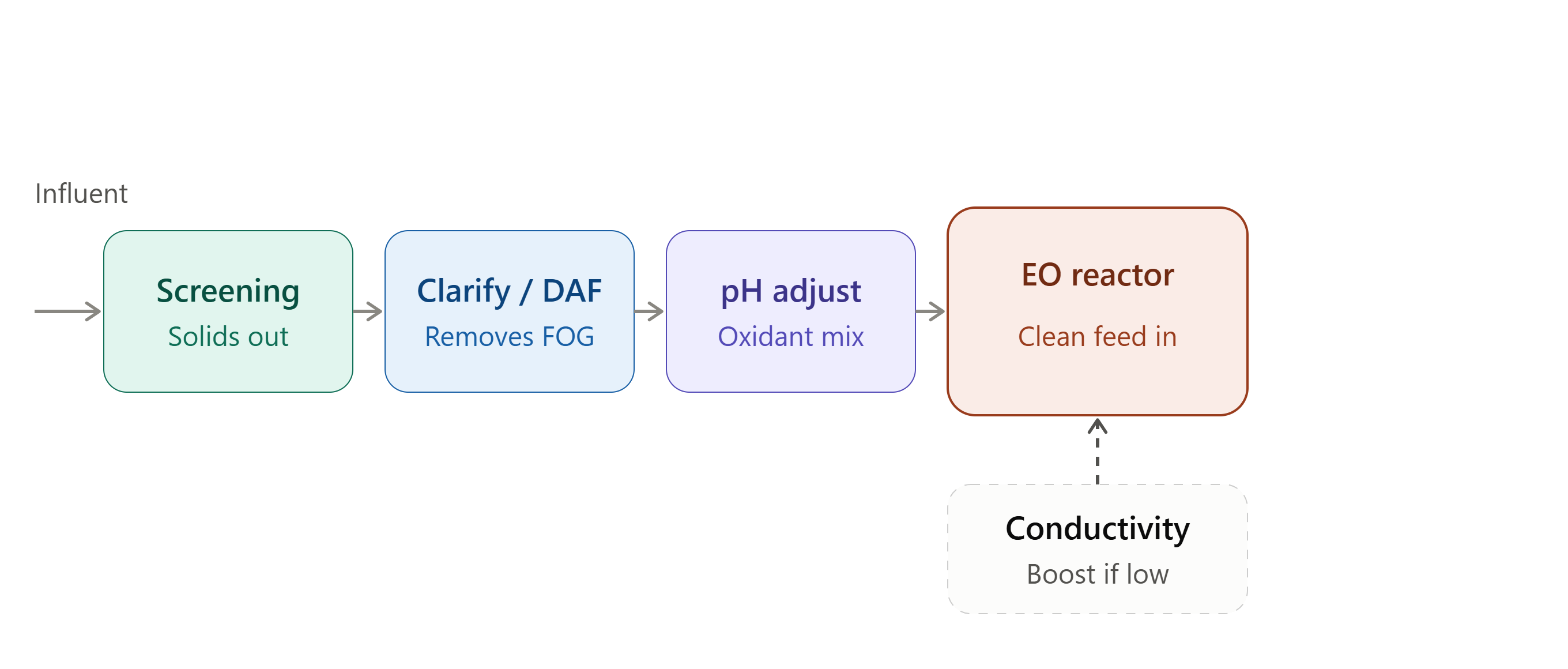
Suspended solids and oil/grease are the two most common causes of premature electrode fouling. Solids blind the electrode surface and increase local current density on the remaining exposed area; oil and grease coat the surface directly and act as an insulating film. A clarifier, DAF unit, or bag/cartridge filtration stage ahead of EO is standard practice for any stream with meaningful TSS or FOG loading, not an optional add-on.
pH adjustment ahead of EO matters for two reasons: it affects which oxidant species dominate (hypochlorous acid vs hypochlorite ion in chloride-containing streams, for example), and extreme pH can accelerate coating degradation on some electrode chemistries. Conductivity is worth checking as well — very low-conductivity streams may need a conductivity boost ahead of EO to avoid an uneconomical ohmic loss penalty, which ties directly back to the energy optimization considerations elsewhere in this cluster.
EO as a Polishing Step After Biological Treatment
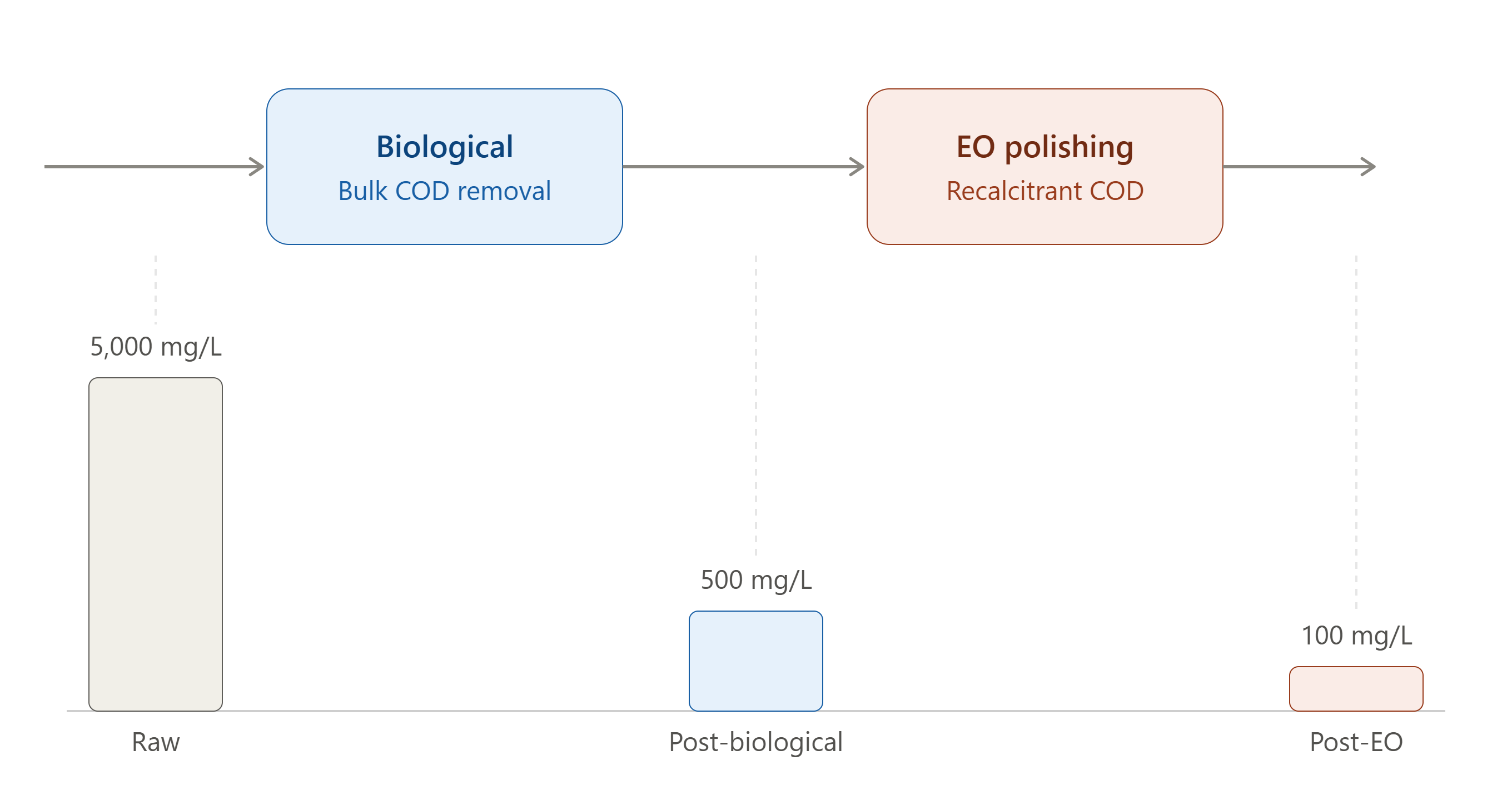
Biological treatment (activated sludge, MBBR, MBR) is generally the more cost-effective way to remove bulk biodegradable COD. EO earns its keep on what biological treatment leaves behind: recalcitrant or non-biodegradable COD, color bodies, and specific micropollutants that resist microbial degradation. Running EO on raw high-strength influent instead of as a post-biological polishing step usually means paying electrochemical treatment costs for load that biological treatment would have removed far more cheaply.
This sequencing also protects the EO electrodes indirectly, since biological treatment typically reduces both organic loading and solids carryover before the stream reaches the electrodes.
Hybrid Combinations: EO with Ozone, UV, or Fenton
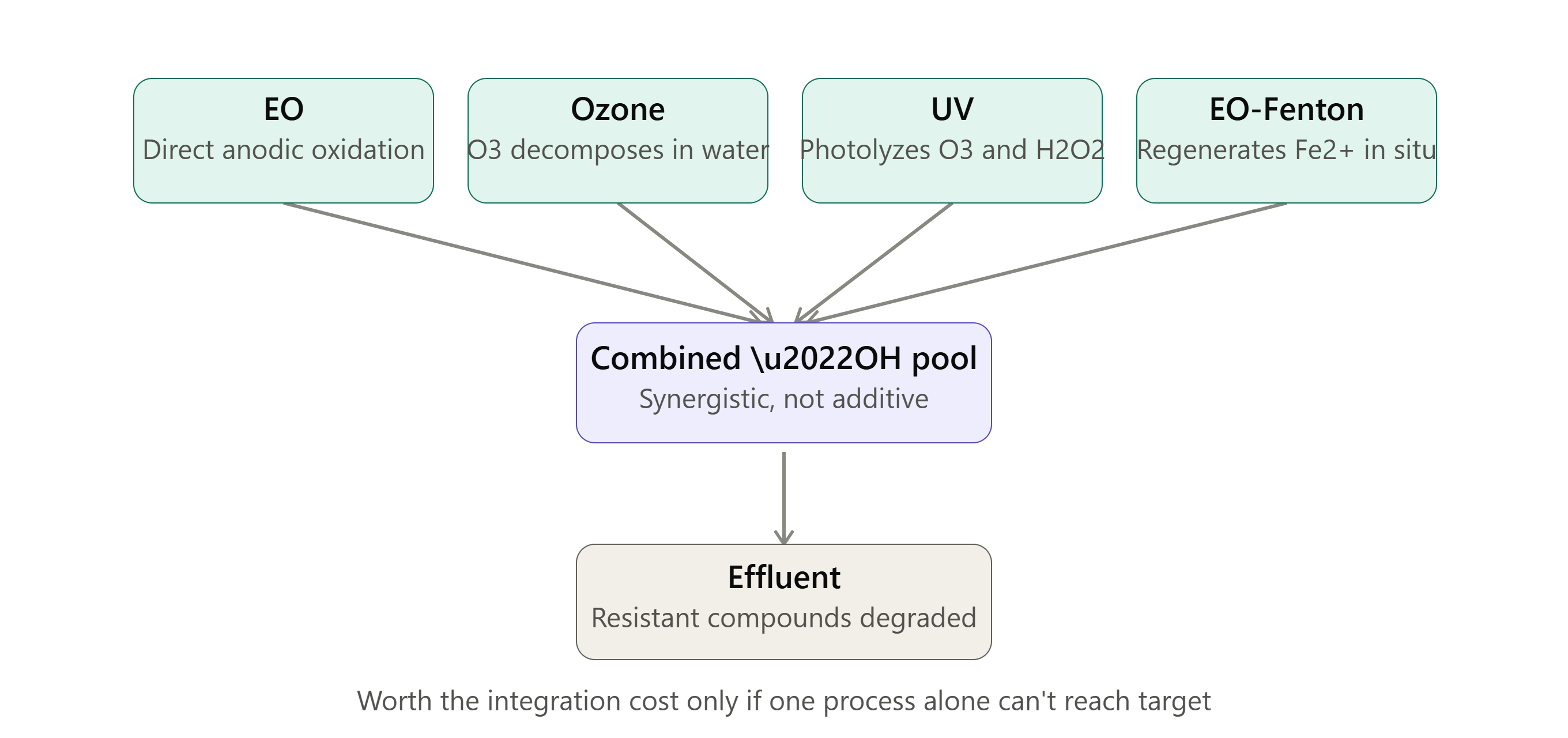
EO pairs well with ozone and UV because all three generate hydroxyl radicals through different mechanisms, and combining them can achieve synergistic — not merely additive — degradation of resistant compounds, sometimes at lower total energy input than pushing EO alone to the same endpoint. EO-Fenton hybrids use the electrochemical cell to regenerate ferrous iron in situ, extending the Fenton reaction without continuous fresh iron dosing.
The integration cost is real, though: additional dosing/generation equipment, more complex control logic, and more points of failure than a single-process train. These combinations tend to make sense specifically where a single process cannot economically reach the required removal target, not as a default design choice.
Downstream Requirements: Dechlorination, Degassing, and Safety
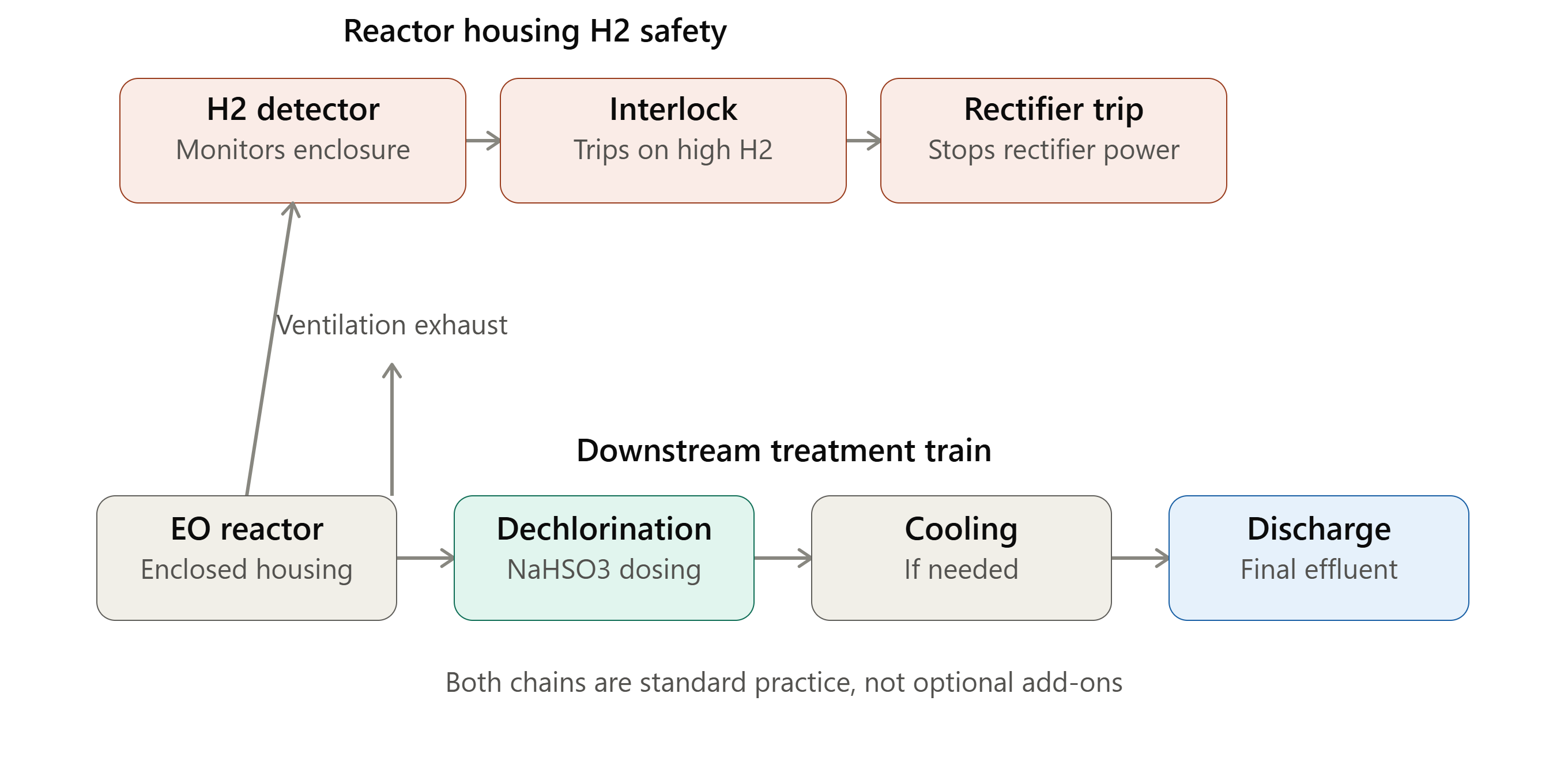
On chloride-containing streams, EO can leave residual active chlorine (as free chlorine or chloramines) in the effluent. If the discharge permit has a chlorine residual limit, or the water goes to a biological process downstream that chlorine would damage, a dechlorination step — sodium bisulfite dosing is common — needs to be part of the design, not an afterthought discovered during permit review.
Hydrogen gas evolved at the cathode is a genuine safety consideration, particularly in enclosed reactor housings or confined equipment rooms. Adequate ventilation, gas detection, and interlocks that shut down the rectifier on high hydrogen concentration are standard engineering practice, not an optional safety add-on. Heat generated by the process (both resistive and reaction heat) may also need a cooling or heat-exchange step if the effluent temperature rise would exceed downstream process or discharge limits.
Pretreatment Priority
TSS and FOG removal ahead of EO prevents the most common cause of premature electrode fouling
Best Positioning
EO as a polishing step after biological treatment, targeting recalcitrant COD rather than bulk load
Safety Requirement
Hydrogen gas detection and rectifier interlock at the reactor housing, not an optional add-on
See how EO stacks up before you commit to a train layout
Compare EO against ozone, Fenton, and biological options for where it earns its place in a train.
Engineering Process
Where system integration sits in the full bench-to-commercial sequence.
Confirm pretreatment requirements on your actual matrix before finalizing the train layout.
Where EO Fits in the Treatment Train
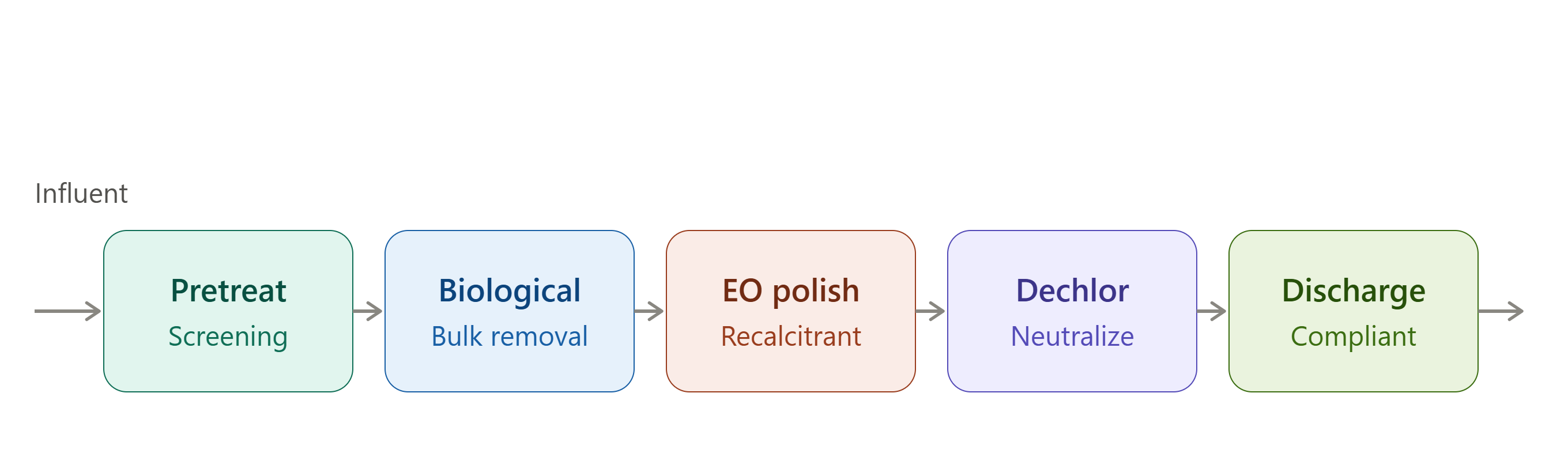
Solids and FOG removal, pH adjustment, and conductivity check ahead of the EO reactor to protect electrode surface and control ohmic loss.
Ozone, UV, or Fenton combinations for streams where a single process cannot economically reach the removal target on its own.
Dechlorination if a chlorine residual limit applies, hydrogen gas ventilation and detection, and heat management if temperature rise exceeds discharge limits.
Common System Integration Mistakes
This usually means paying electrochemical treatment costs for organic load that biological treatment would remove at a fraction of the energy cost per kg COD.
Discovering a chlorine residual limit during permit review, after the process train is already built, is a common and avoidable rework cause.
Confined equipment rooms with an EO reactor need gas detection and rectifier interlocks as standard design, not a value-engineering cut.
Low-conductivity influent without a conductivity boost step can make an otherwise well-designed EO reactor uneconomical purely on ohmic loss.
Where does this take you next?
Rational decision making about system integration actually depend on what is already on site. Where you go next follows from that
Train layout is set
Model what the full system costs to run once EO’s position is fixed.
Weighing EO against other tech
See a direct comparison against ozone, Fenton, and biological alternatives.
Unsure pretreatment is adequate
Treatability testing on your actual matrix will confirm what pre-treatment EO needs.
Map EO into your existing treatment train
Send us your process flow diagram and we will identify where EO fits, what pretreatment it needs, and what downstream handling to design in.
More in Engineering & System Design
Guide To Decision Gate