Technology Comparison: RO
Eelectro Oxidation Processes vs. Reverse Osmosis
Reverse osmosis and electrochemical oxidation solve fundamentally different problems on paper, which is exactly why they get compared so often in practice — one concentrates, the other destroys, and knowing which job your stream actually needs is the entire decision.
Reviewed for technical accuracy by Janeczka Kowalski, Process / Electrochemical Engineering. Figures and ranges on this page are engineering starting points — verify against your own pilot or vendor data before finalizing a design. The content is created by the Evoaeo engineering team led by Janeczka, All rights reserved.
How reverse osmosis actually works
Reverse osmosis is a separation technology, not a destruction technology
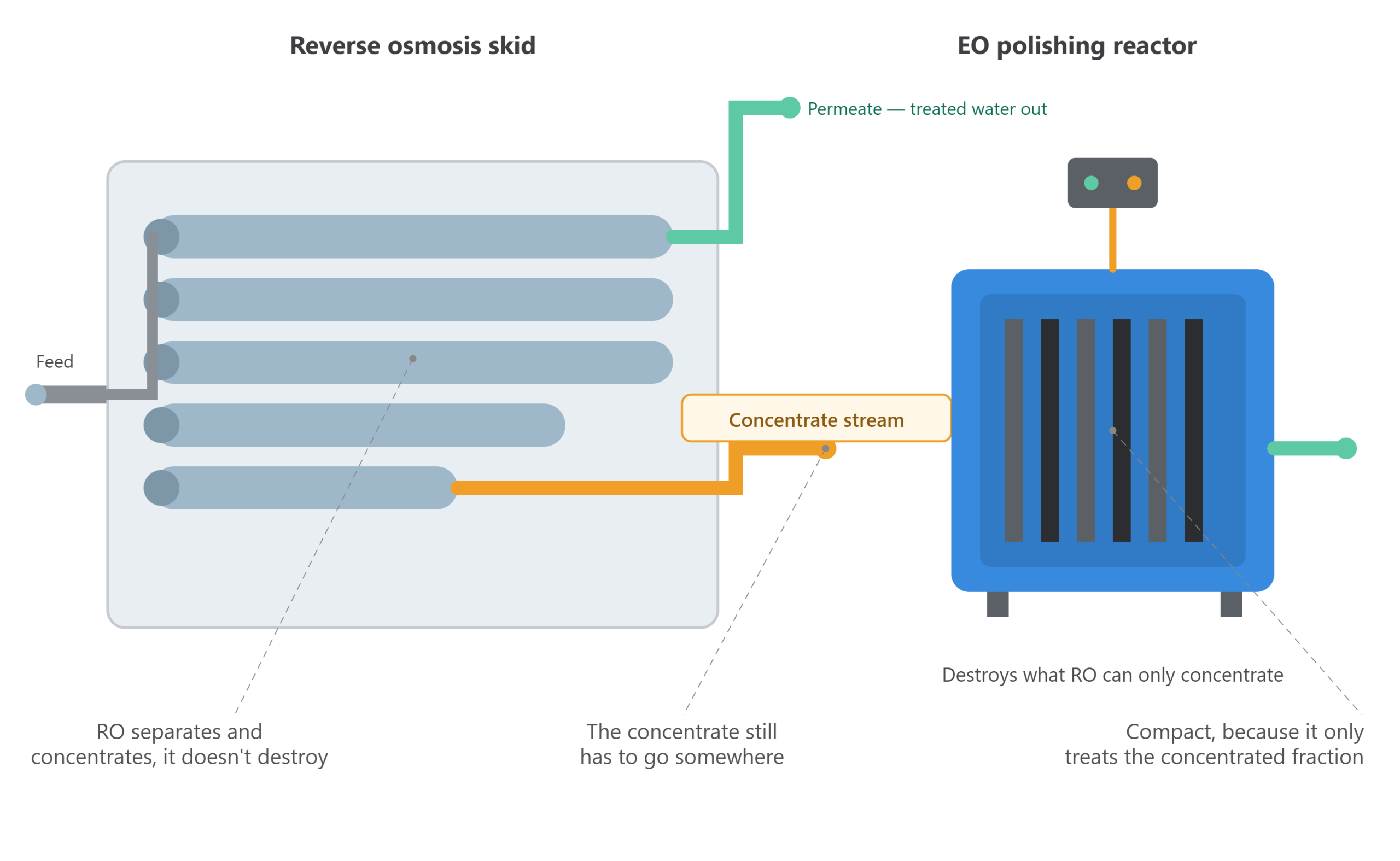
Reverse osmosis pushes water through a semi-permeable membrane at pressure well above natural osmotic pressure — typically 150 to 600 psi — rejecting roughly 99% of dissolved and suspended species above about 200 g/mol molecular weight: salts, heavy metals, particulates, and typical pathogens. The membrane functions less like a filter and more like a selectively controlled barrier, allowing water molecules through while restraining everything above that size threshold. Nothing is destroyed in that process; every rejected pollutant ends up concentrated in the reject/brine stream rather than eliminated, while the purified permeate passes through for reuse or discharge. EO works on the opposite principle: applied current drives oxidation reactions that break organic pollutants down toward CO₂ and water, destroying the compound rather than relocating it into a smaller-volume stream that still needs to go somewhere.
Where RO genuinely excels
High-quality permeate, compact footprint, and a real ZLD enabler
RO produces extremely high-quality permeate suitable for industrial reuse (boiler feed water, municipal reuse, agricultural application), and it’s genuinely effective at removing total dissolved solids, heavy metals, bacteria, and viruses in a single pass. Despite a substantial upfront capital cost, RO units are compact, modular, and largely self-contained, demanding relatively little operator interaction once commissioned — a real advantage for facilities with limited space or staffing for continuous monitoring.
Modern RO systems can remove upward of 99% of many pollutant classes, which is precisely why RO shows up so often in Zero Liquid Discharge (ZLD) system designs: it does the heavy lifting on volume reduction and water reuse, slashing raw water intake and discharge volume, and helping facilities meet strict environmental limits that would otherwise be difficult to hit through discharge alone.
Where RO’s application range actually extends
Far beyond a single use case
RO’s application range is broader than most facilities initially assume: municipal and residential drinking water purification (particularly effective on fluoride, lead, arsenic, and nitrate), desalination of seawater and brackish water for coastal facilities and vessels, mineral removal for boiler feed water to prevent scale and corrosion, and production of ultrapure water for semiconductor and pharmaceutical manufacturing. On the industrial wastewater side, RO recovers water and removes heavy metals — copper, zinc, nickel, chromium — from metal finishing and electroplating effluent, concentrates wastewater from food, beverage, and pulp & paper processing to recover roughly 80–90% of process water, and handles high-TDS effluent streams such as flue gas desulfurization (FGD) wastewater.
- Drinking water purification: fluoride, lead, arsenic, nitrate removal
- Seawater and brackish water desalination for coastal facilities and vessels
- Boiler feed water preparation: mineral removal to prevent scale and corrosion
- Ultrapure water production for semiconductor and pharmaceutical manufacturing
- Heavy metal recovery (Cu, Zn, Ni, Cr) from metal finishing and electroplating wastewater
- Food, beverage, and pulp & paper process water concentration (80–90% recovery)
- High-TDS effluent treatment, including flue gas desulfurization (FGD) wastewater
Where RO runs into real limitations
Fouling, concentrate handling, and membrane chemistry vulnerabilities
Industrial effluent typically carries enough organic and inorganic load to cause membrane fouling and scaling, which drags down permeate flow and efficiency and demands frequent, often harsh chemical cleaning — in practice, this means most industrial influent needs dedicated pretreatment before it can even reach an RO membrane productively. The concentrate stream RO produces isn’t a solved problem either: it typically carries high levels of salts, heavy metals, and organic pollutants, meaning it requires its own post-treatment or disposal pathway rather than simply being discharged.
RO also isn’t selective the way a destruction technology can be — it rejects dissolved solids broadly, and residual chlorine or certain solvents can chemically degrade the polyamide membrane material itself, causing a permanent loss of selectivity and a shortened membrane lifespan. High-pressure pumps and periodic membrane replacement add ongoing capital and operating cost on top of the cleaning burden.
Engineering note
RO membranes are vulnerable to fouling and scaling from the same organic and inorganic load that EO is built to destroy — running EO as pretreatment ahead of RO, rather than only considering EO for the concentrate afterward, can materially extend membrane life and reduce chemical cleaning frequency on organically loaded influent.
Comparison #1: Contaminant type & concentration
What each technology is actually built to remove
Pollutant type and concentration level is the first and most fundamental factor in choosing between RO and EO. Reverse osmosis is built to remove dissolved inorganic salts and total dissolved solids from a wide range of industrial wastewater. Electrochemical oxidation, as a destruction approach, is built for persistent organic pollutants — high TOC, unfavorable COD:BOD ratios, dyes, and phenolic or other refractory organic compounds. Because these are genuinely different target classes, combining RO with EO in a complex wastewater stream is often the right answer rather than treating the choice as either/or, particularly with a BDD electrode as the core EO component for the organic fraction RO can’t touch.
Pollutant-by-pollutant comparison
How EO and Reverse Osmosis perform on the pollutants that matter
| Pollutant | EO | Reverse Osmosis | Engineering take |
|---|---|---|---|
| Dissolved salts / TDS | Not applicable — EO does not desalinate | Excellent — RO’s core function | This is the clearest case of non-overlapping capability on this entire comparison |
| Refractory organics (dyes, phenolics, high-TOC) | Excellent — destruction, not relocation | Concentrates only — rejects into brine stream, doesn’t eliminate | A membrane rejecting an organic pollutant still leaves it in the water system, just in a smaller volume |
| Heavy metals | Indirect at best — not EO’s primary mechanism | Excellent — high rejection based on molecular size/charge | RO is the more direct tool here; EO isn’t the right technology for metals removal alone |
| Pathogens / microorganisms | Good — via chlorine-mediated disinfection pathway | Excellent — physical size-exclusion barrier | Different mechanisms reaching a similar outcome; RO’s barrier is more absolute for reuse specifications requiring guaranteed exclusion |
| PFAS | Excellent (BDD) — genuine destruction | Concentrates only — does not destroy | See our EO vs. Membrane Filtration page for the full PFAS-specific concentrate-liability analysis and CERCLA context |
Decision Gate Guidance Regarding PFAS
Our EO vs. Membrane Filtration comparison page already covers the PFAS-specific version of this comparison in depth — concentrate disposal liability under CERCLA, permit trends narrowing deep-well injection, and the specific NF/RO-reject sizing math for PFAS destruction. That page is the right destination for a PFAS-driven decision; this page is the right destination for the general RO-versus-EO mechanism and recovery-rate question independent of PFAS.
Comparison #2: Water recovery
A meaningful gap with real disposal-cost consequences
Water recovery matters directly given how universal water scarcity concerns have become, and the two technologies land in genuinely different ranges. EO is usually the stronger performer for high-recovery applications, commonly achieving 85–95% recovery, which matters most where minimizing reject volume is the priority. Reverse osmosis generally operates in the 50–85% recovery range, and while modern high-efficiency RO technology can reach 80–90% under favorable conditions, ongoing RO operation still generates a concentrate stream that requires further treatment — a downstream cost EO’s destruction-based approach doesn’t carry in the same way.
Comparison #3: Operation & maintenance
Lower power draw vs. lower mechanical upkeep
RO requires high-pressure pumps to overcome osmotic pressure, but because it relies on pressure and semi-permeable membranes rather than continuous high electrical load, its power consumption is comparatively lower than EO, which relies on direct current and demands a substantial amount of electric power to drive oxidation reactions. The trade-off runs the other direction on mechanical upkeep: RO requires frequent membrane replacement and maintenance due to the fouling and scaling covered above, plus the recurring cost of chemical cleaning, while EO requires no filtration media or membrane at all, which generally means less scheduled downtime for media/membrane replacement.
Comparison #4: Pretreatment requirements
What has to happen before EO can work efficiently
Pretreatment ahead of EO exists to reduce the energy-intensive burden of high COD, organic load, and large solids, which in turn improves electrolyte conductivity and overall EO efficiency. Sedimentation and filtration remove total suspended solids and cut organic load before the stream reaches the electrochemical cell, directly boosting efficiency against the recalcitrant pollutants EO is meant to destroy. Ultrafiltration paired with chemical treatment and pH adjustment removes suspended solids, turbidity, pathogens, and large-molecular-weight organics, while also preventing membrane fouling and inorganic scaling and supporting dechlorination and salt-solubility optimization where RO is part of the same treatment train. EO is particularly effective specifically on RO concentrate — reducing the toxic, persistent pollutants that concentrate carries and that are refractory to most other treatment approaches.
Combining the two
RO concentrate as a genuinely favorable EO feedstock, and how the combination gets built
RO concentrate is often disposal-constrained precisely because it’s small in volume but carries everything the membrane rejected — and that same concentration works in EO’s favor, since higher salinity and conductivity generally improve EO’s energy efficiency rather than hurting it. Treating only the concentrate fraction with EO, rather than sizing EO for full original flow, is usually the more economical combination architecture: RO handles the bulk dissolved-solids separation at high volume, EO destroys the concentrated recalcitrant organic fraction left behind.
This is the same underlying logic covered in more regulatory-specific depth on our EO vs. Membrane Filtration page, which focuses on PFAS-laden NF/RO concentrate specifically and the CERCLA liability considerations driving that particular combination — this page covers the general mechanism and recovery-rate comparison across RO applications broadly, not just the PFAS-concentrate case.
- Step 1 — Treatability evaluation and engineering appraisal of your specific RO concentrate or effluent
- Step 2 — A treatability trial outlining the pilot project scope with electro oxidation trial equipment
- Step 3 — Full-scale implementation of the combined reverse osmosis and electro oxidation hybrid system
Related comparisons
Where this decision connects to others
Grounded in the literature
This comparison reflects published research, not just our own field data
The mechanisms and performance patterns described on this page are consistent with the peer-reviewed environmental engineering literature — journals including Water Research, Chemosphere, the Journal of Hazardous Materials, Environmental Science & Technology, and the Chemical Engineering Journal regularly publish comparative studies on electrochemical and membrane-based treatment technologies. Our engineering team tracks this literature as part of how we validate bench and pilot results against the broader research base, and can provide specific citations relevant to your stream on request.
Working through an RO concentrate stream, or weighing RO against EO for a new design?
Send us your stream data and we’ll respond with an engineering read — no obligation.