Home › Products › Electrochemical Oxidation EO Pilot Modules
Electrochemical Oxidation EO Pilot Modules
Field-deployable electrochemical cells for piloting oxidation, disinfection, and recalcitrant-COD destruction on your actual wastewater before you commit to a full-scale design. These are sized a step up from bench trial units, built to run continuously on a skid at your site and generate the kind of performance data a full-scale design actually needs. Browse the configurations below, or work through the selection guide further down to narrow in on the electrode chemistry and current density range that fits your water.
Written by and reviewed for technical accuracy by Janeczka Kowalski, Process / Electrochemical Engineering. Figures and ranges on this page are engineering starting points — verify against your own pilot or vendor data before finalizing a design.
Everything on this page is engineering and product information written for process engineers, environmental professionals, and technical buyers. It isn’t a substitute for a site-specific engineering, electrical, and process-hazard review, or advice from a licensed professional engineer in your jurisdiction. Hydrogen off-gas handling, electrical area classification, and byproduct discharge limits vary by location and application, so confirm compliance with your regulatory authority before specifying or installing any unit.
What Does The EO Pilot Modules Page Covers
- ✓What electrochemical oxidation is and how it differs from biological or chemical treatment
- ✓How anode and cathode chemistry drives performance, energy use, and byproduct risk
- ✓Where EO pilot modules fit, and where they don’t, across industrial wastewater applications
- ✓A structured guide for choosing between electrode types and configurations before you pilot
- ✓Practical deployment, safety, and pilot-to-full-scale guidance
What Is Electrochemical Oxidation?
Electrochemical oxidation (EO) is an advanced oxidation process that runs a current across a pair of electrodes, an anode and a cathode, submerged directly in the wastewater. Organic contaminants break down and pathogens get inactivated without dosing in oxidizing chemicals from an outside supply chain. Two overlapping pathways do the work:
Direct oxidation happens when pollutant molecules adsorb onto the anode surface and get oxidized by direct electron transfer. This pathway is limited by how fast contaminants reach the electrode surface, so it tends to be selective: effective on some compounds, barely touching others.
Indirect (mediated) oxidation happens when the current generates strong oxidants in the water itself, most often hydroxyl radicals at high-overpotential anode surfaces, and, where chloride is present, active chlorine species from chloride oxidation at the anode. These oxidants then react with pollutants throughout the bulk solution rather than just at the electrode surface, which is exactly why chloride content is one of the first things worth characterizing before picking a module.
Get a better and in-depth comprehension about electrochemical oxidation wastewater treatment processes mechanism hub.
Engineering View: How EO Pilot Modules Work
Electrode Chemistry Drives Everything
Anode material decides whether a cell behaves as an active or non-active electrode, which in turn drives mechanism, selectivity, energy consumption, and how deep the mineralization goes:
| Anode Type | Behavior | Typical Use Case | Key Consideration |
|---|---|---|---|
| Mixed Metal Oxide (MMO) — e.g. Ti/IrO₂, Ti/RuO₂ | Active: low oxygen overpotential, favors chlorine-mediated oxidation when chloride is present | Disinfection, moderate COD reduction, chloride-rich streams | Lower energy cost per unit removed, but incomplete mineralization and byproduct risk from chloride chemistry |
| Boron-Doped Diamond (BDD) electrode | Non-active: high oxygen overpotential, favors hydroxyl radical generation and near-complete mineralization to CO₂ | Recalcitrant COD, PFAS destruction, low-chloride streams | Higher capital and energy cost, more fragile substrate, but mineralizes compounds other technologies can’t touch |
| Legacy PbO₂ | Non-active, historically used for high oxidation power | Largely phased out | Lead-leaching risk. Avoid for new installations, and flag immediately if evaluating older or used equipment |
Current Density, Voltage, and Energy Consumption
Performance and energy draw scale with applied current density, typically expressed in mA per square centimeter of active electrode area, not just flow rate. Push current density higher and oxidation and disinfection speed up, but energy consumption doesn’t scale in a straight line. Past a certain point, side reactions, mainly oxygen evolution and, at the cathode, hydrogen evolution, start eating current without doing any useful oxidation work. That’s exactly why piloting at multiple current densities, rather than one fixed setpoint, is the single most useful thing a pilot run can tell you before full-scale sizing: it shows you where diminishing returns kick in for your specific water.
Reported energy consumption for EO varies widely in the literature, typically somewhere from a few to several tens of kWh per kg of COD removed, and it depends heavily on influent chloride content, target contaminant, and how deep a removal you need. Treat any vendor-quoted energy figure as specific to their test conditions until you’ve checked it against your own pilot data. This is exactly the kind of number that shouldn’t get extrapolated from a datasheet written for a different water matrix.
Cell & Flow Configuration
Pilot modules typically run as either plate-and-frame stacks (parallel electrode plates with fixed gap spacing) or tubular/concentric configurations. Plate-and-frame designs are easier to inspect and reconfigure between pilot runs, which matters when you’re testing more than one electrode gap or material. Flow can be run in batch recirculation, where a fixed volume cycles through the cell repeatedly and you track removal against total charge passed, or continuous flow-through, which mimics a full-scale hydraulic profile more closely but needs a larger feed volume to run a meaningful trial. Most treatability programs start in batch mode to establish kinetics, then move to continuous-flow testing once a target electrode chemistry and current density are locked in.
Application View: Where EO Pilot Modules Fit
Electrochemical oxidation isn’t a universal replacement for biological or conventional physicochemical treatment. It earns its place where recalcitrant, toxic, or poorly biodegradable contaminants make conventional treatment slow, ineffective, or simply nonexistent as an option. The strongest fit patterns:
Landfill Leachate
High recalcitrant COD and ammonia-nitrogen loads that resist biological treatment, particularly on aged leachate with a low BOD:COD ratio.
PFAS-Impacted Water
BDD-electrode EO is one of the few technologies capable of direct mineralization (defluorination) of PFAS rather than just moving it to another phase. An active area of pilot-stage deployment, not yet a mature commercial default.
Textile and Dye Wastewater
Chromophore destruction and color removal where conventional coagulation struggles with soluble, reactive dyes.
Pharmaceutical / API Wastewater
Destruction of active pharmaceutical ingredients and process intermediates that are toxic to conventional activated sludge biomass.
Cyanide-Bearing Wastewater
Oxidative destruction of free and complexed cyanide, common in metal finishing and mining effluent.
RO Concentrate / ZLD Polishing
Pretreatment or polishing step to cut recalcitrant organics ahead of evaporation and crystallization in zero liquid discharge trains.
Explore EO Pilot Module Configurations
New pilot configurations get added to this line as they’re validated. The cards below show how the collection is laid out; wire the query above them to your product taxonomy and it populates automatically as new modules are published.
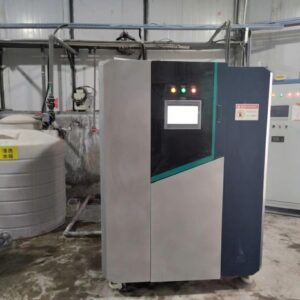
Evoaeo EO Pilot Module
Pilot scale electro oxidation · Fully automatic Electro oxidation wastewater treatment unit, a compact system for wastewater treatment via electro oxidation process development, ready to operate consistently to treat various complex industrial effluents.
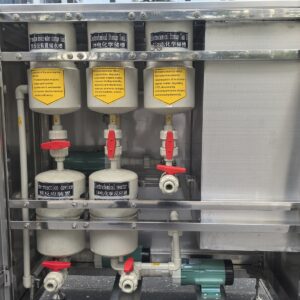
EO Bench Module — Coming Soon
BDD anode/MMO cathode · PLC control We are developing various types of elecrtochemical oxidation wastewater treatment system and equipment suitable for applications of different industry and business sectors, stay tune with us.
How the Pilot Configurations Compare
| Single-Stack MMO | 20–80 L/min · MMO electrodes · Chloride-rich streams, disinfection, moderate COD |
| BDD Recalcitrant-COD | 20–80 L/min · BDD electrodes · PFAS, recalcitrant organics, low-chloride streams |
| Multi-Bay Comparative | 20–60 L/min per bay · Up to 3 electrode types in parallel · Side-by-side chemistry screening |
| High-Flow Field Skid | 80–250 L/min · Configurable chemistry · Extended field campaigns, near design-basis flow |
*Disclaimer: Dual to constant technical update with our electrochemical oxidation wastewater treatment products, the data and information within the comparison table might not necessarily reflect the actual product parameters of our electro oxidation EO pilot modules, in this case, please do contact our sales and engineering team for the available products, we reserve the rights to release or demonstrate all the product information.
Purchase Decision Guide
Picking the right pilot configuration usually comes down to five questions, worked through in roughly this order.
- What’s driving the pilot? A short chemistry-screening run and a multi-month campaign meant to generate full-scale design data call for different configurations. Get clear on the goal before comparing electrode types.
- Characterize your wastewater, chloride and bromide especially. Chloride content alone often decides between MMO and BDD before anything else does. Run pH, conductivity, COD/TOC, and suspended solids alongside it.
- Decide whether you need to compare chemistries or you already know which one fits. If you’re still choosing between MMO and BDD, the multi-bay comparative unit answers that question in one campaign instead of two sequential ones.
- Match flow rate to how representative the data needs to be. Smaller single-bay units are enough for kinetics and screening; the high-flow field skid gets you closer to design-basis hydraulics if that’s what your next funding gate requires.
- Confirm site logistics and power before committing to a configuration. Field skids need a power source, feed access, and drainage or containment; confirm these are available before the unit ships, not after it arrives.
Practical Application Guide
Pretreatment & Feed Conditioning
Suspended solids and oil/grease foul electrode surfaces fast, so screening or filtration ahead of the cell usually pays for itself in reduced cleaning frequency. If hardness or iron/manganese are elevated, expect scale to build on the cathode over time; softening or sequestration upstream extends the interval between cleanings. Feed a consistent flow rate into the pilot where possible; slug flows make it harder to correlate removal against charge passed, which is the number you actually need for scale-up.
Monitoring During Piloting
Track cell voltage and current continuously; a rising voltage trend at a fixed current usually means scaling or electrode fouling before it shows up anywhere else. Sample by charge dose passed through the cell rather than on a fixed time interval, since charge, not elapsed time, is what drives the chemistry. If chloride or bromide are present, test for chlorate, perchlorate, and bromate periodically through the run, not just at the end, so you catch a trend rather than a single data point.
Electrode Maintenance
Plan for periodic acid cleaning or mechanical cleaning of electrode surfaces; how often depends entirely on your water’s scaling potential, not a fixed calendar interval. BDD electrodes are more fragile than MMO and shouldn’t be scrubbed abrasively; check manufacturer cleaning guidance before improvising. Keep spare electrode sets on hand for a pilot campaign of any real length, since swapping a fouled or degraded electrode is far faster than trying to clean it back to baseline performance mid-run.
Safety & Regulatory Considerations
EO cells generate hydrogen at the cathode and oxygen at the anode. Both need proper ventilation, and enclosed installations typically require an electrical area classification review (NEC Class I or your local equivalent) before commissioning — this is not optional paperwork, it’s a genuine ignition-risk control.
Chlorate and perchlorate formation is a real risk on chloride-rich streams treated with active-chlorine mediated chemistry (MMO electrodes especially). Bromate is the analogous concern where bromide is present. Regulatory limits on these byproducts vary by jurisdiction and by what the treated water is used for afterward, so confirm requirements with your regulatory authority before finalizing a treatment approach or discharging pilot effluent.
This page reflects general engineering practice for electrochemical oxidation. It doesn’t substitute for a site-specific electrical safety review, a process hazard evaluation, or a conversation with whoever issues your discharge permit.
Frequently Asked Questions
Trial modules are bench-to-small-skid scale, meant for first-pass screening of whether EO works on your water at all. Pilot modules run at higher flow, for longer campaigns, and are built to generate the kind of cortinuous-flow performance data a full-scale design actually needs.
Chloride content is usually the deciding factor. If chloride is present and your discharge target can tolerate chlorine-mediated byproducts, MMO is cheaper to run. If you’re targeting PFAS, recalcitrant COD, or a lou-chloride stream, BDD’s hydroxyl-radical chemistry does more of the work.
Yes, that’s what the multi-bay comparative configuration is for. It runs multiple electrode types on the same feed at the same time, which removes a lot of the variability you’d get testing them sequentially in separate runs.
Removal kinetics at multiple current densities, specific energy consumption, byproduct formation data, and enough of a hydraulic performance record to size a full-scale system with real confidence.
Usually, yes, but it depends entirely on your local authority and what is in the water. Confirm with your regulator before discharging any pilot effluent, especially from chloride-rich runs where chlorate or perchlorate could be present.
Anywhere from a few weeks for chemistry screening to several months for a campaign meant to generate full design-basis data across seasonal water quality variation.
Sources & Standards Referenced
- ✓Peer-reviewed literature on electrochemical advanced oxidation processes (EAOPs): electrode materials, mechanisms, and byproduct formation
- ✓EPA guidance on advanced oxidation processes and emerging contaminant treatment
- ✓NEC (National Electrical Code) Class I hazardous location provisions, or the applicable local electrical code, for hydrogen off-gas area classification
- ✓OSHA process safety and hazardous gas exposure guidance
- ✓Standard Methods for the Examination of Water and Wastewater (APHA/AWWA/WEF): analytical methods for COD, TOC, residual chlorine, and halogenated byproducts
This page summarizes general engineering practice for electrochemical oxidation and doesn’t cite specific studies verbatim. Confirm current literature and the applicable code edition in your jurisdiction before finalizing a design.
Ready to Pilot an EO Module on Your Water?
Send your water quality data, chloride and bromide content especially, and we’ll recommend which electrode configuration to pilot first.
Talk to a Process Engineer
Not sure which pilot configuration fits, or ready to schedule a field deployment? Tell us about your wastewater and someone from engineering will follow up.