Comparison: EO vs Fenton
EO vs Fenton Process
Fenton and electro-Fenton are genuine alternatives to EO for some recalcitrant organic applications. This page defines where the comparison is real, where Fenton wins, and where EO’s operating profile is the better fit.
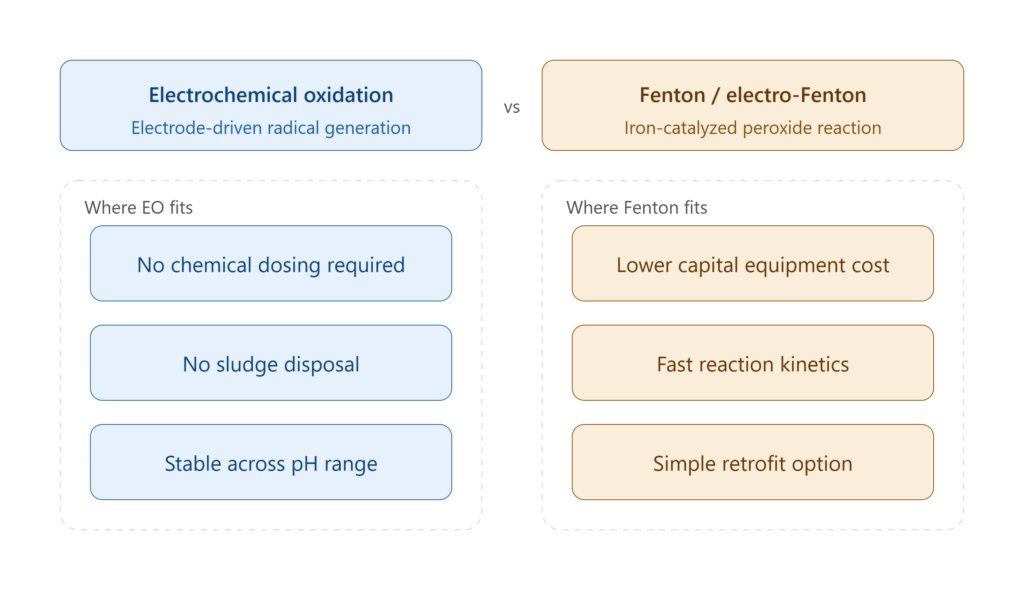
Shared mechanism, different constraints
Both generate hydroxyl radicals — from different sources
Fenton chemistry and electrochemical oxidation share the same primary oxidant — the hydroxyl radical (•OH). Fenton generates it through the reaction of H₂O₂ with Fe²⁺ ions; EO generates it electrochemically at the BDD anode. The shared mechanism means both can address the same recalcitrant organic compounds. The differences lie in the operating constraints each approach imposes: iron sludge management for Fenton, electrode maintenance for EO; continuous H₂O₂ and iron supply for Fenton, continuous electrical input for EO; pH sensitivity for Fenton, matrix conductivity requirements for EO.
Quick verdict
Which one actually fits your stream
Choose EO when
- You can't accept another sludge stream — iron hydroxide sludge from Fenton needs dewatering, handling, and disposal that compounds over the plant's life
- Continuous operation matters more than batch flexibility
- You want to avoid pH swings — Fenton needs an acidic environment (roughly pH 3) and neutralisation before discharge
- Reagent logistics — storing and dosing ferrous sulfate and hydrogen peroxide reliably — are a bigger operational headache at your site than running a rectifier
Choose Fenton when
- You need a fast, well-understood batch process and have tankage and staff for chemical dosing
- Iron sludge disposal is already a manageable, low-cost line item at your site
- Capital budget favours simple tanks and mixers over a rectifier and electrode stack
- Local reagent pricing (ferrous sulfate, peroxide) genuinely undercuts your electricity cost per kilogram removed
Where Fenton wins and where EO wins: quick suitability check
The conditions that determine the choice
The decision between Fenton and EO is typically made on three variables: iron sludge management cost, pH control feasibility, and whether PFAS is among the target compounds.
✓ EO is likely a fit when:
- No iron sludge tolerance: EO does not produce iron sludge from the electrochemical reaction
- PFAS in the target compound list: Fenton at conventional pH does not effectively activate C-F bonds — EO via BDD does
- Continuous chemical supply is a site constraint: EO requires no continuous H₂O₂ or iron reagent supply
- High-pH stream: Fenton operates at pH 2–4; if pre-acidification cost is prohibitive, EO's wider pH tolerance is advantageous
- Remote or operator-limited site: EO has simpler operational profile than Fenton reagent management
✕ EO is likely not a fit when:
- Low capital budget for a known, characterised stream where Fenton is already installed
- Target compounds that are highly susceptible to Fenton at moderate H₂O₂:Fe ratios (e.g. simple aromatic compounds, certain dyes)
- Iron sludge is manageable and the site already has sludge handling infrastructure
- Matrix is already at low pH — Fenton pre-acidification cost is minimal
- Target does NOT include PFAS and the compound is well-characterised in Fenton literature
Underneath the verdict
How they actually differ
Fenton’s reagent produces hydroxyl radicals homogeneously in solution through the reaction between ferrous iron and hydrogen peroxide, and it does it fast — reaction times are often measured in minutes once dosed correctly. That speed comes with two costs that don’t show up on a reagent price list until you’re running the plant: the iron has to be removed afterward as a hydroxide sludge, and the water usually needs acidifying before treatment and neutralising after.
Sludge dewatering and disposal is frequently the largest line item in a Fenton system’s real operating cost, not the peroxide itself. EO skips both of those steps — no iron to precipitate, no pH swing to manage around the reaction — at the cost of running continuous current and maintaining an anode with a finite service life.
The PFAS and iron sludge limits
Two specific Fenton limitations that resolve the comparison for PFAS-containing streams
Conventional Fenton operates at pH 2–4, which generates iron sludge during the neutralisation step — an iron hydroxide precipitate that must be separated, dewatered, and disposed of as a secondary waste stream. For PFAS-containing streams, this iron sludge requires PFAS-specific disposal — it will contain PFAS adsorbed from the treated water. Electro-Fenton generates H₂O₂ electrochemically at the cathode rather than from reagent addition, reducing chemical supply cost. However, it still produces iron sludge from the Fe²⁺/Fe³⁺ cycling, and the Fenton mechanism at conventional pH does not provide sufficient •OH potential for C-F bond activation in PFAS structures. BDD electrodes in EO operate at higher overpotential than the Fenton •OH generation potential — the mechanism difference that determines PFAS treatment capability.
Find out Why electrochemical oxidation is suitable for efficient PFAS removal when Fenton failed to deliver
- Conventional Fenton: iron sludge at neutralisation step — contains co-contaminants from treated stream
- PFAS-loaded iron sludge creates secondary disposal liability analogous to PFAS-loaded spent carbon
- Electro-Fenton: reduces chemical addition but retains iron sludge generation
- BDD electrode •OH generation potential exceeds Fenton reaction potential — relevant for C-F bond activation
- pH 2–4 requirement means pre-acidification cost must be included in the Fenton lifecycle cost comparison
Not always either/or
Can they work together?
Common questions
EO vs Fenton FAQ
No. Electro-Fenton is a specific electrochemical process in which H₂O₂ is generated at the cathode and reacts with added iron to produce Fenton hydroxyl radicals in the solution bulk. Electrochemical oxidation (anodic EO) generates •OH directly at the anode surface through water oxidation at high electrode potential. The two processes can be combined in a single cell — anodic oxidation at the BDD anode alongside cathodic H₂O₂ generation — which is sometimes called an electrochemical advanced oxidation process (EAOP) configuration. For industrial deployment, they are usually considered separately.
For high-strength biodegradable COD with a specific recalcitrant component, Fenton is often more cost-effective per unit COD removed on the biodegradable fraction. However, if the recalcitrant component is PFAS or another compound requiring BDD-level oxidation potential, EO addresses that fraction where Fenton fails. The comparison should be made on the specific recalcitrant compound target, not on total COD removal.
Does EO need iron or peroxide dosing like Fenton does?No — standard EO generates hydroxyl radicals directly at the anode without added chemicals. Some configurations pair EO with peroxide (electro-Fenton variants), but that’s a design choice, not a requirement.
On reagent cost alone, sometimes yes. Once you add iron sludge dewatering, disposal, and pH adjustment chemicals to the ledger, the comparison often narrows or reverses — cost it on your actual reagent and disposal pricing, not on peroxide cost per litre alone.
Yes, though it’s uncommon outside electro-Fenton configurations. More typically, a site picks one as the primary oxidation step and evaluates the other only if performance or cost targets aren’t met.
Fenton-informed
The comparison does not dismiss Fenton — it identifies the three specific conditions where EO's operating profile is the better fit.
PFAS mechanism stated
The reason Fenton does not address PFAS is stated mechanistically — overpotential, not dose.
Sludge cost explicit
Iron sludge management cost for PFAS-laden sludge is identified as a real secondary liability, not a footnote.
Level 1 Decision Gate
Where does this take you next?
Every page in the Decision Layer routes to one of three outcomes. Choose the path that matches where you are.
→ Yes — EO is a fit
Your contaminant is recalcitrant, your regulatory driver requires destruction, and the matrix is compatible. Move to treatability testing.
→ Not sure yet
You have answered some of the fit questions but not all. Use the Go / No-Go Checklist to work through the remaining decision variables.
→ No — EO is not the right fit
The contaminant is biodegradable, the scale is too large, or the driver does not require destruction. Review the alternatives.