Home -Research, Development & Engineering
Technology Research & Engineering
From BDD material science to wastewater systems that can be operated, Evoaeo connects boron-doped diamond electrode material development, electrochemical oxidation process engineering, and treatability validation for industrial wastewater that is difficult to treat by conventional means alone.Our research focus are: BDD electrode design, reaction pathways, reactor integration, process controls, and scale-up validation.
Reviewed for technical accuracy by Janeczka Kowalski, Process / Electrochemical Engineering. Figures and ranges on this page are engineering starting points — verify against your own pilot or vendor data before finalizing a design. The content is created by the Evoaeo engineering team led by Janeczka, All rights reserved.
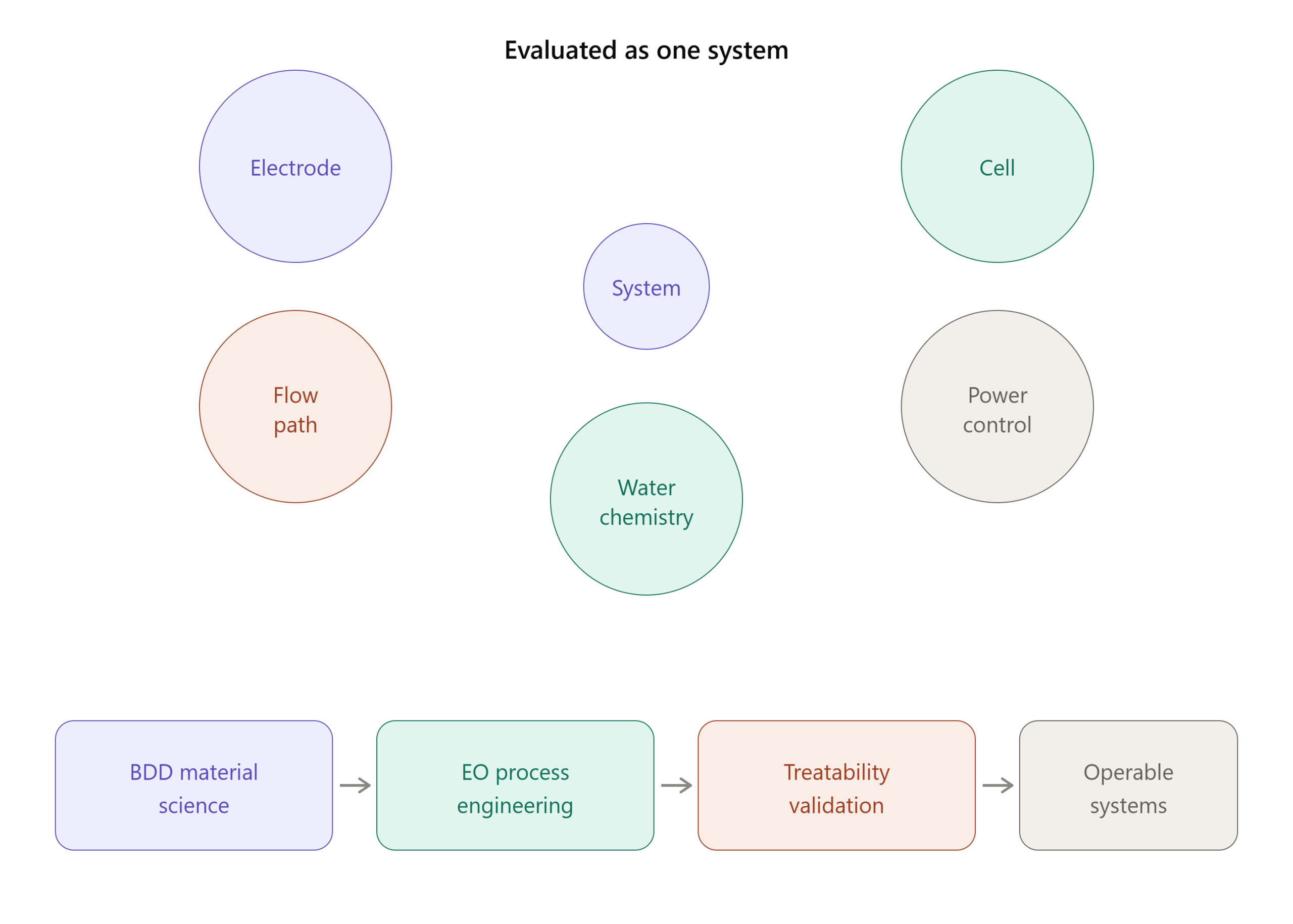
Electrode, reactor, flow path, power control, and water chemistry are evaluated as one system.
BDD anode plates
Electrode architecture, active area, surface condition, conductivity, and service access are considered as part of the treatment design.
Controlled electrolysis
Current density, chemistry, mass transfer, hydraulic residence time, and power control are engineered together.
Wastewater matrix
Influent chemistry, pretreatment, flow path, safeguards, and monitoring define the operating context.
Electrode, cell, flow path, power control, and water chemistry are evaluated as one system.
BDD material and electrode architecture
EO reaction and byproduct control
Reactor, power, and hydraulic engineering
Representative pilot validation
Electrochemical oxidation only performs as well as the system around the electrode.
BDD can offer a broad electrochemical operating window, strong resistance to corrosion, and useful oxidation pathways for difficult contaminants. Those material properties are important, but they do not replace sound wastewater characterization, reactor design, power control, mass transfer, and validation at representative conditions.
01 · Material and interface research
We examine electrode substrate, BDD coating architecture, active area, surface condition, conductivity, mechanical integration, and operating envelope as the starting point for a dependable treatment design.
02 · Electrochemical reaction engineering
We translate oxidation mechanisms into practical operating choices: current density, conductivity, pH, chloride management, hydraulic residence time, mass transfer, and control logic.
03 · Process-train design
Electrochemical oxidation is evaluated in context. Depending on the stream, it can be a pretreatment, targeted destruction step, polishing stage, or part of a combined biological, physical, and chemical treatment train.
04 · Evidence before scale-up
Bench and pilot work is used to establish treatment response, energy demand, electrode condition, operational constraints, and the design inputs required for a robust production system.
Influent profile → Treatability objective → BDD + reactor selection
Start with representative chemistry and the treatment question before selecting electrode and reactor configuration.
Pretreatment & hydraulics → EO operating window → Monitoring & safeguards
Define upstream conditioning, residence time, power window, instrumentation, and chemistry-dependent safeguards.
Pilot data → Scale-up basis → Serviceable system
Use measured evidence to establish design inputs, maintenance requirements, and an operable production configuration.
The process is designed around the wastewater and treatment objective, rather than assuming that a single electrode configuration is universal.
Where research meets real wastewater decisions.
Application work begins with contaminant behavior and treatment constraints. The same technology can play a different role in each wastewater category: improving biodegradability, reducing recalcitrant organics, removing color, controlling toxic compounds, or polishing a stream before discharge or reuse.
Pharmaceutical & fine chemical wastewater
Assess persistent organics, toxicity, salinity, biodegradability, and downstream biological-treatment compatibility before defining the EO duty.
Petrochemical, refinery & produced water
Design around variable loads, hydrocarbons, emulsions, COD, conductivity, solids, and the role of pretreatment and polishing in the treatment train.
Textile & dye wastewater
Evaluate color removal, dye chemistry, salt content, COD, and how electrochemical oxidation interacts with upstream solids removal and downstream polishing.
Leachate & PFAS-related treatment trains
Evaluate the full train, concentrating mechanisms, water chemistry, byproduct controls, and analytical verification rather than treating “PFAS” as a single uniform problem.
Battery, plating & metal-bearing wastewater
Separate the roles of metals handling, dissolved-organic removal, pH control, and EO polishing. A treatment train should respect both recovery opportunities and discharge targets.
From laboratory insight to a pilot system
Use representative wastewater, a stated objective, a controlled operating plan, and documented decision criteria before moving to a production-scale design.
What must be understood before promising performance.
Claims about electrochemical oxidation should be tied to wastewater conditions, a defined target, and a system design. These variables shape both treatment performance and operating risk.
01 · Influent chemistry
COD, TOC, target compounds, pH, conductivity, chloride, alkalinity, solids, oils, and temperature.
02 · Treatment target
Destruction, color reduction, biodegradability improvement, compliance, polishing, or reuse quality.
03 · Electrode and cell
BDD configuration, active area, spacing, current distribution, service access, and maintainability.
04 · Operating window
Current density, hydraulic residence time, electrolyte conditions, mass transfer, energy input, and heat management.
05 · Byproduct safeguards
Assess chemistry-dependent formation pathways and define monitoring, control, and downstream treatment measures.
06 · Scale-up evidence
Use representative tests to establish a decision basis, not just a single favorable laboratory result.
Technology research becomes useful when it produces a defensible design decision.
Each stage should answer a specific engineering question. This keeps pilot work focused, avoids misleading scale-up assumptions, and makes the final system easier to operate and maintain.
Characterization
Build a representative influent profile and define variability, contaminants, treatment constraints, and the required result.
Screening
Establish whether EO has a useful role in the treatment train and what must be controlled before testing.
Testing
Run a focused bench or pilot protocol using representative wastewater, measured operating conditions, and defined success criteria.
Engineering
Convert test evidence into reactor configuration, power requirements, pretreatment, controls, instrumentation, and service requirements.
Operation
Track treatment performance, energy, electrode condition, water chemistry, maintenance events, and process stability after deployment.
Bring the wastewater profile. Build the right technology research and engineering path from there.
Share your flow range, analytical data, operating constraints, and treatment objective. The first step is to define the question that a treatability assessment or pilot must answer.