Battery Recycling › Decision Support
Beyond Compliance: What Metal Recovery From Battery Recycling Wastewater Is Actually Worth
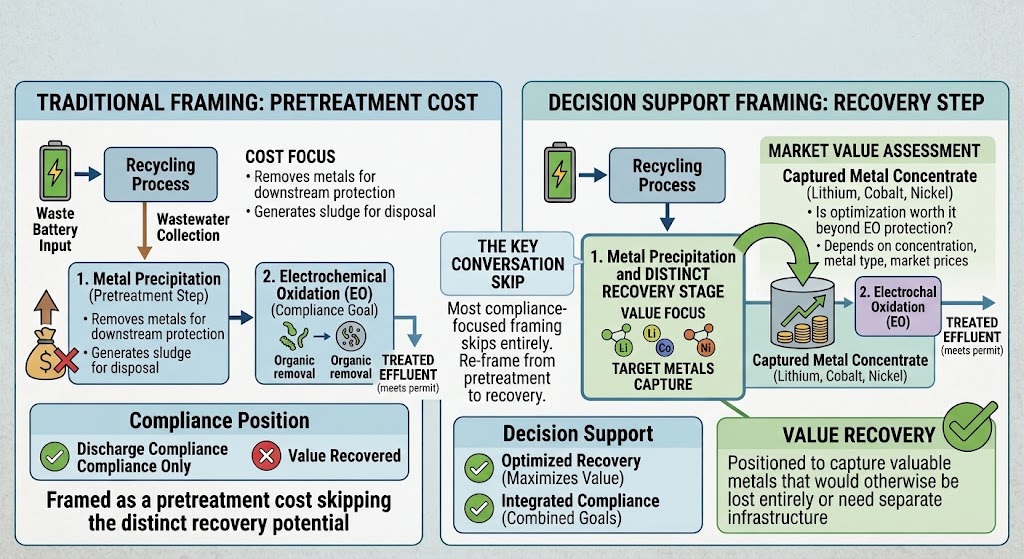
Metal precipitation gets framed as a pretreatment cost — a step that has to happen before electrochemical oxidation can run. It’s worth looking at the same step through a different lens: what it actually recovers.
Reviewed for technical accuracy by Janeczka Kowalski, Process / Electrochemical Engineering. NO RECOVERY YIELD OR REVENUE FIGURES WERE INVENTED. No existing page on the site states recovery percentages or dollar values for recovered metals. Figures and ranges on this page are engineering starting points — verify against your own pilot or vendor data before finalizing a design. The content is created by the Evoaeo engineering team led by Janeczka, All rights reserved.
What the Existing Treatment Train Already Recovers
Our Battery Recycling Wastewater Treatment page describes metal precipitation and recovery as a distinct stage ahead of EO. Depending on influent chemistry, this stage is positioned to capture lithium, cobalt, and nickel before the stream moves to organic-focused treatment — metals that would otherwise either need separate recovery infrastructure or be lost to the waste stream entirely.
From Pretreatment Cost to Recovery Step
Whether metal recovery is worth optimizing for — beyond simply clearing the stream for EO — depends on the specific metals present, their concentration, and current market value. This is a genuinely different conversation from “what does treatment cost,” and one most compliance-focused framing of battery recycling wastewater skips entirely.
What Determines Whether Recovery Is Worth Optimizing For
Metal concentration
Higher-concentration streams make dedicated recovery infrastructure easier to justify than marginal, low-concentration ones.
Facility scale
Recovery economics generally improve with throughput — a factor worth bench-testing against your actual volume, not assuming from a generic benchmark.
Market conditions
Lithium, cobalt, and nickel prices move independently and significantly — recovery economics that work today may not next year, and vice versa.
Curious what your stream could recover?
Send us your influent metal concentrations — we’ll advise on whether dedicated recovery infrastructure makes sense for your scale.