Pharmaceutical Wastewater › Frequently Asked Engineering Questions
Frequently Asked Engineering Questions About Pharmaceutical Wastewater Treatment via Electro Oxidation Technology
Specific questions from pharmaceutical manufacturers evaluating electrochemical oxidation — organized by the stage of decision you’re actually at.
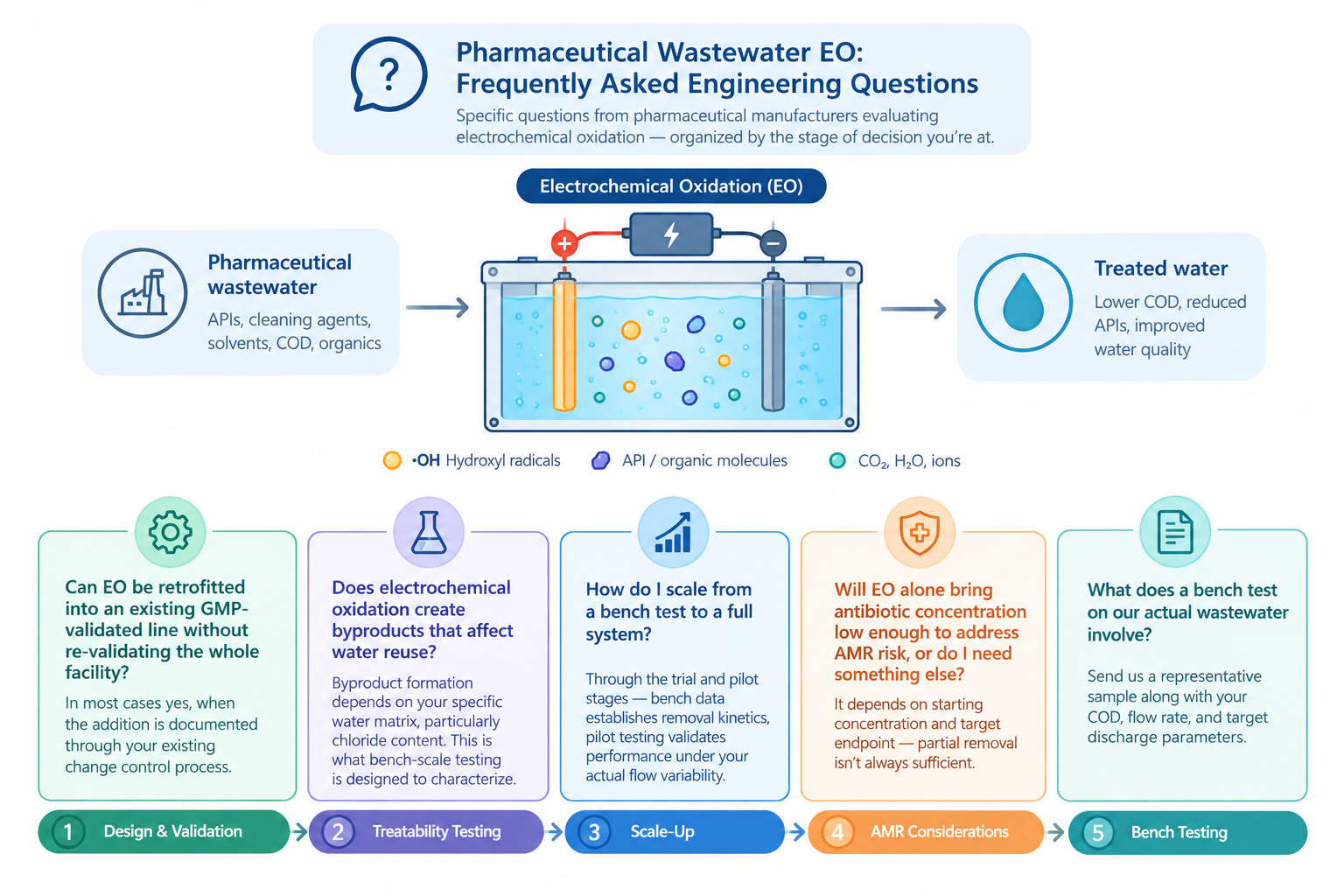
Can EO be retrofitted into an existing GMP-validated line without re-validating the whole facility?
In most cases yes, when the addition is documented through your existing change control process rather than treated as a new facility build. See our GMP validation page for what documentation we provide during commissioning.
Does electrochemical oxidation create byproducts that affect water reuse?
Byproduct formation depends heavily on your specific water matrix, particularly chloride content. This is exactly what bench-scale treatability testing is designed to characterize before you commit to a design.
How do I scale from a bench test to a full system?
Through the trial and pilot stages described in our Engineering Services process — bench data establishes removal kinetics, pilot testing validates performance under your actual flow variability before full-scale design.
Will EO alone bring antibiotic concentration low enough to address AMR risk, or do I need something else?
It depends on starting concentration and target endpoint — see our AMR risk page for why partial removal isn’t always sufficient, and talk to us about your specific compound and concentration.
What does a bench test on our actual wastewater involve?
Send us a representative sample along with your COD, flow rate, and target discharge parameters. See Wastewater Characterization & Treatability Studies for what we test for.
Question not covered here?
Ask us directly — we’ll answer or point you to the right resource.