Technology Comparison: Photocatalysis
Eelectro Oxidation Processes vs. Photocatalysis
Photocatalysis generates the same kind of hydroxyl radical destruction EO does, driven by light instead of current. The difference in driving force turns out to matter a great deal for what water it actually works on.
Reviewed for technical accuracy by Janeczka Kowalski, Process / Electrochemical Engineering. Figures and ranges on this page are engineering starting points — verify against your own pilot or vendor data before finalizing a design. The content is created by the Evoaeo engineering team led by Janeczka, All rights reserved.
A related radical-generation mechanism
Light-driven instead of current-driven
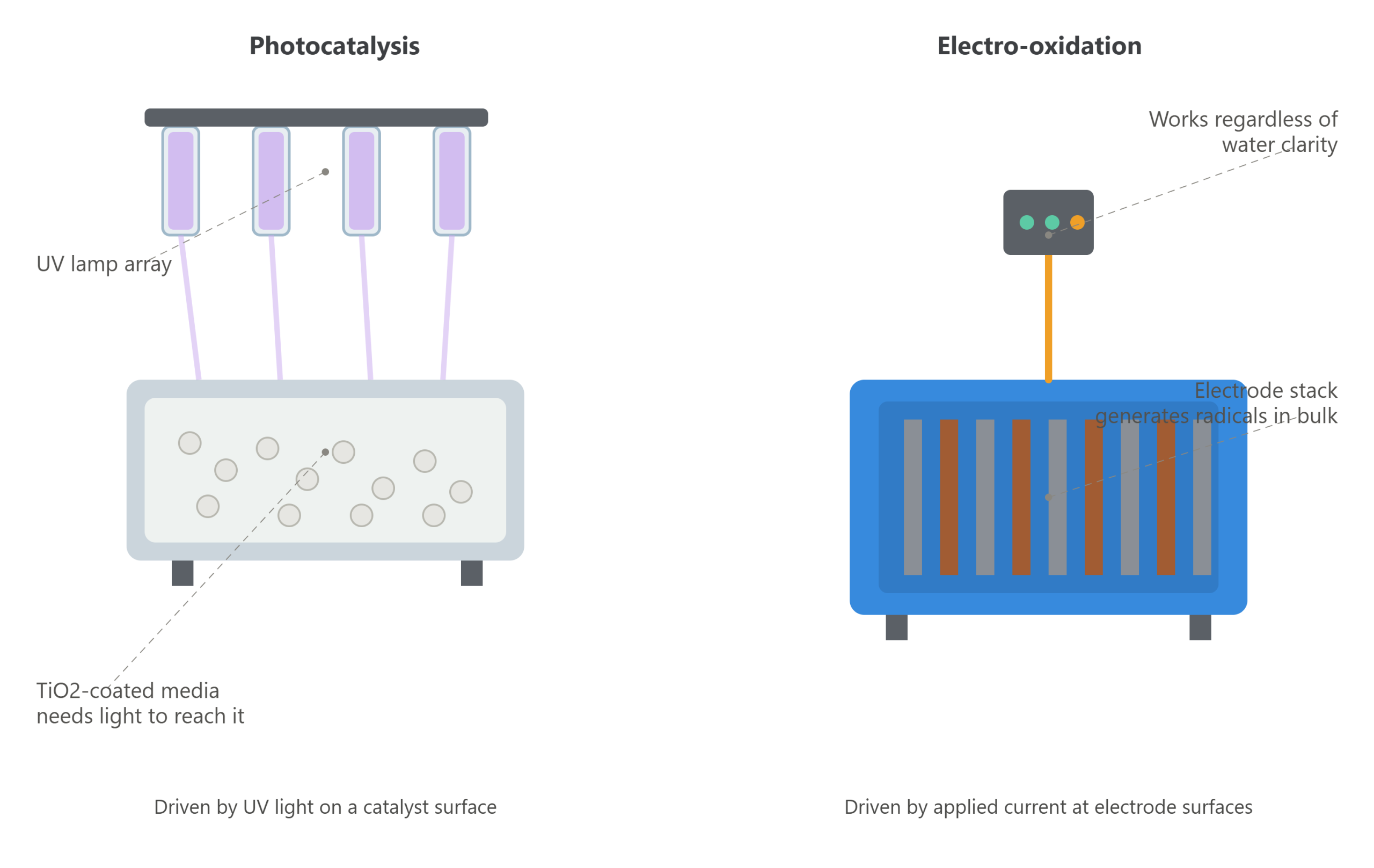
Photocatalysis — most commonly UV light striking a semiconductor catalyst such as titanium dioxide (TiO₂) — generates electron-hole pairs at the catalyst surface that go on to produce hydroxyl radicals, conceptually similar in oxidizing character to the non-active pathway BDD electrodes rely on in EO. The driving force is fundamentally different, though: photocatalysis depends on photons reaching and activating the catalyst surface, while EO’s driving force is applied electrical current independent of light.
Why water clarity becomes the limiting factor
Photocatalysis needs light to actually penetrate
Because photocatalysis depends on UV light reaching the catalyst, turbidity, color, and high organic absorbance in the water directly limit how effectively the reaction proceeds — a heavily loaded, colored industrial effluent can block light penetration before it ever reaches meaningful catalyst surface area, throttling the reaction regardless of catalyst quality. EO has no equivalent limitation, since applied current reaches the electrode surface regardless of water clarity, which is a large part of why EO scales more predictably to concentrated, opaque industrial streams than photocatalysis does.
Engineering note
Photocatalyst fouling and gradual deactivation on real industrial water is also a practical maintenance factor that hasn’t been fully solved at commercial industrial scale, which is part of why photocatalysis remains more established in dilute, clear-water polishing and drinking water contexts than in concentrated industrial effluent treatment.
Where photocatalysis fits
A complementary niche, not a direct competitor
Photocatalysis is best suited to dilute, relatively clear water — reuse polishing, drinking water treatment, low-concentration disinfection — rather than the heavily loaded industrial effluent EO typically handles. For most industrial wastewater applications carrying meaningful color, turbidity, or high organic concentration, EO remains the more directly applicable technology, with photocatalysis serving a genuinely different, lower-concentration niche rather than competing head-to-head for the same streams.
Pollutant-by-pollutant comparison
How EO and Photocatalysis perform on the pollutants that matter
Ratings reflect typical performance patterns reported across industrial-scale applications, not a substitute for bench testing on your specific matrix.
| Pollutant | EO | Photocatalysis | Engineering take |
|---|---|---|---|
| Trace pharmaceuticals (dilute, clear water) | Excellent | Good — effective when light penetration is adequate | Photocatalysis performs well in its intended niche of clear, low-load water |
| Endocrine-disrupting compounds (EDCs) | Excellent | Good | A genuine strength area for photocatalysis in reuse-grade or near-drinking-water contexts |
| Taste & odor compounds | Good | Good | Roughly comparable for polishing-stage applications |
| Dyes at low concentration | Excellent | Good | Comparable in dilute conditions; diverges sharply as concentration or color rises |
| Turbid or colored industrial effluent | Excellent — unaffected by clarity | Poor — light penetration is blocked | This is the core reason photocatalysis hasn’t scaled to concentrated industrial streams |
Micropollutant spotlight
Photocatalysis’s real established niche is trace organic micropollutants in dilute, optically clear water — endocrine-disrupting compounds and low-level pharmaceutical residues in reuse-grade or near-drinking-water applications, where light can actually reach the catalyst surface. That’s a meaningfully different water quality than most industrial effluent EO is built to treat, which is why these two technologies tend to serve different points in a treatment train rather than compete head-to-head on the same stream.
PFAS spotlight
Photocatalytic PFAS destruction is an active area of research, but demonstrated performance at industrial scale remains limited compared to established BDD-electrode EO systems. For a facility with a near-term PFAS compliance deadline, EO is the technology with a commercially proven track record; photocatalysis is one to watch rather than one to specify today.
Related comparisons
Where this decision connects to others
Grounded in the literature
This comparison reflects published research, not just our own field data
The mechanisms and performance patterns described on this page are consistent with the peer-reviewed environmental engineering literature — journals including Water Research, Chemosphere, the Journal of Hazardous Materials, Environmental Science & Technology, and the Chemical Engineering Journal regularly publish comparative studies on electrochemical and competing treatment technologies. Our engineering team tracks this literature as part of how we validate bench and pilot results against the broader research base, and can provide specific citations relevant to your stream on request.
Considering a light-driven versus current-driven oxidation approach?
Send us your stream data and we’ll respond with an engineering read — no obligation.