Electrochemical Oxidation / Engineering & System Design /Energy Consumption Optimization
Optimizing Energy Use in Electrochemical Oxidation
Electricity is usually the single largest operating cost line in an EO system. Most of the waste comes from running the process mass-transfer limited without knowing it.
Why This Matters
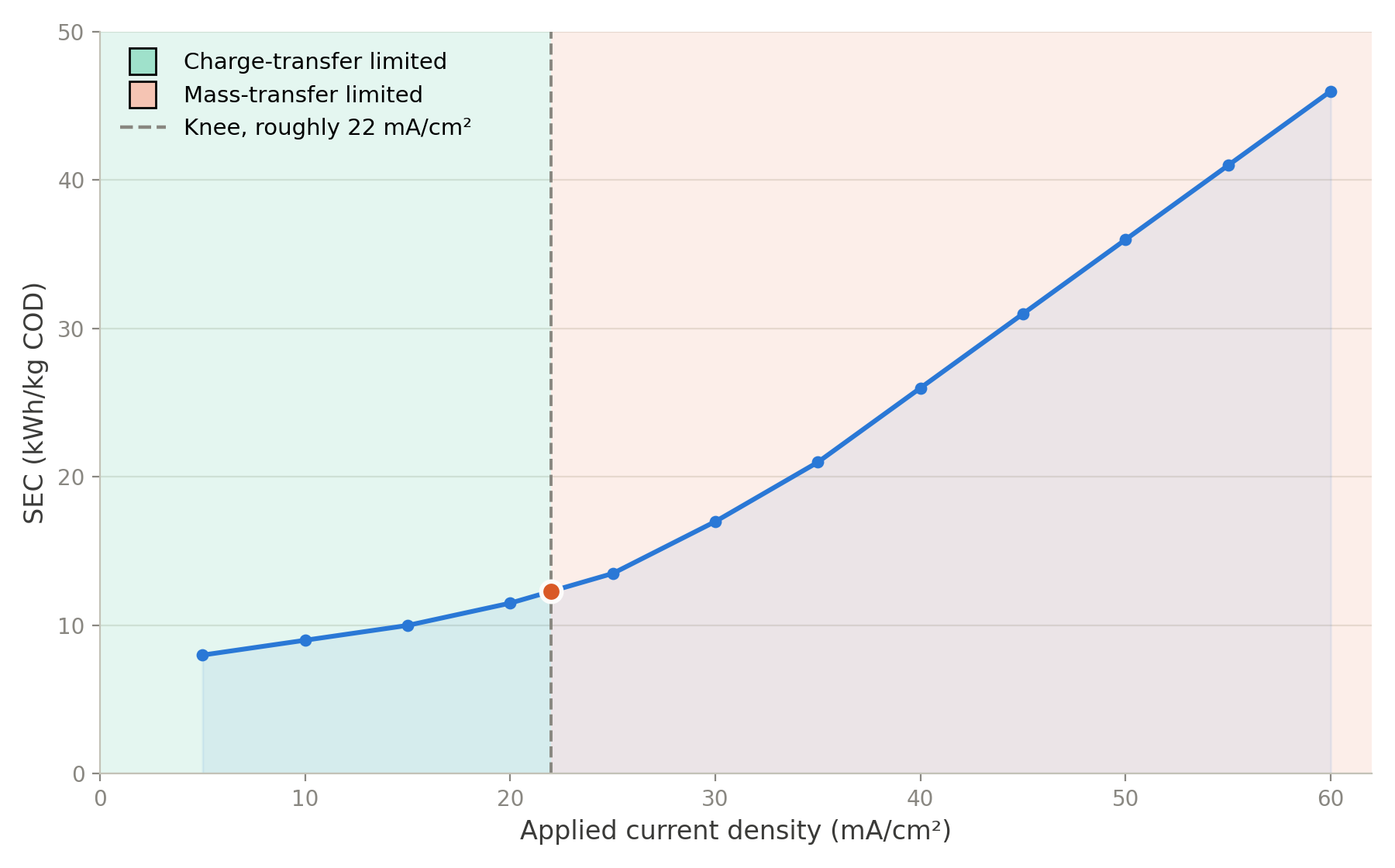
Specific energy consumption (SEC), expressed as kWh per kg of COD removed, is the number that decides whether EO is competitive against alternatives on a given stream. Reported values for real installations swing widely, commonly somewhere between 10 and 40+ kWh/kg COD, and the spread has less to do with the electrode material than with how close the operating point sits to the mass-transfer limit.
The lever that moves SEC the most is not exotic. It is keeping the process charge-transfer limited (current doing useful oxidation work) rather than mass-transfer limited (current going into side reactions like oxygen evolution because pollutant cannot reach the electrode fast enough). Everything below builds from that one distinction.
Charge-Transfer Limited vs Mass-Transfer Limited Operation
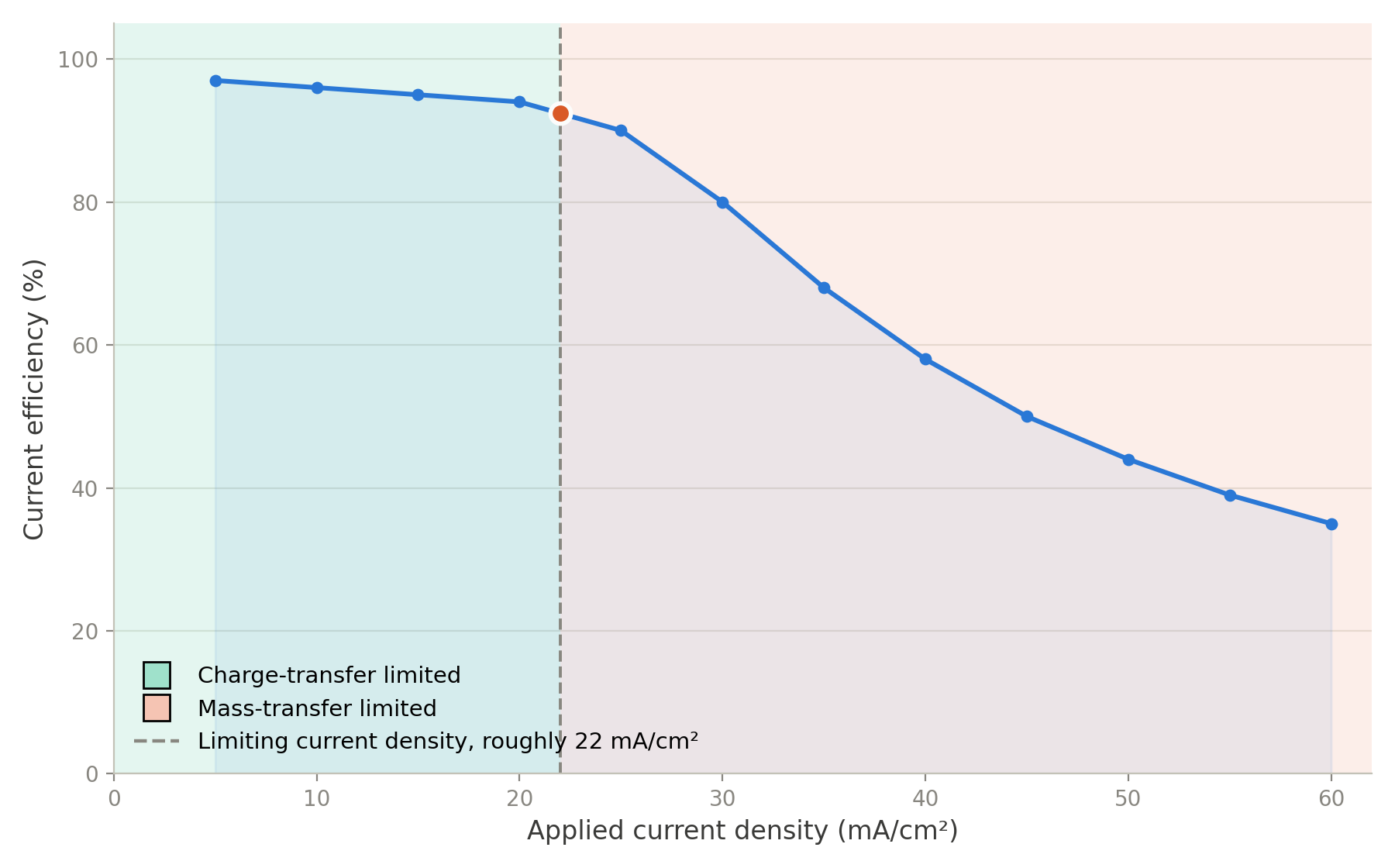
Below a certain current density, every electron delivered to the electrode finds a pollutant molecule to oxidize — this is the charge-transfer limited regime and it is the efficient zone to operate in. Push current density higher than the rate at which pollutant molecules can physically diffuse to the electrode surface, and additional current starts going into water oxidation (oxygen evolution) instead, which does nothing for COD removal but still costs full voltage.
The limiting current density for a given stream depends on pollutant concentration and mass transfer coefficient (which depends on flow velocity and reactor geometry). Running above it is the single most common reason a plant’s real-world SEC comes in worse than the lab data that sized it.
Electrolyte Conductivity and Electrode Gap
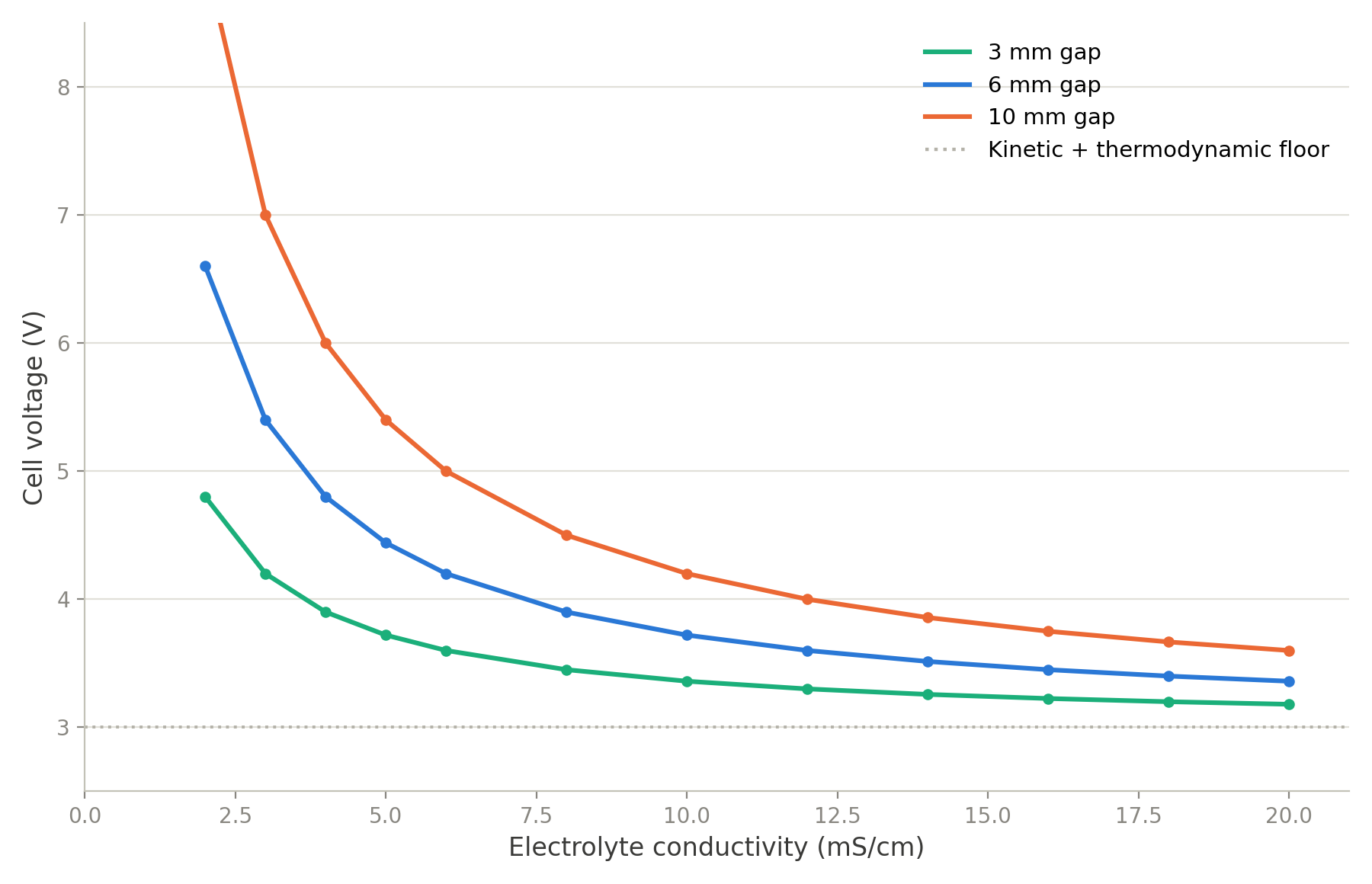
Ohmic loss (I2R heating in the electrolyte between plates) is pure waste — it raises cell voltage without contributing any oxidation. It is proportional to interelectrode gap and inversely proportional to solution conductivity, so the two most direct energy levers are tightening the gap and raising conductivity.
Gap reduction is mechanically limited by manufacturing tolerance and fouling risk. Conductivity enhancement, often through modest electrolyte or salt dosing, is usually the cheaper lever, though on chloride-rich streams it comes with a tradeoff: higher conductivity from chloride also drives more active-chlorine-mediated indirect oxidation, which can be an energy benefit or a disinfection-byproduct liability depending on the discharge target.
Pulsed and Reverse-Polarity Current
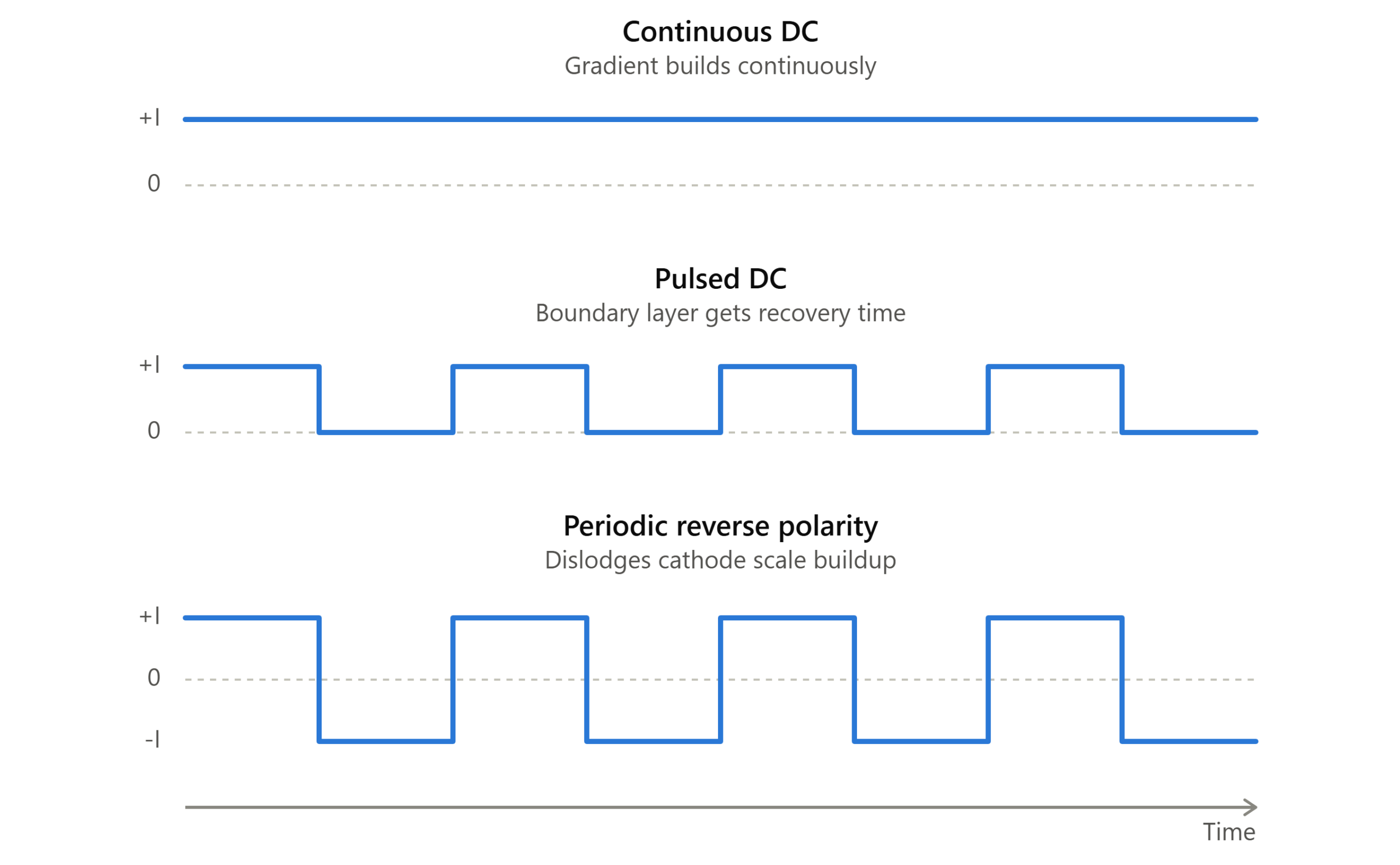
Continuous DC operation lets concentration gradients build up at the electrode surface, pushing the process toward the mass-transfer limit faster than pulsed current does. Interrupting current briefly (pulsed DC) gives the boundary layer time to relax and pollutant concentration at the surface to recover, which can extend the charge-transfer-limited operating window to a higher average current density.
Periodic polarity reversal serves a different purpose: it helps dislodge scale (particularly carbonate and calcium deposits) that forms preferentially on the cathode, keeping active surface area available rather than fighting a slowly fouling electrode. The energy benefit is indirect but real, since a fouled electrode needs higher voltage to hold the same current.
Closed-Loop Control on ORP or COD
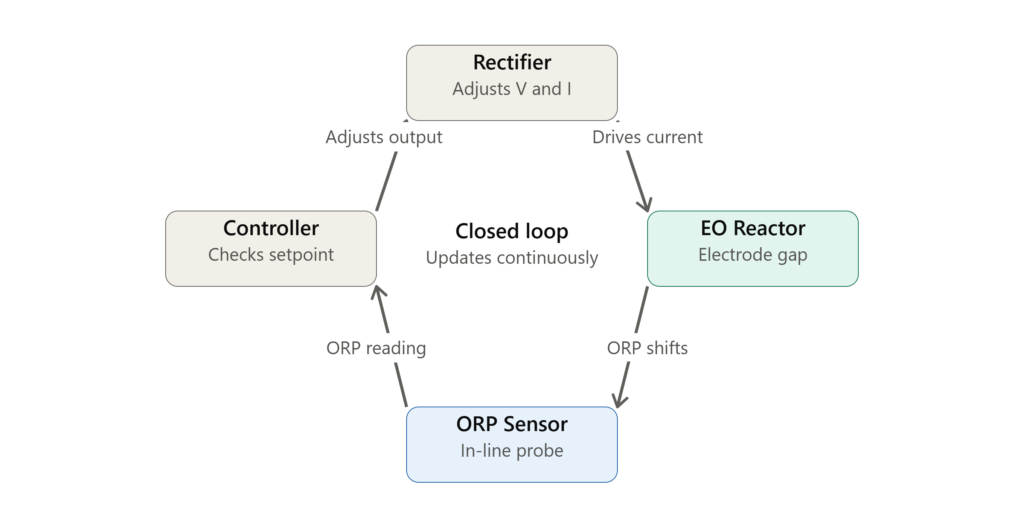
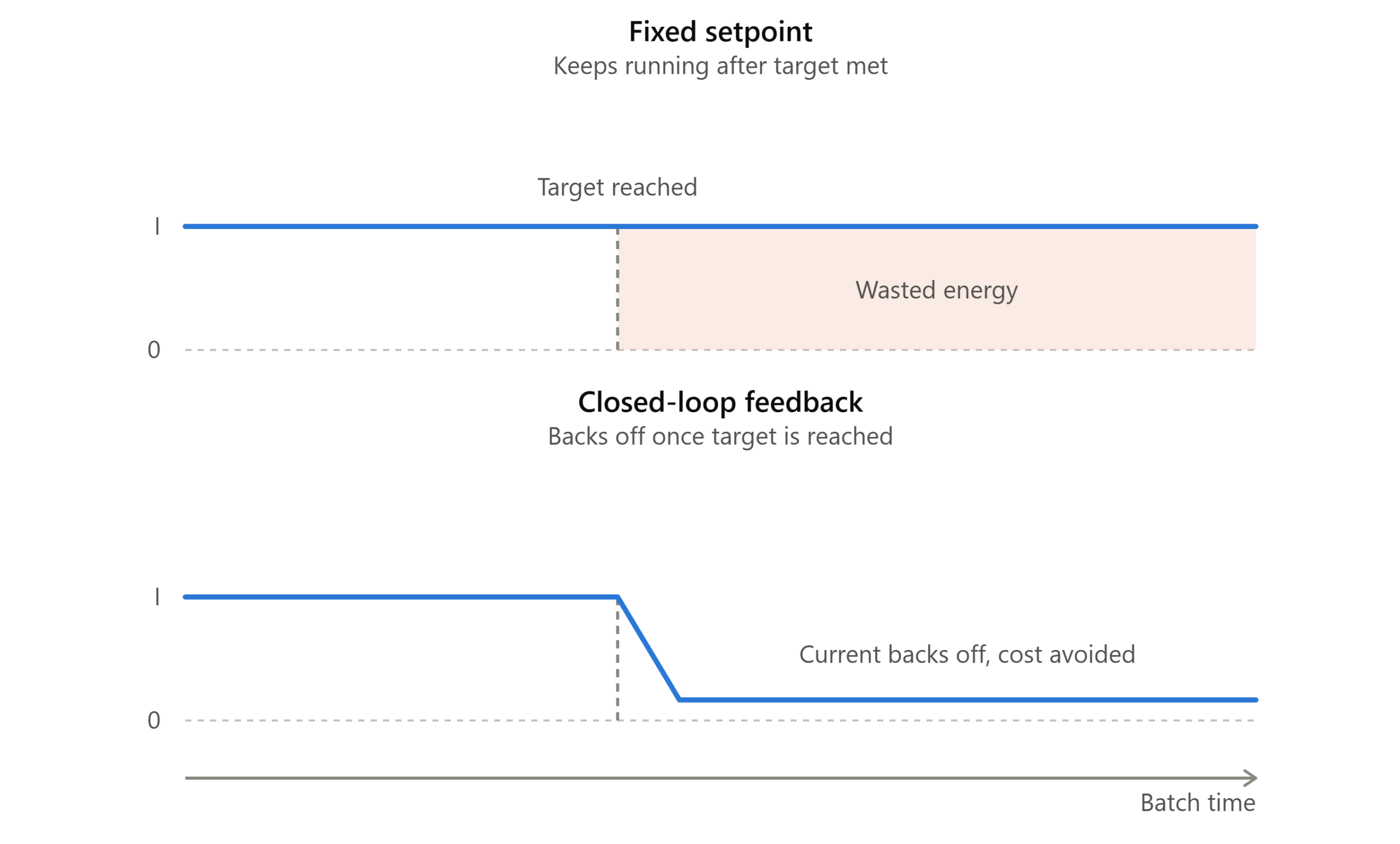
Running EO on a fixed setpoint (constant current or constant time) treats every batch as if influent load never varies, which it does. Feedback control on oxidation-reduction potential (ORP) or an inline COD/TOC surrogate lets the rectifier back off once the target degradation is reached, instead of continuing to apply current — and cost — to a stream that has already met spec.
This is frequently the single highest-return optimization available on an existing installation, because it requires no reactor modification, only instrumentation and control logic on equipment already installed.
Typical SEC Range
10-40+ kWh per kg COD removed, depending on electrode, conductivity, and operating regime
Limiting Current Density
The point where current efficiency drops sharply as oxygen evolution competes for available current
Highest-ROI Lever
Closed-loop ORP or COD control on existing hardware, no reactor modification required
Energy cost is stream-specific — confirm yours before benchmarking
Wastewater Compatibility Score
Score your matrix and get a readiness assessment that flags energy-cost risk factors.
Treatability Studies
The bench data that pins down your actual limiting current density.
Engineering Process
Where energy optimization fits in the full bench-to-commercial sequence.
Energy Levers Ranked by Typical Payback
Fastest payback. Uses existing hardware, adds instrumentation and control logic only. Prevents over-treatment past the target setpoint.
Low capital cost, immediate ohmic-loss reduction. Watch for disinfection byproduct tradeoffs on chloride-rich streams.
Requires a rectifier capable of the waveform. Extends charge-transfer-limited operating range and helps manage cathode scaling.
Mechanically limited and usually a redesign, not a retrofit. Best captured at initial reactor design stage rather than after commissioning.
Common Energy-Waste Mistakes
Limiting current density is stream-specific. A value that works on one effluent’s pollutant concentration and flow velocity can push a different stream straight into the mass-transfer-limited zone.
Without ORP or COD feedback, the system cannot tell when it has already hit target and keeps consuming full power past the point of any additional benefit.
Chloride-driven conductivity gains can trip disinfection byproduct or total dissolved solids limits on the discharge permit. Check the permit before dosing.
Scale buildup raises cell voltage gradually, and it is easy to attribute the drift to “the process getting harder” rather than to a fouled electrode that periodic polarity reversal or cleaning would fix.
Where does this take you next?
Energy cost is usually the deciding line item. Where you go next depends on whether you have real operating data yet.
Have an SEC baseline
See how current density is affecting your electrodes at that operating point.
No operating data yet
Score your matrix to estimate where your stream will sit on the energy curve.
Comparing EO's total cost
Fold the energy number into a full levelized cost picture.
Have pilot data? Let's stress-test the scale-up plan
Share your influent characteristics and current operating data and we will identify where your kWh/kg COD number has room to move.