Electrochemical Oxidation / Engineering & System Design / Scale-Up Consideration
Scaling EO from Bench to Full Production
Pilot data rarely survives contact with a full-scale manifold. These are the variables that actually shift between a 20-liter pilot skid and a 200 m3/h plant.
Why This Matters
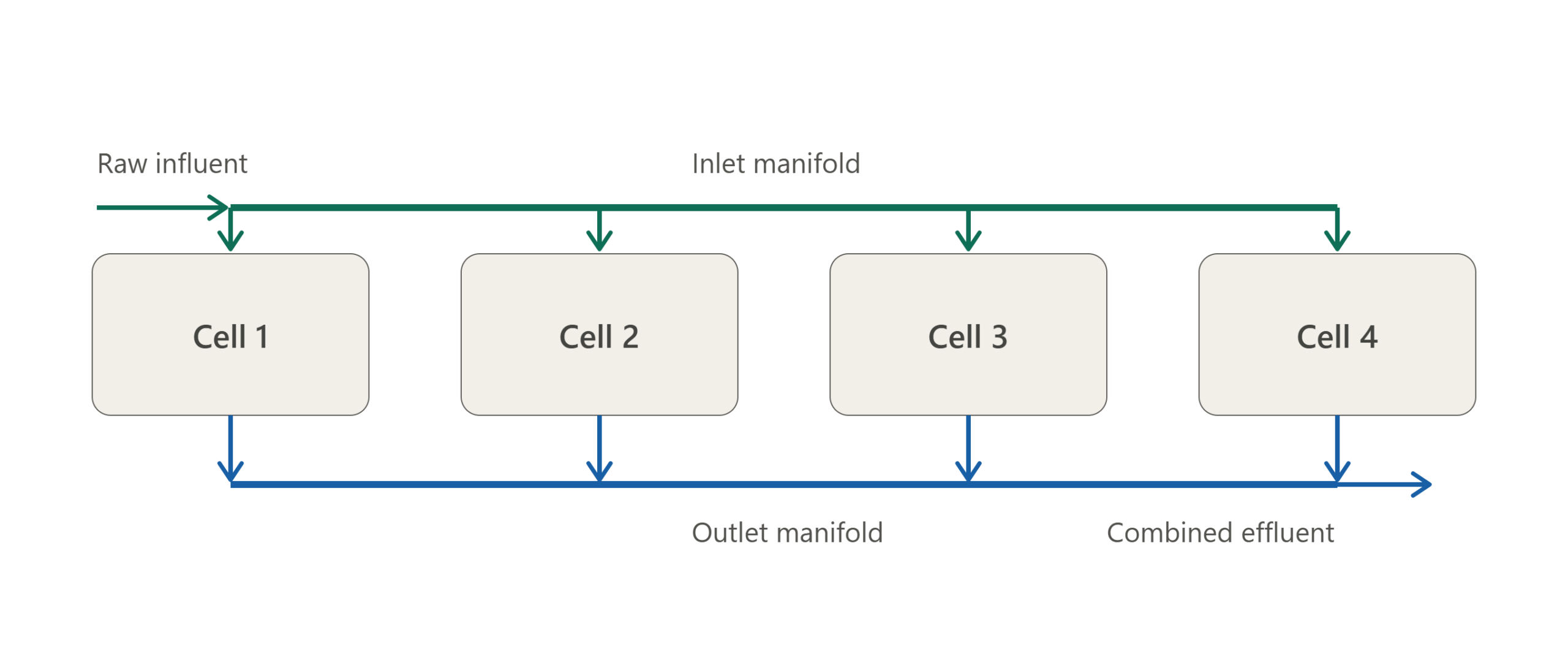
Electrochemical oxidation scales predictably on paper: hold current density constant, multiply electrode area, done. In practice, three things break that assumption every time — current distribution across parallel cells, gas-bubble interference with conductivity, and flow maldistribution through a manifold that a single pilot cell never had to deal with.
None of these are exotic problems. They are the same hydraulic and electrical engineering issues that show up in any process scaled from a single unit to a bank of parallel units. Treating EO scale-up as an electrochemistry problem alone, without the plant engineering that goes with any parallel-unit process, is where most timeline overruns start.
Current Density vs Total Current
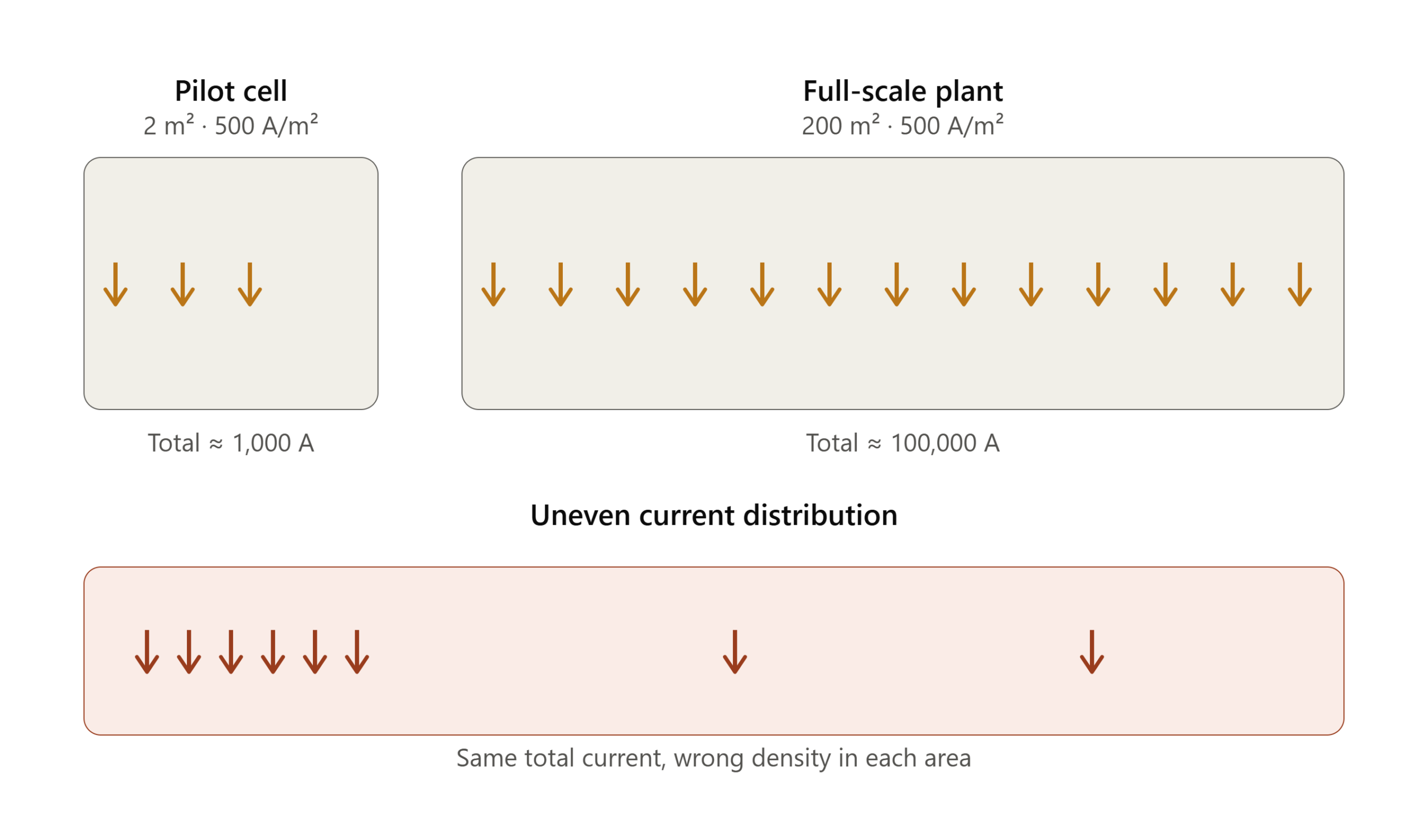
Current density (A/m2 of electrode surface) is the parameter that governs oxidation chemistry and electrode life. Total current (A) is what your rectifier delivers. Scaling up means adding electrode area to hold current density roughly constant while total current climbs with plant throughput.
The failure mode is treating total current as the scaling variable instead. A pilot cell running at 500 A/m2 on 2 m2 of electrode and a full plant running the same 500 A/m2 on 200 m2 of electrode look nothing alike on the rectifier nameplate, but they should behave almost identically at the electrode surface. If they do not, the gap is almost always in current distribution, not chemistry.
Gas Evolution and Conductivity at Scale
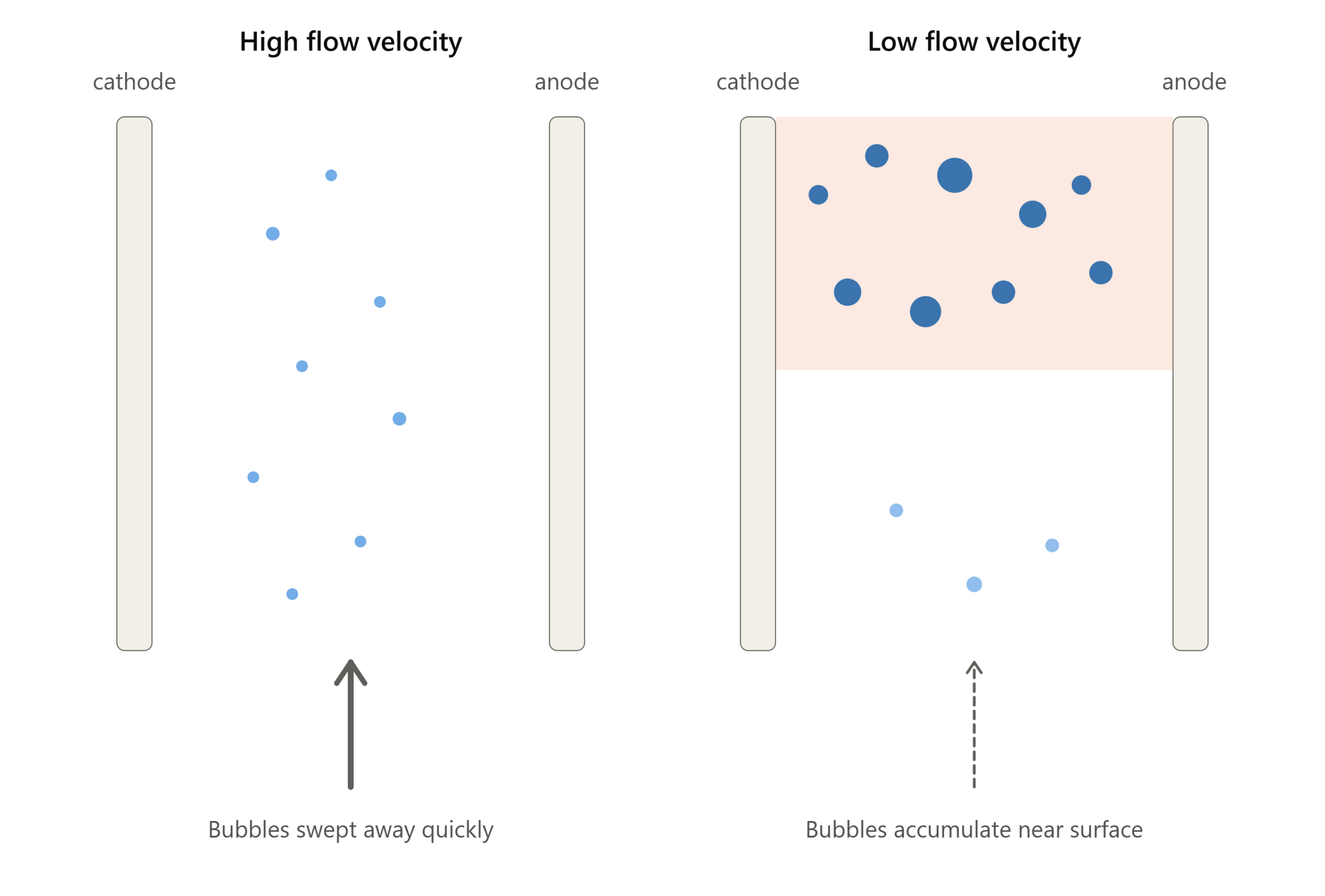
Hydrogen at the cathode and oxygen (plus, in chloride-containing streams, chlorine) at the anode generate gas bubbles that physically block part of the electrode surface and raise the effective resistance of the electrolyte between plates. In a small pilot cell with high flow velocity relative to electrode area, bubbles sweep away quickly. In a full-scale stack with many parallel channels, local velocity can drop enough that bubble accumulation becomes uneven from cell to cell.
This shows up as cell-to-cell voltage variation on the same rectifier bus, which pilot data at a single cell simply cannot predict. Budget for a voltage margin above the pilot-derived number, and instrument individual cells (or at minimum cell groups) so uneven gas holdup is visible before it becomes an electrode hot-spot problem.
Flow Distribution Across Parallel Cells
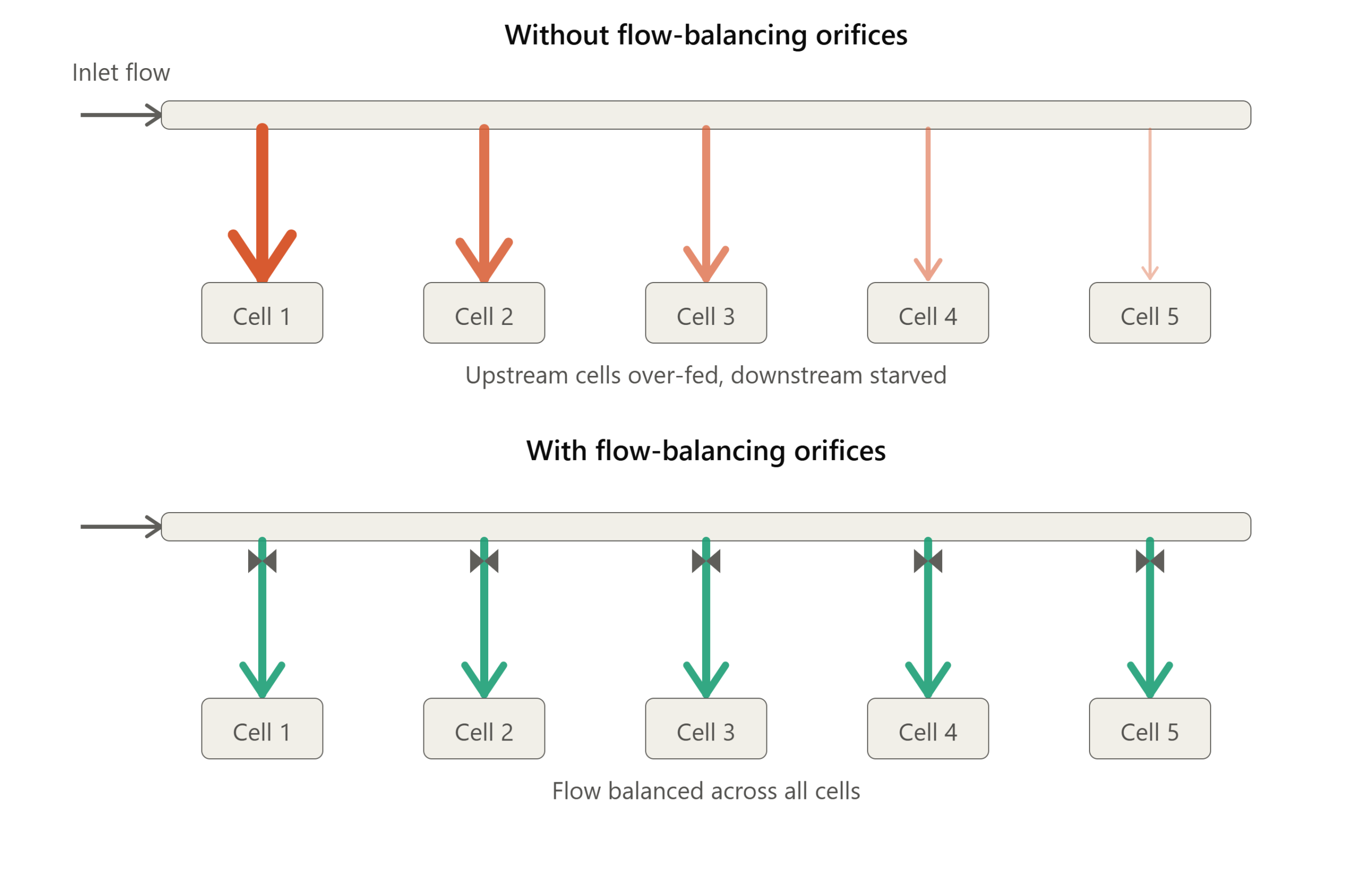
A single pilot cell has one flow path by definition. A full plant usually runs dozens of cells fed from a common header, and headers do not distribute flow evenly without deliberate design. Cells near the inlet of a straight header tend to starve cells further downstream unless the header is sized correctly or fitted with flow-balancing orifices.
Hydraulic short-circuiting compounds this: if any parallel path offers less resistance, flow preferentially routes there, leaving other cells under-treated even while total plant flow and total plant current both look correct on the control room readout. Verify manifold design with a hydraulic model, not a rule of thumb carried over from the pilot skid.
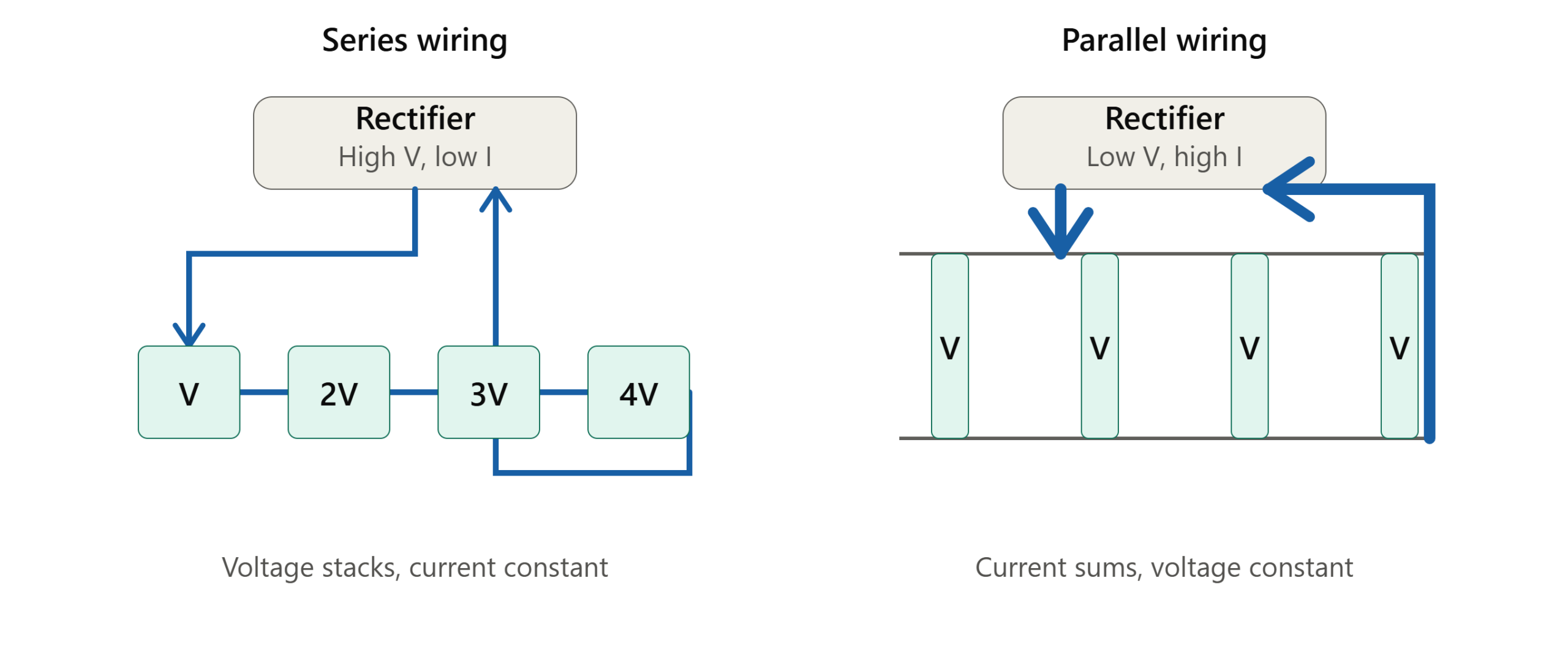
Stack Wiring and Power Supply Sizing
Whether the full-scale plant wires cell groups in series (voltage stacks, current stays constant) or parallel (current stacks, voltage stays constant) changes the rectifier spec substantially. Series groupings need a rectifier capable of higher voltage at lower current; parallel groupings need the opposite.
Get the rectifier sized against the actual full-scale wiring topology, not against the pilot unit’s power supply scaled up linearly. A pilot rectifier rated for 50 A at 12 V does not simply become a 5,000 A rectifier at 12 V when electrode area increases 100x — the wiring topology decision changes the voltage-current relationship entirely.
Scaling Variable
Hold current density (A/m2) constant; let total current climb with added electrode area
Flow Regime Shift
Watch for laminar-to-turbulent transition changes as channel geometry changes with scale
Manifold Design
Header sizing and flow-balancing orifices prevent cell-to-cell starvation at scale
Scale-up runs on pilot data — make sure yours is enough
Pilot Test Requirements
Sample volume, duration, and instrumentation a pilot needs to actually predict full-scale behavior.
Engineering Process
Where scale-up sits in the full bench-to-commercial sequence.
Treatability Studies
If you do not have pilot data yet, this is the step that generates it.
Bench, Pilot, and Full-Scale: What Changes
Single cell, controlled flow, minimal gas interference. Good for chemistry screening. Poor predictor of manifold and current-distribution behavior.
First real test of flow distribution and gas holdup effects. Still typically single or few-cell, so cell-to-cell variation is not yet visible.
Manifold design, cell-to-cell current balance, and rectifier topology all become live variables. This is where pilot assumptions get tested against real hydraulics.
Where Scale-Up Timelines Slip
It does not, once gas holdup and manifold flow distribution enter the picture. Budget contingency into the rectifier voltage spec rather than taking the pilot number at face value.
Without per-cell or per-group voltage monitoring, uneven gas holdup or flow starvation stays invisible until an electrode fails early. Instrument before commissioning, not after a failure.
A header sized to whatever pipe diameter was on hand, rather than modeled for even distribution, is one of the most common causes of underperforming full-scale plants that tested fine at pilot.
Series vs parallel cell wiring at full scale changes the voltage-current relationship. Size the rectifier against the actual topology, not a linear multiple of the pilot unit.
Where does this take you next?
What you do next depends on whether you already have pilot data to scale from, with electrochemical oxidation wastewater treatment ?
Have pilot data
Use it to size the full plant, then check the energy and cost impact of your operating point.
Need pilot data first
See what a pilot needs to produce before it can be trusted for a full-scale design.
Reconsidering reactor geometry
Scale-up problems sometimes trace back to the reactor architecture itself.
Have pilot data? Let's stress-test the scale-up plan
We review pilot results against full-scale hydraulics and rectifier topology before you commit to a manifold design.