Engineering Design & System
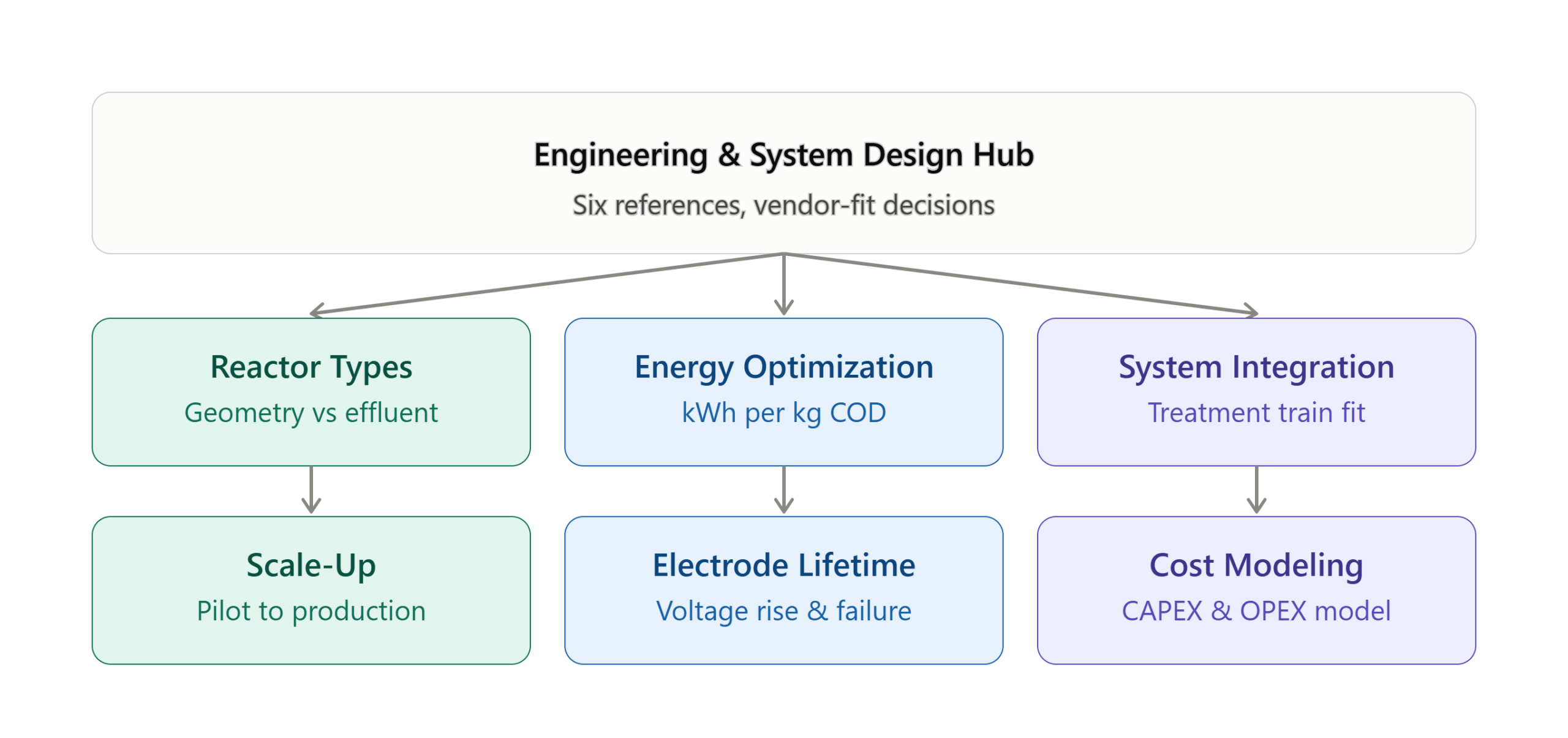
Six technical references covering the decisions that separate a working EO installation from an expensive pilot that never scaled. Written for engineers evaluating vendor fit, not for a general audience.
Reviewed for technical accuracy by [Reviewer Name, PE — Process / Electrochemical Engineering]. Last reviewed August 2026. This cluster assumes EO has already cleared a feasibility screen; if you have not run that screen yet, start with the decision gate below.
DECISION GATE
Not sure if EO applies? Start with the decision gate before committing to a design path.
Why This Section Exists
Most EO content online stops at chemistry: what hydroxyl radicals do, which pollutants respond well, why the process is chemical-free. That is useful, but it is not what an engineer needs once EO has already cleared the feasibility question and the conversation moves to what a real installation looks like.
This section is the engineering layer. It assumes you already have a stream in mind and a reason to believe EO could work, and it goes into the design, scale-up, energy, maintenance, integration, and cost detail that a proposal review actually runs on.
The Six Pages in This Cluster
EO Reactor Design Types
Compare parallel-plate, packed-bed, tubular, and rotating electrode architectures and match geometry to your effluent.
Scale-Up Considerations
What actually changes between a pilot skid and a full production plant, from current distribution to manifold design.
Energy Consumption Optimization
Cut kWh per kg COD removed by keeping the process charge-transfer limited instead of mass-transfer limited.
Electrode Lifetime Management
Why electrodes fail, how to read voltage rise as an early warning, and how to budget replacement.
System Integration
Where EO fits in a treatment train: pretreatment, hybrid pairings, and downstream handling.
Operational Cost Modeling
Build a levelized dollar-per-cubic-meter model with CAPEX, OPEX, and sensitivity analysis you can defend.
Who This Section Is For
Before You Start
No. They are written to stand alone. Reactor Design Types and Scale-Up Considerations are the most useful starting point if you have not yet fixed a reactor geometry, but every page links back to the others where the topics intersect.
Start with the decision gate linked at the top and bottom of every page in this cluster. It is a shorter, upstream screen for whether EO is a fit before you invest time in engineering-level detail.
This section explains the engineering variables a proposal should already account for, so you can evaluate a quote against real design tradeoffs rather than taking vendor claims at face value.
The engineering principles here (current density, mass transfer, electrode degradation mechanisms) are stable process fundamentals. Specific figures and ranges are illustrative starting points; verify against your own pilot or vendor data before finalizing a design.
Where does this take you next?
This hub assumes EO already cleared feasibility. If you are earlier or later in the decision, these are the right next stops.
Not sure EO is the fit
Work through the twelve-variable checklist before investing time in engineering-level detail.
Design work is done
Confirm your assumptions on your actual matrix before it goes into a proposal.
Comparing against alternatives
See how EO stacks up against ozone, Fenton, and biological options.
Talk to our process engineers about your application
Send us your flow rate, COD/TOC targets, and constraints, and we will help you work through which pages in this cluster matter most for your project.
DECISION GATE
Not sure if EO applies? Start with the decision gate before committing to a design path.
Electrochemical Oxidation Wastewater Treatment — Engineering & System Design Hub by Evoaeo engineering team © All rights reserved.