Home › Products › EO Bench Modules
Electrochemical Oxidation EO Bench Modules
This is where every benchtop electrochemical oxidation unit we build lives: small-batch, tabletop-scale rigs for feasibility screening and process-route comparison before any water goes into a pilot skid. Each unit combines a pretreatment reactor with one or more independently controlled electrochemical stages, so you can test whether pretreatment is worth the extra step, compare single-stage against multi-stage treatment, and generate the early data a pilot or full-scale design actually needs. Browse the configurations below, or work through the guides further down the page.
Written by and reviewed for technical accuracy by Janeczka Kowalski, Process / Electrochemical Engineering. Figures and ranges on this page are engineering starting points — verify against your own pilot or vendor data before finalizing a design.
What This Page Covers
- ✓What a benchtop EO unit is for, and how it differs from pilot and full-scale equipment
- ✓How pretreatment and multi-stage electrochemical configuration affect what you learn from a bench run
- ✓Where bench modules fit, and where they don’t, across industrial wastewater screening programs
- ✓A structured guide for choosing a configuration and moving from bench data to a pilot program
- ✓Practical operation, safety, and maintenance guidance
What Are Electrochemical Oxidation EO Bench Modules?
Electrochemical oxidation EO bench modules are small, self-contained electrochemical treatment rigs, typically running batches in the 2–5 liter range, built to answer one question before anything gets scaled up: does electrochemical oxidation actually work on this specific wastewater, and if so, what combination of process steps performs best? Most bench units on this line combine a pretreatment reactor, which handles suspended solids and floc-forming constituents, with one or two electrochemical stages that carry out the oxidation itself.
The value of running these stages independently, rather than as one fixed process, is that it lets you isolate variables. You can find out whether pretreatment earns its cost on your water, whether one electrochemical stage is enough or a second one adds meaningful removal, and roughly what current and treatment time each stage needs, all from a batch of water you can carry in a sample jug.
Engineering View: How EO Bench Modules Are Built
Configuration and Control
A typical bench module wires its stages so each has its own storage tank, circulation pump, drain valve, and, for electrochemical stages, its own constant-current DC power supply. Manual isolation valves route water between tanks, and a touchscreen PLC handles per-stage timing, starting and stopping circulation and power automatically once the set working time elapses. This design lets one cabinet run several process configurations, commonly: pretreatment into a first electrochemical stage into a second, pretreatment straight into a single stage, two electrochemical stages without pretreatment, or a single stage running alone.
Batch, not continuous, operation is standard at this scale. A fixed volume of water recirculates through a stage for a set time, and you track removal against total treatment time or, more precisely, against total charge passed through the cell. That’s a deliberate tradeoff: batch testing makes it easy to isolate variables and compare configurations side by side, at the cost of not reproducing the continuous hydraulic profile a full-scale system will actually see.
Feedwater Limits Drive the Envelope
Bench units are built around a defined operating envelope, not an open-ended one. Typical limits include a temperature range (commonly 10–60°C), a pH window that can vary slightly by process configuration, and hard caps on fluoride, bromide, suspended solids, and salinity. Hydrogen sulfide in the feed is generally not permitted under any configuration. These limits aren’t arbitrary; fluoride and bromide interfere with electrode chemistry and drive unwanted byproduct formation at the levels the equipment is built for, and high solids or salinity foul electrodes or push current draw outside the supply’s rated range. Check the specific limits on the model you’re considering before scheduling a run.
Engineer’s Note
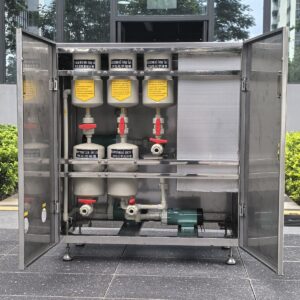
EO Bench Module — Standard
BDD anode/MMO cathode · PLC control Electro oxidation wastewater treatment unit, a compact system for wastewater treatability testing and electro oxidation process development.
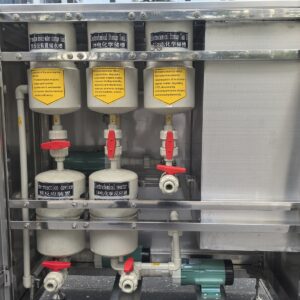
EO Bench Module — Compact
BDD anode/MMO cathode · PLC control Portable bench scale electro oxidation wastewater treatment unit, ready for mobile treatability validation via on-site testing, electro oxidation on the go.
How the Bench Configurations Compare
| Two-Stage Standard | 2.5–3 L · Pretreatment + 2 EC stages · Four process routes, general-purpose screening |
| Single-Stage | 2–3 L · Pretreatment + 1 EC stage · Lighter footprint, simpler screening programs |
| Extended Three-Stage | 3–5 L · Pretreatment + up to 3 EC stages · Comparing more than two treatment stages or electrode chemistries |
*Disclaimer: Dual to constant technical update with our electrochemical oxidation wastewater treatment products, the data and information within the comparison table might not necessarily reflect the actual product parameters of our electro oxidation EO bench modules, in this case, please do contact our sales and engineering team for the available products, we reserve the rights to release or demonstrate all the product information.
Application View: Where Bench Modules Fit
A bench module’s job is answering feasibility and configuration questions cheaply, before a larger commitment. It shows up most often ahead of pilot or full-scale programs across:
Industrial Process Wastewater
First-pass screening on COD, ammonia-nitrogen, color, and oil content before deciding whether electrochemical treatment belongs in a larger design.
Landfill Leachate
Testing whether pretreatment ahead of electrochemical oxidation is worth the extra process step, or whether electrochemical stages alone get you there.
Textile and Dye Wastewater
Quick color and COD removal screening across process configurations to see which combination handles a specific dye chemistry.
Metal Finishing / Plating Effluent
Cyanide and heavy-metal-bearing streams where a bench run establishes rough current and time requirements before committing to pilot-scale electrode counts.
Pharmaceutical / API Wastewater
Screening whether recalcitrant organics respond to electrochemical oxidation before biological treatment is ruled out or supplemented.
Academic and R&D Testing
A self-contained rig for university or corporate R&D groups running comparative electrochemical treatment studies without building lab infrastructure from scratch.
Purchase Decision Guide
Choosing a bench configuration, or deciding whether to skip bench testing and go straight to a pilot module, usually comes down to four questions.
- Do you already have evidence electrochemical treatment works on this water? If not, bench testing is the cheaper, faster way to find out before committing to pilot-scale equipment.
- Do you need to compare process configurations, or do you already know which one you want? A two- or three-stage unit answers a comparison question directly; a single-stage unit is enough once you already know pretreatment and a second stage aren’t needed.
- How much sample volume can you realistically supply? Bench batches run a few liters, manageable from a sample jug. If you need continuous-flow data at higher volume, a pilot module is the right next step, not a bigger bench unit.
- Where will it operate? These units are not rated for explosion-proof or hazardous-area installation. Confirm your lab or site location qualifies before ordering.
Practical Application Guide
Feed Preparation & Startup
Run a no-load water test on any new unit before the first real batch: circulate tap water for at least 30 minutes, confirm no leaks, stable pump operation, and normal current/voltage readings, then drain completely before loading actual wastewater. Filter and pretreat the feed ahead of the cabinet where possible, and confirm pH and other feedwater parameters fall inside the range required for your chosen configuration before running anything.
Running a Bench Campaign
Follow the startup sequence in order every time: confirm liquid level covers the pump inlet with margin, start circulation and let it stabilize for a minute or two, then bring up power gradually. Never energize a stage with no water circulating. Check electrode wiring and submersion before every run, and observe and log appearance throughout each stage; color change, foam, and visible solids all carry information worth recording alongside lab samples. Shut down in reverse: bring current to zero gradually before cutting power, then stop circulation.
Cleaning & Between-Batch Care
Flush thoroughly between different wastewater types: recirculate clean water through the packing and piping until effluent runs clear and pH/conductivity approach clean water baseline. Pull electrodes for cleaning after every run; a 5–10% acid soak handles calcium, magnesium, or organic fouling. Handle electrodes carefully during removal and cleaning, since mechanical shock can crack the internal structure and shorten service life. During an active campaign, brush down surfaces every couple of hours of continuous use to keep buildup from accumulating.
Safety & Regulatory Considerations
Bench units on this line are generally not rated for explosion-proof or hazardous-area installation. They need a well-ventilated, weather-protected location that isn’t classified for Category A or B fire hazard and doesn’t accumulate flammable or explosive gas, since the electrochemical stages generate hydrogen and oxygen off-gas during operation. Confirm your installation location with your EHS team before commissioning any unit.
Electrical grounding matters more on benchtop equipment than people sometimes expect: grounding resistance should stay under 4 ohms, and the enclosure should never be connected to a neutral line, water pipe, or heating pipe as a substitute for a dedicated ground.
Fluoride, bromide, and salinity limits exist because they interfere with electrode chemistry and can drive unwanted byproduct formation at the concentrations these units are built for. Don’t dilute a sample to get inside spec before testing; that defeats the purpose of the screening run. Talk to engineering about whether pretreatment gets your water back inside range, or whether a different technology is a better fit.
This page reflects general engineering practice for benchtop electrochemical testing equipment. It doesn’t substitute for a site-specific electrical safety review, a lab hazard assessment, or a conversation with whoever oversees safety at your facility.
Frequently Asked Questions
Bench modules run small batches, a few liters at a time, for feasibility screening and process-route comparison. Pilot modules run continuous or larger-batch flow at a scale closer to design-basis conditions, once you already know electrochemical treatment works and roughly which configuration you want.
On most configurations, yes. Skipping pre-treatment is one of the standard process routes, so you can compare it directly against
running pre-treatment first on the same equipment and the same water.
Do not run it as it is. Check whether the unit’s own pretreatment stage can bring your water basck inside spec, or talk to engineering team about whether your matrix needs as different technology altogether.
No. Most run on standard single-phase power at a few hundred watts. What matters more is a reliable ground connection with resistance under 4 ohms.
Only in a well-ventilated, weather-protected location that is not rated for Category A or B fire hazard and does not accumulate flammable or explosive gas. These units are not built for hazardous-area installation.
The data (removal performance by configuration, current and time requirements, and any operational observations) typically feeds directly into choosing a pilot module and rough sizing for the next phase.
Sources & Standards Referenced
- ✓Peer-reviewed literature on electrochemical oxidation and electrocoagulation pretreatment: mechanisms, electrode behavior, and byproduct formation with PMC10070158
- ✓EPA guidance on advanced oxidation processes and industrial wastewater pretreatment
- ✓NEC (National Electrical Code) hazardous-area and grounding provisions, or the applicable local electrical code
- ✓OSHA process safety and hazardous gas exposure guidance
- ✓Standard Methods for the Examination of Water and Wastewater (APHA/AWWA/WEF): analytical methods for COD, TOC, residual chlorine, and halogenated byproducts
This section summarizes general engineering practice for benchtop electrochemical testing equipment and doesn’t cite specific studies verbatim. Confirm current literature and the applicable code edition in your jurisdiction before finalizing a design.
Ready to Screen an EO Bench Module on Your Water?
Send your water quality data, pH, fluoride, bromide, and suspended solids especially, we’ll confirm whether a bench trial is the right spot.
Talk to a Process Engineer
Not sure which bench configuration fits, or ready to schedule a screening run? Tell us about your wastewater and someone from engineering team will follow up.