Comparison: EO vs Ozone
EO vs Ozonation
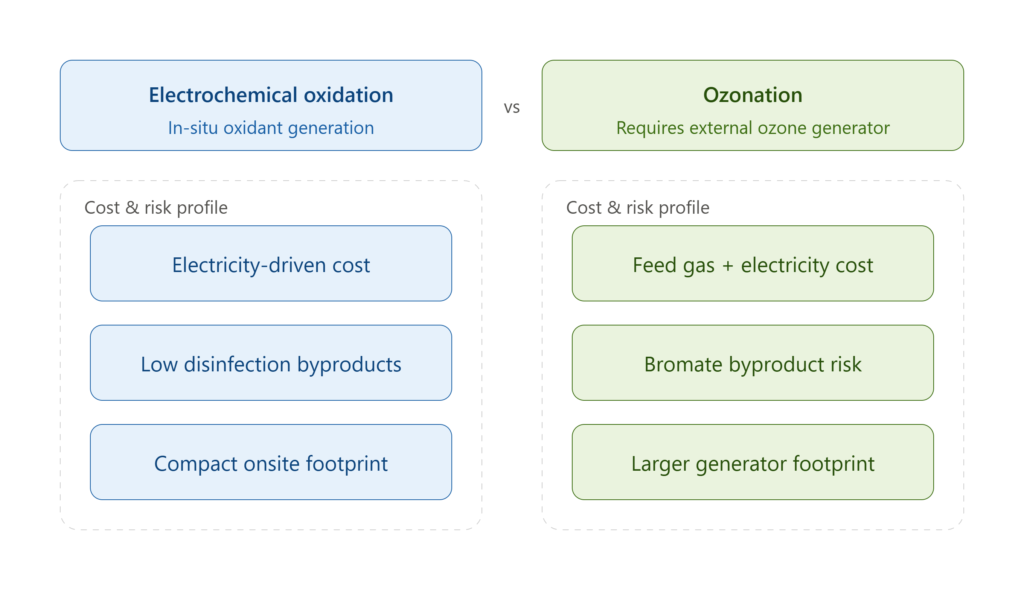
Ozone and EO both generate powerful oxidants for recalcitrant organic treatment. They are genuine alternatives for some applications — and genuinely not comparable for others. This page identifies which category your application falls into, The difference shows up in your utility bill and your byproduct risk, not in the chemistry textbook.
When they overlap
Both technologies generate hydroxyl radicals. The delivery mechanism differs.
Ozone and EO share the same primary oxidation chemistry: hydroxyl radical attack on organic compounds. They differ in how those radicals are generated — ozone through chemical reaction with water (typically with UV activation or H₂O₂ addition), EO through electrochemical water oxidation at the anode surface. That delivery difference creates real performance differences in specific matrix conditions and real infrastructure differences at the site level.
The decision matrix
EO vs Ozone — the conditions that determine the outcome
Apply these criteria to your application before evaluating detailed costs. Like we said before, electrochemical oxidation can not be “one for all”, therefore we concluded scenarios when electrochemical oxidation is likely a fit, then selecting the right approach when there are specific requirement or situations.
✓ EO is likely a fit when:
- Turbid or coloured matrix: UV penetration is limited — EO generates oxidants regardless of turbidity or colour
- No infrastructure for ozone generation or off-gas management at site
- PFAS is the target compound: ozone at practical doses does not activate the C-F bond — EO via BDD does
- High-chloride matrix: EO generates active chlorine synergistically; ozone/chloride interactions are a byproduct concern
- Small to medium industrial facility: EO modular skid may have lower capital than ozone system at this scale
- Combined COD + micropollutant target: EO addresses both simultaneously in one electrochemical stage
✕ EO is likely not a fit when:
- Large municipal WWTP (>100,000 m³/day): ozone has established cost basis at scale; EO electrode area at this scale is prohibitive
- Clean, low-turbidity polishing: UV/ozone has excellent energy efficiency in clean matrices without turbidity penalty
- Target compound is NOT PFAS: ozone competes effectively for many pharmaceutical and micropollutant targets
- Site already has ozone infrastructure installed and operating — capital is sunk
- Regulatory framework specifically cites ozone as the BAT technology for this application class
Underneath the verdict
How they actually differ
Ozone’s oxidation potential (about 2.07 V) sits below the hydroxyl radical’s (about 2.80 V), and ozone dissolves and reacts within the limits of gas-liquid mass transfer — which is why ozone contactors are sized around contact time and bubble diffusion, not just dose. EO generates the hydroxyl radical directly at the anode surface, in the liquid, without a mass-transfer step for a dosed gas. That advantage comes with its own cost: BDD anodes wear over their service life and need periodic replacement, whereas ozone generators are largely a power-and-maintenance cost with no consumable electrode.
Byproducts are the other side of this comparison worth taking seriously. Ozone in bromide-bearing water forms bromate, a regulated byproduct in drinking-water contexts; EO in chloride-bearing water can drive chlorate and, on non-active anodes like BDD, perchlorate. Neither process is byproduct-free — the deciding factor is which halide is actually in your water.
Infrastructure and operational comparison
The mechanism difference creates operational differences that matter for site selection.
EO vs Ozone: operational profile
Choose EO when
- Chloride is present and you'd rather manage chlorate/perchlorate risk through electrode choice than bromate from an ozone-bromide reaction
- You need continuous, higher-strength COD destruction rather than trace-level polishing
- You want to avoid an ozone generator, off-gas destruction unit, and the safety monitoring that comes with an on-site toxic gas
- Footprint and operational simplicity matter more than the lowest possible energy cost per kilogram removed
Choose ozonation when
- The target is disinfection, colour, or taste-and-odour compounds at trace concentration
- Water is relatively clean already and you're polishing rather than destroying a high-strength load
- Bromide is not present in the source water, removing ozone's main byproduct risk
- You can justify the capital and footprint of a generator, contactor, and off-gas destruct system for the throughput involved
The PFAS exception
Why ozone does not work for PFAS and EO does
Ozone has high oxidising potential — 2.07 V — which is sufficient for most pharmaceutical and natural organic matter destruction. It is not sufficient to activate the C-F bond in PFAS compounds. The C-F bond dissociation energy is approximately 544 kJ/mol, making it one of the strongest bonds in organic chemistry. Hydroxyl radical at 2.80 V can attack it; ozone at 2.07 V cannot at practical doses. BDD electrodes generate hydroxyl radicals at high overpotential, which is why BDD-based EO systems consistently achieve PFAS defluorination while ozone alone does not. This is not a dose question — it is a thermodynamic limit for ozone. If your target compound includes any PFAS structure, ozone is eliminated from the comparison and EO remains.
- C-F bond energy (≈54 kJ/mol) exceeds ozone oxidation potential at practical doses
- BDD anode generates •OH at 2.80 V — sufficient for C-F activation
- PFAS partial oxidation products (shorter-chain PFAS) are possible with ozone — not a clean result
- EPA D&D Guidance does not identify ozone as a PFAS destruction technology
- EO via BDD is specifically named in the D&D Guidance evaluation of destruction technologies
Not always either/or
Can they work together?
Common questions
EO vs Ozonation FAQ
Ozone-informed framing
The comparison does not dismiss ozone — it identifies the conditions where each technology has a genuine advantage.
PFAS thermodynamics
The C-F bond energy explanation is mechanistically grounded — not a vendor claim.
Scale-explicit
The scale boundary where ozone's cost advantage becomes decisive is stated explicitly rather than avoided.
Suitability Check
Where does this take you next?
Choose the path that matches where you are now.
→ Yes — EO is a fit
Your contaminant is recalcitrant, your regulatory driver requires destruction, and the matrix is compatible. Move to treatability testing.
→ Not sure yet
You have answered some of the fit questions but not all. Use the Go / No-Go Checklist to work through the remaining decision variables.
→ No — EO is not the right fit
The contaminant is biodegradable, the scale is too large, or the driver does not require destruction. Review the alternatives.