Level 1 · Critical filter
When Electrochemical Oxidation Is Not Suitable
Spot conditions rule electrochemical oxidation out more often than any electrode limitation ever will. This page exists to catch them early — before a vendor call, not after a pilot invoice.
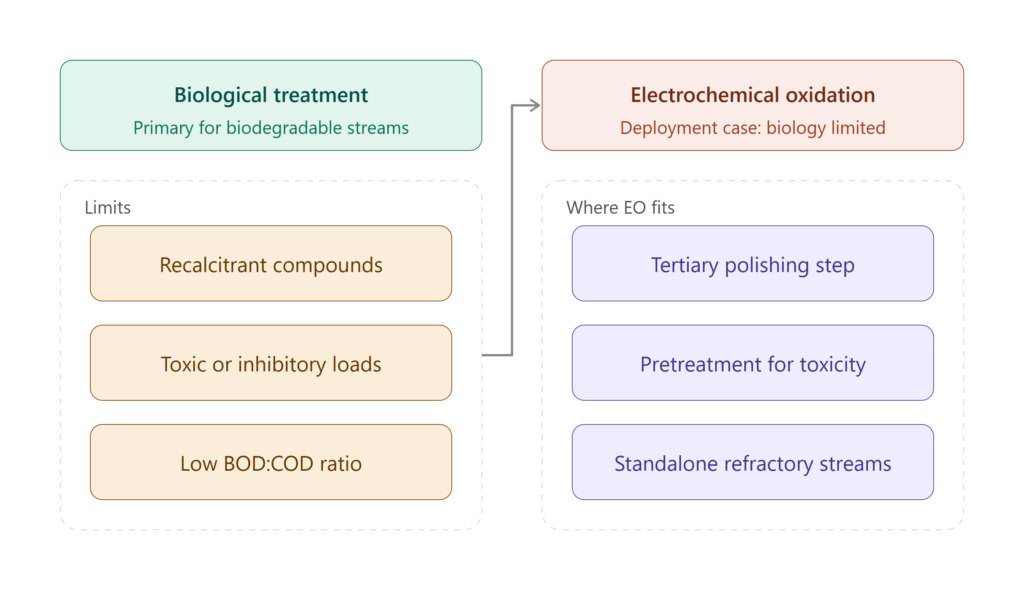
The five that matter
Five conditions that end this conversation quickly
Your stream is mostly biodegradable
A BOD:COD ratio above roughly 0.5 means biological treatment will remove the load for a fraction of the energy cost. Full page: high-BOD wastewater limitations.
Nothing actually needs destroying
If conventional treatment already clears your discharge limit and no compound or toxicity flag remains, EO adds cost without a regulatory or operational reason. Full page: low-toxicity stream limitations.
The energy math doesn't close
Dilute concentration, a poor local electricity tariff, or a target requiring near-complete mineralisation can push specific energy consumption past what the project can justify. Full page: energy intensity constraints.
Chloride pushes toward a byproduct problem
High chloride content risks chlorate and perchlorate formation, and some discharge limits on those compounds sit low enough that even modest formation is a compliance issue. Full page: chloride byproduct risks.
You're sizing for full municipal flow
Municipal-scale volume is the worst-case profile for EO economics — large, dilute, and mostly biodegradable. Full page: cost barriers for municipal use.
How to use this list
You don't need to fail all five
Treat this as five independent tripwires, not a cumulative score. A stream with a BOD:COD ratio of 0.7 doesn’t get partial credit for having low chloride — it’s mostly biodegradable, and that alone is usually reason enough to route it to biological treatment instead. Conversely, a stream can clear four of these five cleanly and still need a real answer on the fifth before capital moves.
Work through each subpage against your own lab numbers rather than pattern-matching from an industry label — two streams from the same sector can land on opposite sides of every single one of these conditions.
What actually ties these together
None of these are electrode failures
It’s tempting to read a list like this as a catalogue of technology weaknesses. It isn’t — every condition above is a case where the underlying economics or safety math doesn’t close, not a case where the electrode chemistry breaks down. Aeration genuinely is cheaper than EO on biodegradable load. Perchlorate genuinely does form on some chloride-rich, high-current-density combinations. Municipal-scale dilution genuinely does erode current efficiency.
That distinction matters because it means these aren’t problems to be engineered away with a better electrode — they’re structural mismatches between the technology’s cost profile and the stream in front of you. The fix is usually routing to a different technology, not iterating on the EO design.
Straight answers