Comparison: EO vs Biology
EO vs Biological Treatment
Biology is the default for organic wastewater treatment — and rightly so for biodegradable streams. This page defines exactly where biological treatment’s limits create the EO deployment case and where biology should remain the primary step.
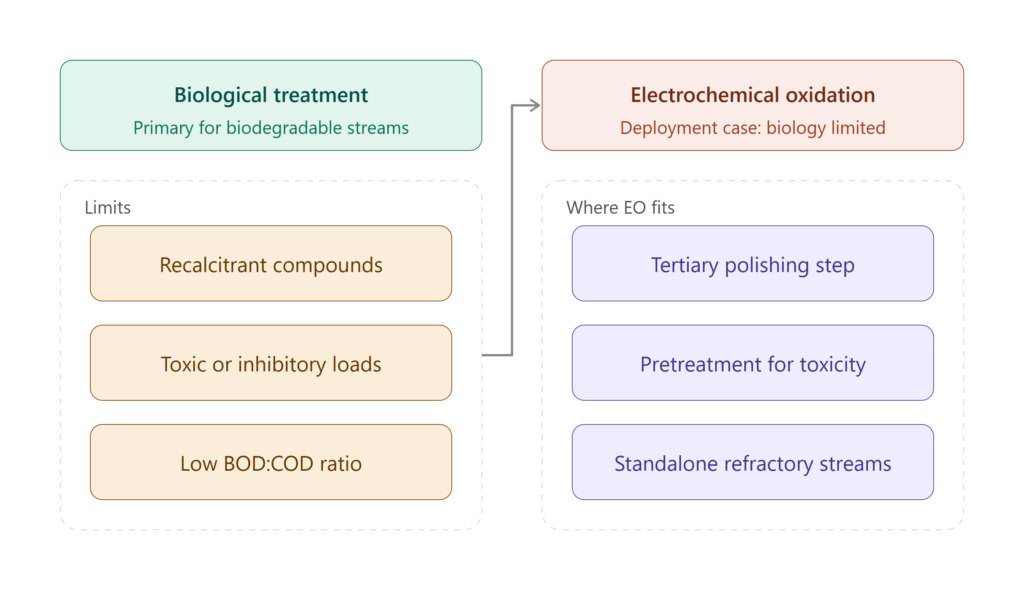
This comparison is at decision level. It describes the conditions under which EO is evaluated as a replacement for or complement to biological treatment — not a detailed process engineering guide to either technology.
Page last reviewed: July 2026.
The baseline
Biology first — always
Biological treatment is the correct first choice for wastewater containing biodegradable organic load. Activated sludge, moving bed biofilm reactors, and anaerobic digestion treat high-strength biodegradable COD at an energy efficiency that no oxidation technology matches. This is not a competition EO enters or wins at the COD level. The EO deployment case exists entirely in the space biology cannot reach — recalcitrant compounds that pass through the biological stage unchanged or that are toxic to the biology itself.
Where biology fails
The biological treatment failure modes that create the EO case
Biological treatment fails on recalcitrant organic compounds through three mechanisms: the compound is not biodegradable (PFAS, 1,4-dioxane, many pharmaceuticals), the compound is present at concentrations that are inhibitory or toxic to the microbial population, or the compound biodegrades slowly enough that the residence time required for adequate removal is economically prohibitive. All three failure modes produce an effluent that exceeds the discharge limit for a specific compound even when the system performs as designed for bulk COD. EO addresses these failure modes because it does not depend on microbial activity — it generates chemical oxidants electrochemically, independently of whether the compound supports biological degradation.
- PFAS: not biodegradable — passes biological treatment unchanged regardless of residence time
- 1,4-Dioxane: very slow biodegradation rate — biological residence time for adequate removal is impractical
- Pharmaceuticals: many APIs and antibiotics resist biological mineralisation — UWWTD quaternary provision reflects this
- High-salinity industrial streams: inhibitory to biology, but electrochemically favourable for EO
- Cyanide at high concentration: toxic to aerobic biology; requires specific pre-treatment or non-biological approach
- Recalcitrant colour compounds (melanoidins, reactive dyes): biological effluent still exceeds discharge colour limits
The complement vs replace decision
Is EO replacing biology or working after it?
In almost all industrial applications, EO is not a replacement for biological treatment — it is a complement. The question is which step comes first and what each step’s role is.
✓ EO is likely a fit when:
- EO as polishing: biological pre-treatment reduces bulk COD; EO addresses the recalcitrant residual at much lower charge density than if treating raw influent
- EO as side-stream: concentrate from biological clarifier or membrane unit treated separately by EO
- EO as primary for toxic streams: where the influent COD concentration or compound toxicity makes biological treatment unviable without extensive pre-treatment
- Combined train: biology → EO → discharge: the standard configuration for PFAS + COD + ammonia in landfill leachate
✕ EO is likely not a fit when:
- EO replacing biology for high-BOD, biodegradable COD at large volume — energy cost is prohibitive
- EO instead of biology where biological treatment is already operating and meeting permit for non-recalcitrant COD
- EO as primary treatment where the bulk COD is biodegradable and the recalcitrant fraction is a minor component — pre-treatment by biology then EO polishing is more cost-effective
- EO where the capital and energy cost per unit COD removed exceeds the cost of biological treatment for the same target compound
The energy arithmetic
The single most misused number in EO vs biology comparisons is the energy cost comparison. The comparison is only meaningful when it is applied to the specific fraction of the COD load that each technology is being asked to treat.
How the energy comparison actually works
Aerobic biological treatment: approximately 0.3–1.0 kWh/kg COD removed. EO for biodegradable COD: approximately 20–80 kWh/kg COD removed. Biology wins by a factor of 30–80x. Do not use EO for biodegradable COD.
Biological treatment: essentially no removal. EO: 5–40 kWh/m³ depending on matrix and target. The comparison is not biology vs EO — it is EO vs the alternative advanced oxidation option (ozone, UV/AOP) for the same recalcitrant fraction.
Biological treatment: zero removal. EO: 30–150+ kWh/m³ depending on PFAS profile, matrix conductivity, and target. High energy but no alternative destruction technology. The cost comparison is against the liability of not destroying PFAS — not against biological treatment.
Biology treats the biodegradable fraction at 0.3–1.0 kWh/kg COD. EO then treats a stream with reduced COD and concentrated recalcitrant fraction — at lower charge density and lower energy than if treating the full raw influent. This is the correct combined architecture.
Common questions
EO vs Biological Treatment FAQ
Biology-first framing
The starting position on this page is that biology is the default and EO earns its place by addressing the compounds biology cannot handle.
Energy-honest
The energy comparison is applied to the specific treatment fraction, not to the total stream — the comparison that matters for the actual project cost model.
Train-level thinking
The comparison is not one technology versus another in isolation — it is where each technology fits in the complete treatment sequence.
Level 1 Decision Gate
Where does this take you next?
Every page in the Decision Layer routes to one of three outcomes. Choose the path that matches where you are.
→ Yes — EO is a fit
Your contaminant is recalcitrant, your regulatory driver requires destruction, and the matrix is compatible. Move to treatability testing.
→ Not sure yet
You have answered some of the fit questions but not all. Use the Go / No-Go Checklist to work through the remaining decision variables.
→ No — EO is not the right fit
The contaminant is biodegradable, the scale is too large, or the driver does not require destruction. Review the alternatives.