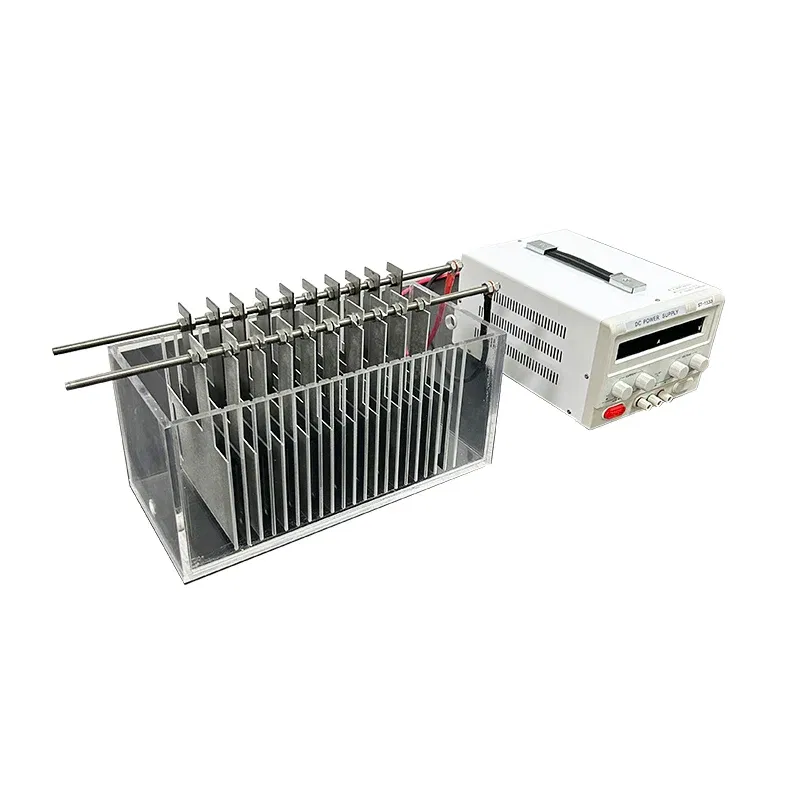
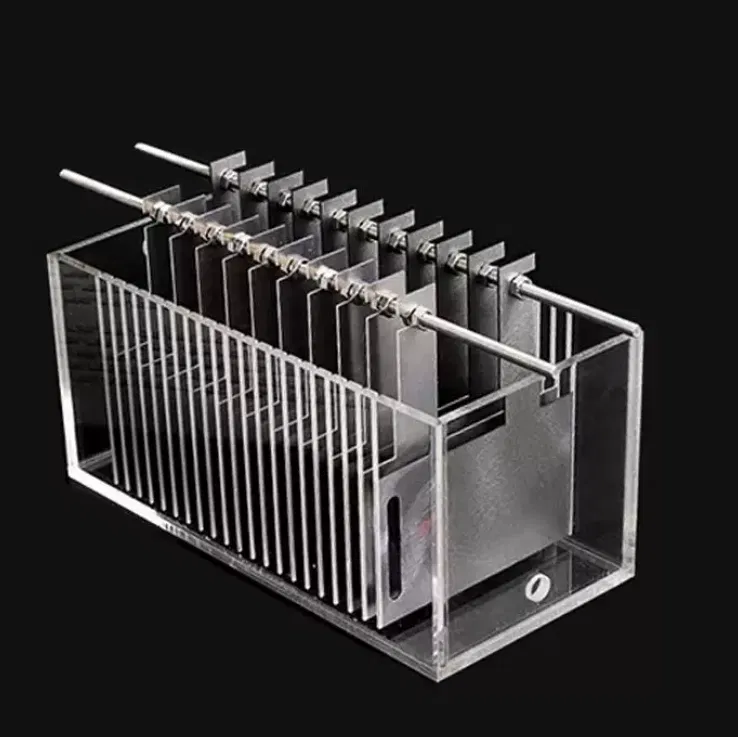
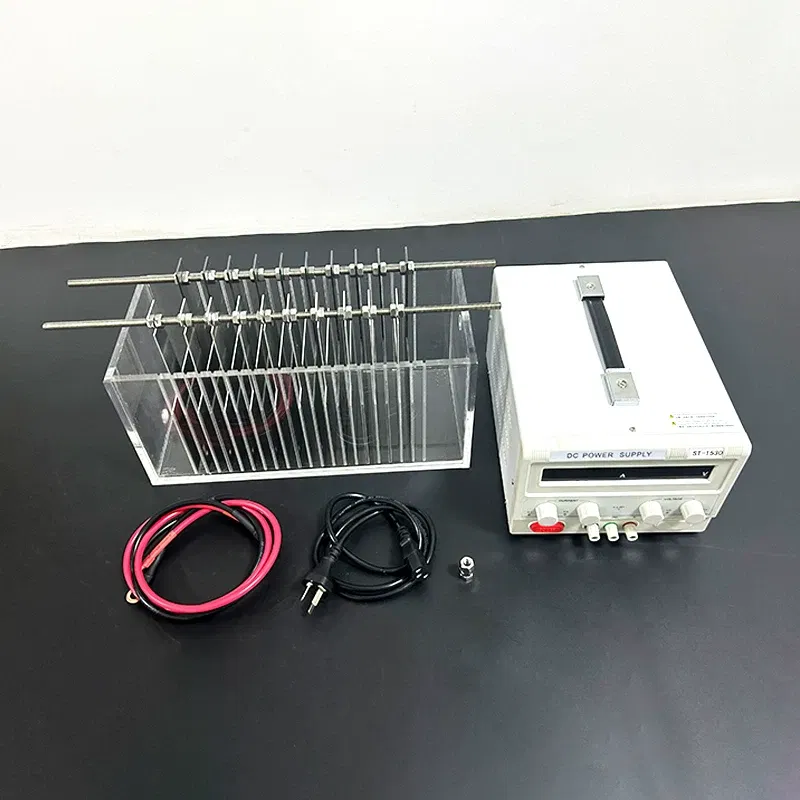
Engineering Overview Toward Electro Oxidation Trial Module
Current distribution stays even across the electrode stack, hydrodynamics adjust through cell format and flow rate, and electrodes swap out in the field without touching the reactor body. Because current density, electrode chemistry, and flow regime are the same variables a full-scale design runs on, data from this unit carries forward reliably when it’s time to size the real system.
Key Features
- Order BDD or Ruthenium-Iridium MMO anodes, or both, to run side by side in the same reactor body
- Closed/static cell for quick bench screening, or a recirculating mini-pump loop for continuous-flow data
- Inter-electrode gap adjustable mm in the field for mass-transfer tuning
- Rectifier input voltage and frequency configured to the destination site before it ships
- Constant-current or constant-voltage operation, cell voltage and current displayed in real time
- Off-gas is vented and managed so hydrogen, oxygen, and, where chloride is present, chlorine don’t build up
- Optional timed polarity reversal cuts cathodic scaling and stretches electrode life
- Wetted parts rated for high-salinity, aggressive industrial effluent
Configuration Options
Three axes, specified at order time. Change any one of them on the next order without touching the others.
BDD or Ruthenium-Iridium MMO
- BDD: direct anodic oxidation, works with or without chloride, strongest on recalcitrant organics and PFAS
- MMO: chloride-mediated, lower cell voltage, cheaper to run on saline or chloride-rich streams
- Order both for a head-to-head bench comparison
Closed / Batch or Recirculating Loop
- Closed cell: sealed, no pump, fastest bench setup
- Recirculating: external tank, variable-speed mini pump, in-line probe ports
- Recirculating format matches full-scale flow-through behavior more closely
Axis 03 / Power Supply
Rectifier Matched to Your Site
- 50 Hz or 60 Hz, built to order
- 0–60 VDC / 0–100 A output, constant current or voltage
- CE, UL documentation matched to destination market
Anode Material — Detailed Comparison
| Boron-Doped Diamond (BDD) | Ruthenium-Iridium MMO | |
|---|---|---|
| Substrate | Silicon or niobium substrate, CVD diamond coating | Titanium substrate (ASTM B265), thermally applied Ru-Ir oxide coating |
| Oxidation pathway | Direct anodic oxidation — hydroxyl radicals at the electrode surface, works with or without chloride | Primarily chloride-mediated — active chlorine/hypochlorite when chloride is present, plus oxygen evolution |
| Current density | 10–300 mA/cm² | 20–150 mA/cm² |
| Cell voltage / energy | Higher, more energy per unit COD removed | Lower, generally cheaper to run |
| Best fit | Low-chloride streams, recalcitrant organics, PFAS/emerging contaminants | Chloride-rich or saline streams — textile, tannery, brackish RO reject |
| Byproduct watch-outs | Chlorate/perchlorate risk if chloride present at high current density | Chlorate, perchlorate, AOX/THM formation when chloride is significant |
| Coating life | Rated in operating hours at design current density | Rated in amp-hours per unit coating mass consumed |
| Relative cost | Higher | Lower |
Most customers start with the anode that matches their full-scale plan, then order the other for comparison once bench numbers land close. Chloride-rich water usually answers this fast; low-chloride recalcitrant organics tend to favor BDD from the start.
AC-DC Power Supply — Regional Configuration
| Site voltage / frequency | 50 Hz or 60 Hz, vary according to different regions and actual requirement |
| Rectifier output | 0–60 VDC / 0–100 A, sized to anode and current density |
| Control mode | Constant current or constant voltage; |
| Ripple filtering | Standard switch-mode; low-ripple option for voltage-sensitive processes |
| Polarity reversal | Optional, timer-controlled |
| Enclosure | NEMA 4X / IP65 standard; corrosion-resistant coating for coastal or chemical-plant sites |
Tell us the destination country and the rectifier’s input stage is built to match local supply before it leaves the shop — moving between a 60 Hz and a 50 Hz site later is a rectifier swap, not a reactor rebuild.
Study Path — Bench to Full-Scale
The electro oxidation trial module is one stop on a ladder, not a one-off box. Most programs move through this sequence, though not every program needs all four steps.
Step 1 / Days
Bench / Jar Screening (This EO Trial Module Unit)
- Quick jar or beaker-scale runs on a grab sample
- Answers whether the chemistry works at all
- Rough current density and charge dose target
Step 2 / Weeks
EO Bench Module
- Skid-mounted, runs on your site’s water and power
- Removal kinetics, energy per unit removed, byproduct data
- What a full-scale system gets sized from
Containerized Pilot
- Longer unattended runs, regulatory-grade data
- Same electrode chemistry, larger scale
- Weeks to months, for programs that need it
Full-Scale Design
- Current density, flow regime, chemistry carry forward
- Only the size changes, not the process
- Trial data drives the equipment sizing
Engineering Views
Request the drawing package before planning installation:
- General arrangement drawing — skid footprint, nozzle locations, utility tie-in points
- P&ID — flow path, instrument locations, control loop connections for the recirculating configuration
- Exploded electrode stack view — plate spacing, gasket layout, anode/cathode pairing
- Electrical single-line diagram — rectifier, distribution, grounding, drawn for your site’s voltage and frequency
- Pump and piping isometric for the recirculating loop, with wetted-material callouts
Application Ranges
Influent conditions the module handles without extra prep. Outside these windows, the water may still be treatable — plan on pretreatment or a bench check first.
| pH | 2–11 (4–9 keeps electrodes lasting longer) |
| Conductivity | Above 1,000 µS/cm for better energy efficiency |
| Chloride | 0–5,000 mg/L. MMO leans on this for active-chlorine oxidation; BDD doesn’t need it, but chlorate/perchlorate can still form at high current density if it’s present |
| COD / TOC | Up to ~5,000 mg/L COD at trial scale |
| Suspended solids | Below 500 mg/L; filter ahead of the cell if running higher |
| Temperature | 5–40°C |
| Flow rate | 1–50 L/min, recirculating configuration |
Specifications & Technical Characteristics
Process
| Electrode configuration | BDD or Ru-Ir MMO anodes, titanium or stainless cathodes, configurable |
| Inter-electrode gap | 1–10 mm, field-adjustable |
| Current density | 10–300 mA/cm² (BDD) or 20–150 mA/cm² (MMO) |
| Cell format | Closed/batch or recirculating loop with variable-speed mini pump |
| Operating mode | Batch recirculation or continuous flow-through |
| Control system | Constant current or constant voltage; PLC/HMI optional |
| Flow capacity | 1–50 L/min at trial/pilot scale, recirculating configuration |
| Materials of construction | PVC/CPVC or PP wetted parts, chemical-resistant seals; pump wetted parts matched to effluent |
Electrical & Mechanical
| Power supply | Input voltage/frequency configured to destination site; DC rectifier output |
| Rectifier output | 0–60 VDC / 0–100 A, sized to application |
| Footprint | ~1.2 m × 0.8 m for the trial skid (closed cell); add ~0.5 m × 0.5 m for the recirculating tank and pump skid |
| Weight | 150–300 kg dry, varies by configuration |
| Enclosure rating | NEMA 4X / IP65 |
| Instrumentation | Inline conductivity, pH, ORP, and cell voltage/current monitoring available |
Application Notes
What we typically see across common wastewater sources — a starting point for scoping the trial, not a substitute for running your own sample.
Textile & Dye Wastewater
High color, high COD, and usually plenty of chloride left over from salt-based dyeing — a combination that plays to MMO’s strengths. Azo dye bonds tend to cleave early in the run, so color often drops faster than COD; don’t stop the trial at decolorization if COD removal is the actual permit driver.
Pharmaceutical & API Manufacturing
Trace APIs, antibiotics, and endocrine-disrupting compounds tend to be structurally stubborn — ring structures that chlorine-mediated oxidation doesn’t always finish off. BDD’s hydroxyl radical pathway generally gets further here, often run as a polishing step around biological treatment.
Metal Finishing & Plating Rinse Water
Cyanide destruction is well established here, often paired with electrocoagulation for metals removal on the same line. MMO is usually the economical choice once chloride is dosed deliberately to drive the reaction.
Landfill Leachate
Mature leachate runs high ammonia, high color, and a low BOD:COD ratio that biological treatment struggles with alone — a common reason EO gets evaluated as a polishing step. Chloride is usually present naturally, which raises the chlorate/perchlorate question; budget for that monitoring in the trial plan, not after.
PFAS & Emerging Contaminants
BDD electrode is one of a short list of technologies capable of direct anodic oxidation of PFAS chains. At low ppb/ppt influent concentrations, energy cost per unit removed climbs fast, so most programs pair EO with an upstream concentration step — foam fractionation or ion exchange — then run EO on the concentrate. Still an emerging application; run the bench trial first.
Food & Beverage Processing
CIP cleaning chemicals leave enough conductivity for EO to run efficiently, and the water is generally low in the scaling minerals that shorten electrode life elsewhere. Most programs run it as a polishing step after primary biological treatment, targeting residual color and COD.
Pairing With Other Unit Processes
The electro oxidation trial module runs standalone, but on a lot of real programs it’s one skid in a short train. Two pairings come up often enough to plan for at order time.
Upstream Concentration for Dilute Loads
For PFAS and other low-ppb targets, an ion-exchange or GAC skid ahead of the EO module concentrates the load before it hits the electrodes — keeps the electrochemical energy bill on the concentrate instead of the full flow, and stretches media life since the EO step can regenerate or destroy what the media would otherwise have to absorb outright. Ask about pairing a loaner IX/GAC skid with the trial module for a combined pilot train.
Solids & Metals Polishing
High-solids or metals-bearing streams foul the electrode surface faster than clean ones. Electrocoagulation or DAF ahead of the EO cell — or electroflotation built into the same cell body — knocks down solids and metals before or alongside the oxidation step, keeping the electrode surface clean and the current density where you specified it.
Go / No-Go Screening
Run through this before committing to a full treatability trial. When it’s a close call, a short bench jar test usually settles it.
GOIndicators
- Conductivity above 1,000 µS/cm, or electrolyte dosing is on the table
- Chloride is present, or you’re willing to add it, for chlorine-mediated oxidation
- Target contaminants are known to oxidize — organics, color, cyanide, phenols, some micropollutants
- Solids can be knocked below 500 mg/L ahead of the cell
- Bench data or published results back EAOP for this matrix
- Site power (voltage, phase, frequency) is known, so the rectifier gets sized right the first time
FLAGNo-Go / Review
- Hardness, iron, or manganese high enough to scale electrodes without pretreatment
- Conductivity under 200 µS/cm and electrolyte dosing isn’t an option
- Bromide present in meaningful amounts, raising bromate as a regulatory question
- Oil, grease, or solids loading high with nothing upstream to catch it
- Contaminants are refractory — RO or biological treatment is a better fit
Engineering Notes
- Electrode choice follows the chemistry: BDD electrode gives the strongest oxidation but costs more, MMO is cheaper and leans on chlorine-mediated pathways
- Run a bench test before committing to pilot scale — the fastest way to nail down current density, charge dose, and energy use per unit removed
- Chloride or bromide in the feed can form chlorate, perchlorate, or bromate; plan to monitor downstream
- Off-gas includes hydrogen, oxygen, and sometimes chlorine — ventilation matters, and enclosed installs need an explosion-proof rating
- Expect pH to drift as the cathode generates hydroxide; plan for inline control or neutralize downstream
- Reversing polarity periodically keeps the cathode from scaling and stretches electrode life
- MMO coating consumption is usually rated in milligrams per amp-year; track cell voltage at fixed current over the run as an early wear signal
- 50 Hz and 60 Hz sites use different rectifier transformer and cooling specs — flag the destination country before the unit is built
- Testing both anodes in the same run? Use the recirculating loop so flow conditions stay identical between comparisons
Procurement & Ownership Notes
- Standard lead time: 6–10 weeks from order confirmation, depending on anode material and rectifier configuration
- Factory acceptance testing (FAT) runs before ship, at your specified current density and, where relevant, on your submitted water sample
- Documentation package: mill certificates for electrode substrates, coating QA records, rectifier test data, CE/UL/CCC paperwork matched to destination market
- Anode warranty terms differ by material — ask for written coverage on operating hours (BDD) or amp-hours (MMO) at your specified current density, not just a calendar term
- Consumables to budget for: electrode replacement on its rated life, pump seals and diaphragms on the recirculating configuration, probe calibration solutions if instrumentation is fitted
- Commissioning and operator training available on-site or remote; remote diagnostics on units with the PLC/HMI option
- Total cost of ownership is driven mostly by energy per unit of contaminant removed and electrode replacement interval — both come out of the trial data, so treat this run as a costing exercise as much as a feasibility one
- Rental / loaner terms are available for extended runs — typically anywhere from a few weeks up to multi-year programs — if you’d rather shift the trial from a capital purchase to an operating expense
What You Get in the Study Report
Every trial run closes out with a written report, not just a data dump. It typically covers:
- Removal efficiency curves for your target parameters — COD, TOC, color, or specific compounds — plotted against charge dose
- Energy consumption per unit of contaminant removed (kWh/kg COD or kWh/kg TOC), the number that drives full-scale opex
- Byproduct data — chlorate, perchlorate, AOX, or other species relevant to your chloride and bromide levels
- A capex and opex estimate for a full-scale system sized off the trial data, including chemicals, labor, and power
- Electrode life projection and replacement interval at your operating current density
- A go/no-go recommendation, with a comparison against alternative technologies where one was run in parallel
Frequently Asked Questions
Most industrial and municipal streams work well above roughly 1,000 uS/cm conductivity. If solids or scaling potential run high, pretreat
first – the Go/No-Go notes above cover this.
If your water is chloride-rich, or you’re already leaning toward a chloride -mediated design, start with MMO-it’s the cheaper way toconfim the chemistry works. If chloride is low, or youre targeting recalcitrant organics or PFAS, start with BDD. Order both if the answer
isn’t obvious from your water report.
Yes, it’s a plumbing change, not a reactor swap. Most customers start on the closed cell for quick screening, then add the recirculating
loop kit once they move to longer or continuous-flow runs.
Yes. Tell us the destination country at order time and we configure the rectifier’s input stage and supply compliance documentation accordingly to match specific power configuration.
Charge dose, energy use, removal kinetics for your target contaminants,and data on any byproducts forming-enoughto size a ful-scale
system from.
One to six weeks in most cases, depending on how many conditions you’re screening.
Power matched to the rectifier spec, a feed connection, drainage, and ventilation for the off-gas.
Request a Quote or Treatability Study
Tell us about your wastewater and what you’re trying to accomplish — our process engineering team follows up with sizing guidance and treatability study options.