Electrochemical Oxidation / Treatment Objects/ COD Reduction
Modeling the True Operating Cost of an EO System
Chemical oxygen demand is the number most discharge permits and most internal treatment targets are actually written against. Getting from a bench removal curve to a reliable design number takes more than picking a current density and running the math.
Mechanism
Two pathways, one number on the report
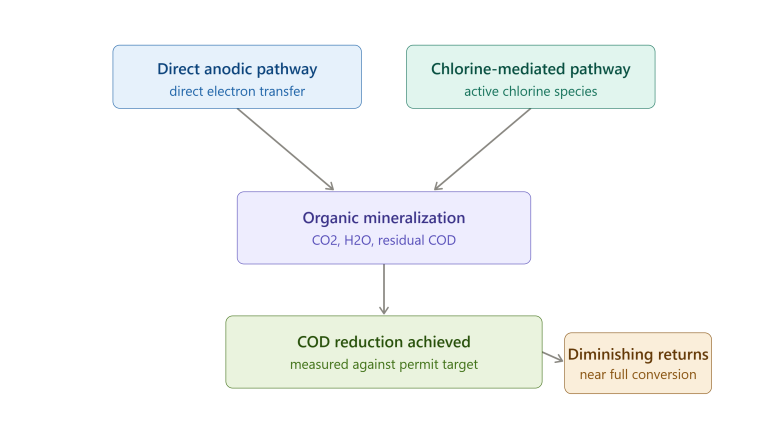
COD reduction under electrochemical oxidation happens through direct anodic electron transfer or through chlorine-mediated indirect oxidation, depending on electrode material and whether chloride is present in the matrix — the underlying chemistry of both pathways is covered on our How Electrochemical Oxidation Works page, and isn’t repeated here. What matters for a COD target specifically is that neither pathway removes COD uniformly across a mixed organic load: some fractions oxidize quickly at low charge dose, and a stubborn residual fraction can require disproportionately more charge to shift.
Engineering note
Removal-versus-charge-dose curves are rarely straight lines. Most streams show a fast-removal region followed by a flattening curve where each additional percentage point of COD reduction costs noticeably more energy than the one before it — knowing where that knee sits is what separates a realistically sized system from one designed against an optimistic early-curve extrapolation.
Setting a realistic target
Removable COD versus true residual
Not every unit of COD in a stream is removable by oxidation at a commercially sensible charge dose. Part of a bench program’s job is separating the fraction that responds within a reasonable energy budget from a residual that would need charge doses well outside that budget to shift — that residual sometimes needs a different technology entirely, or a blended target where EO handles the bulk reduction and a downstream polishing step or discharge allowance covers the rest.
This is also where a stream’s oxygen demand composition matters: COD dominated by readily oxidizable solvents behaves very differently under current than COD dominated by aromatic ring structures or chelated species, even at the same starting COD number.
Where this shows up
Cross-references, not repeated content
COD reduction is the primary or secondary target on nearly every industry page in our Applications cluster. Rather than repeat industry-specific COD ranges and case data here, see the Chemical Industry, Pharmaceutical, and Landfill Leachate pages for matrix-specific figures, and the Bench, Pilot & Commercial System Design page for how a COD target translates into a scale-up program.
Application note
If your permit specifies COD alongside a separate BOD limit, confirm whether your biological pretreatment is removing readily biodegradable COD before EO ever sees the stream — EO bench data run on raw, untreated effluent can overstate the charge dose a post-biological polishing step would actually need.
Questions About COD Reduction via Electro-Oxidation? TALK TO US
Have a COD target and a stream to test it against? Need a stimulation toward the estimated reaction time and other information beyond?
Reviewed for technical accuracy by Janeczka Kowalski, Process / Electrochemical Engineering. Figures and ranges on this page are engineering starting points — verify against your own pilot or vendor data before finalizing a design. The content is created by the Evoaeo engineering team lead by Janeczka, All rights reserved.