Produced Water: Comparison
Offshore vs. Onshore Produced Water: Different Discharge Rules, Different Treatment Priorities
Our main Produced Water page treats this as one topic. In practice, where a well sits changes what “adequately treated” even means — the discharge endpoint is completely different.
Reviewed for technical accuracy by Janeczka Kowalski, Process / Electrochemical Engineering. No specific jurisdiction’s NORM thresholds or disposal classification rules are stated here, deliberately, since these vary significantly and stating one as universal would be actively misleading. Figures and ranges on this page are engineering starting points — verify against your own pilot or vendor data before finalizing a design. The content is created by the Evoaeo engineering team led by Janeczka, All rights reserved.
Two Different Endpoints
Offshore
Direct discharge to open ocean under strict oil-in-water concentration limits. Treatment happens on a platform with real space and weight constraints — a compact footprint matters as much as removal performance.
Onshore
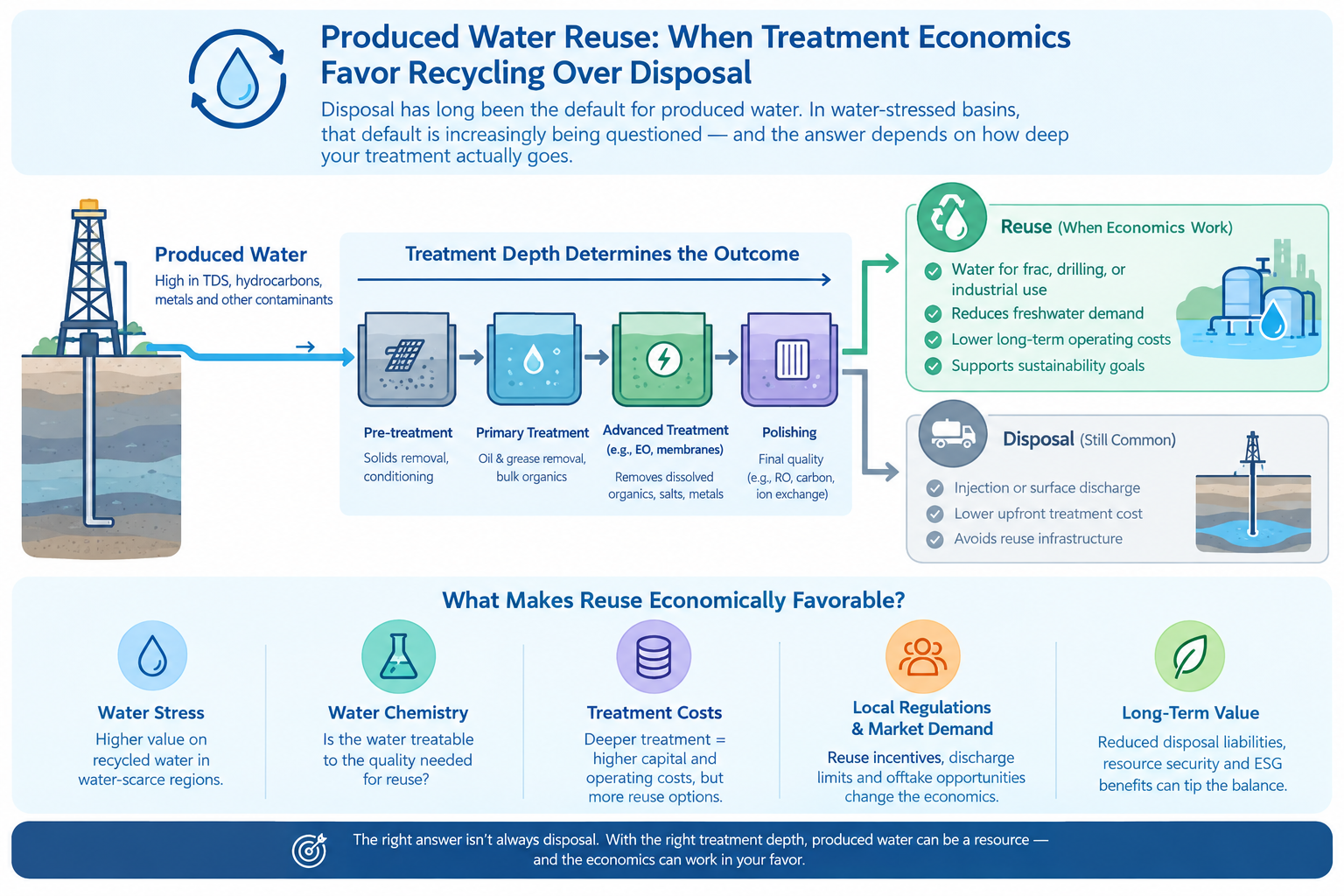
Typically routed to disposal wells, reuse, or surface discharge under permit regimes that vary by state/country. Land availability is rarely the constraint offshore platforms face, which changes the calculus on system footprint.
Where Volume-Matched Deployment Fits Each Context Differently
Our Produced Water Treatment page already covers volume-matched deployment as a core capability — offshore, that’s primarily a space-and-weight conversation; onshore, it’s more often about matching a disposal well’s remaining capacity or a reuse pathway’s demand. Same capability, different sizing conversation.
Offshore platform or onshore site?
Tell us which, and we’ll scope a system against the constraints that actually apply to your location.