Engineering Services: EPC Delivery
Custom EPC Delivery Toward Electro Oxidation Processes
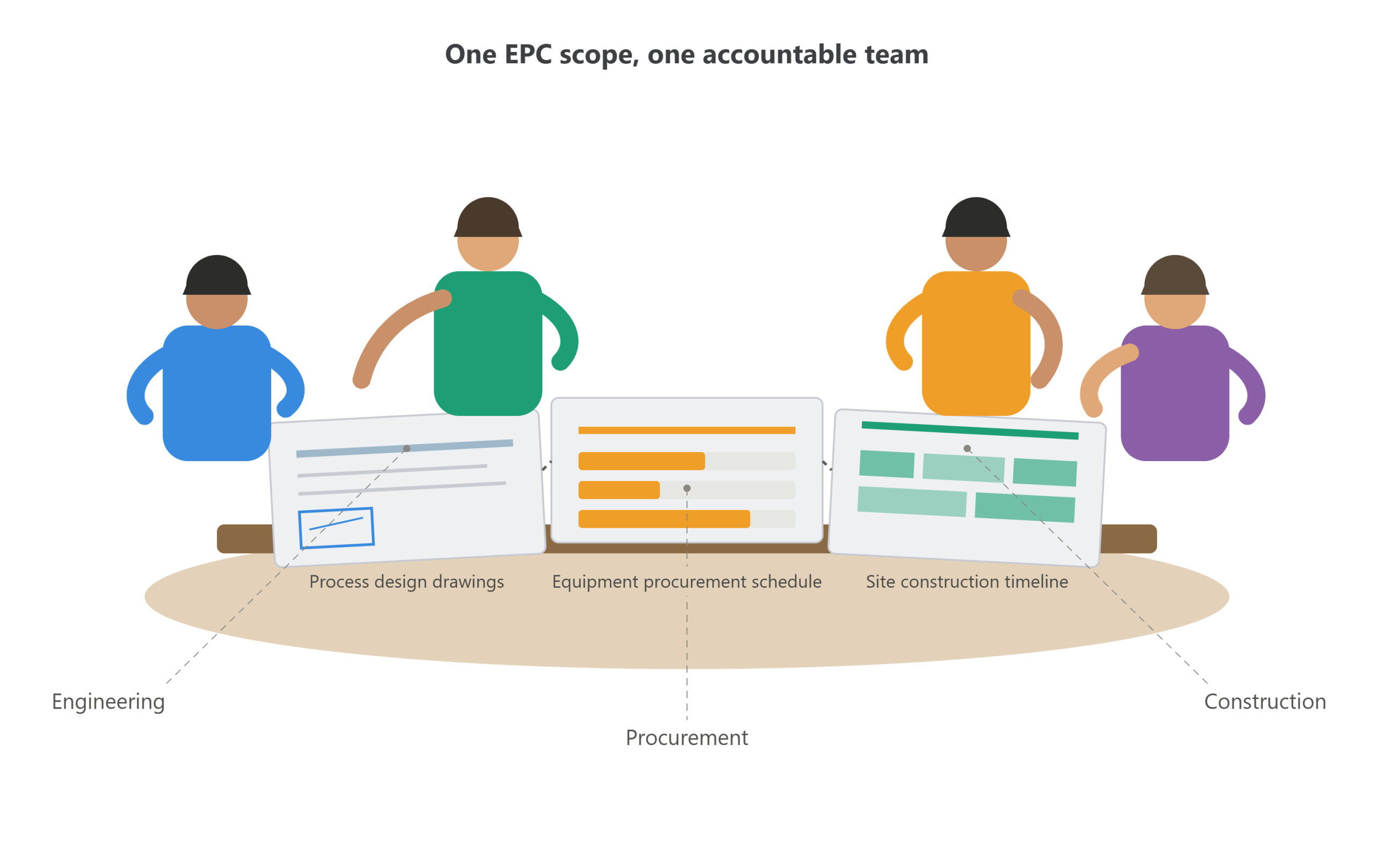
EPC isn’t a separate service we offer alongside engineering, procurement, and construction – it’s how those three normally-separate scopes come together under one contract and one accountable team, built around your specific matrix rather than assembled from a standard catalog.
Reviewed for technical accuracy by Janeczka Kowalski, Process / Electrochemical Engineering. Figures and ranges on this page are engineering starting points — verify against your own pilot or vendor data before finalizing a design. The content is created by the Evoaeo engineering team led by Janeczka, All rights reserved.
What EPC means here, and what it doesn’t
One contract, one accountable team
A conventional path to a new treatment system often means coordinating three separate relationships: an engineering firm producing a design, an equipment vendor supplying hardware against that design, and a construction contractor installing it – with the facility left to manage the handoffs, and no single party accountable if something falls through a gap between scopes. Full EPC delivery collapses that into one contract and one team responsible for the design, the equipment procurement, and the physical construction and installation, start to finish.
This doesn’t mean every project gets the same fixed package. It means the full scope – whichever combination of phases a given project actually needs – sits under one accountable relationship instead of being split across parties who each optimize for their own piece rather than the finished system.
Why customized, not packaged
Every system is specified against your matrix, not selected from a catalog
A packaged, one-size EO unit is built to a generic specification and then adapted, sometimes awkwardly, to whatever stream it’s actually asked to treat. Customized EPC delivery reverses that order: your wastewater characterization data drives electrode material selection, reactor geometry, rectifier sizing, and automation architecture from the start, rather than retrofitting a standard unit after the fact. The tradeoff is real and worth naming directly – a customized system generally costs more upfront and takes longer to specify than pulling a packaged unit off a shelf. What you get in return is a system sized to your actual charge-dose and removal requirements instead of a generic unit running outside its efficient operating window on your specific stream.
Application note
If your stream is genuinely simple and well-characterized against a common matrix profile, a packaged unit may be the more cost-effective choice – full customization earns its cost specifically on streams complex or unusual enough that a generic specification would leave real performance on the table.
How the phases connect as one scope
The same engineering process, under one contract
Every phase covered on our Engineering Services pages can be delivered as a standalone engagement, or as one continuous EPC scope where each phase’s output feeds directly into the next without a contract handoff in between. The sequence doesn’t change – what changes is accountability: one team carries the project from wastewater characterization through commissioned, operating equipment, rather than a design firm’s responsibility ending at a drawing set.
- Feasibility & Design: Wastewater Characterization, Conceptual & Process Design, Reactor Engineering & Electrode Design, Engineering Consultation
- System Development: Bench, Pilot & Commercial System Design, System Integration & Automation, Power Supply & Electrical Integration
- Implementation: Installation and Setup, carried out by the same team that specified the design
- Service & Support: Training, Technical Support, Maintenance, and Software & Hardware Updates continue under the same relationship post-commissioning
Procurement specifically
The scope most EPC comparisons skip past
Procurement is where a split-scope project most often loses time and money, and it’s the piece a design-only engagement doesn’t cover at all: vendor qualification for electrodes, rectifiers, and instrumentation; long-lead-item scheduling so a 20-week rectifier delivery doesn’t sit unaddressed until construction is already underway; and component-level quality verification against the design specification before anything reaches site. Under one EPC contract, procurement decisions stay tied to the original design intent – a vendor substitution made to hit a budget or schedule target gets evaluated against the actual process requirement it needs to meet, not approved in isolation by whoever happens to be managing that piece of the project.
Engineering note
Long-lead electrical components – custom rectifiers in particular – are consistently the critical-path item on a commercial-scale EO project. Procurement timing needs to start the moment reactor and electrode specifications are locked, not after construction planning begins, or the rectifier delivery date becomes the project’s actual schedule constraint regardless of how fast everything else moves.
Proof, not claims
Where EPC scope has actually been delivered
Two of our published case studies were delivered as full EPC scope – design, equipment procurement, and installation under one contract, not a design handed off to separate parties. See our Full-Scale EO Plant deployment for a three-reactor-train commercial complex, and our Commercial EO System for Cyanide Destruction case study for a full-flow single-line installation, both carried from initial characterization through commissioned, operating equipment under one accountable team.
Have a project that would benefit from single-source EPC accountability?
Send us your information and we’ll respond with an engineering read — no obligation.