Technology Comparison:EO vs. Electrocoagulation
Eelectro Oxidation vs. Electrocoagulation
Both use an applied current and both sit under the “electrochemical treatment” umbrella — which is exactly why they get confused. They solve opposite problems. Find out what are the major differences of electro oxidation and electrocoagulation.
Reviewed for technical accuracy by Janeczka Kowalski, Process / Electrochemical Engineering. Figures and ranges on this page are engineering starting points — verify against your own pilot or vendor data before finalizing a design. The content is created by the Evoaeo engineering team led by Janeczka, All rights reserved.
The core distinction
Destruction vs. separation
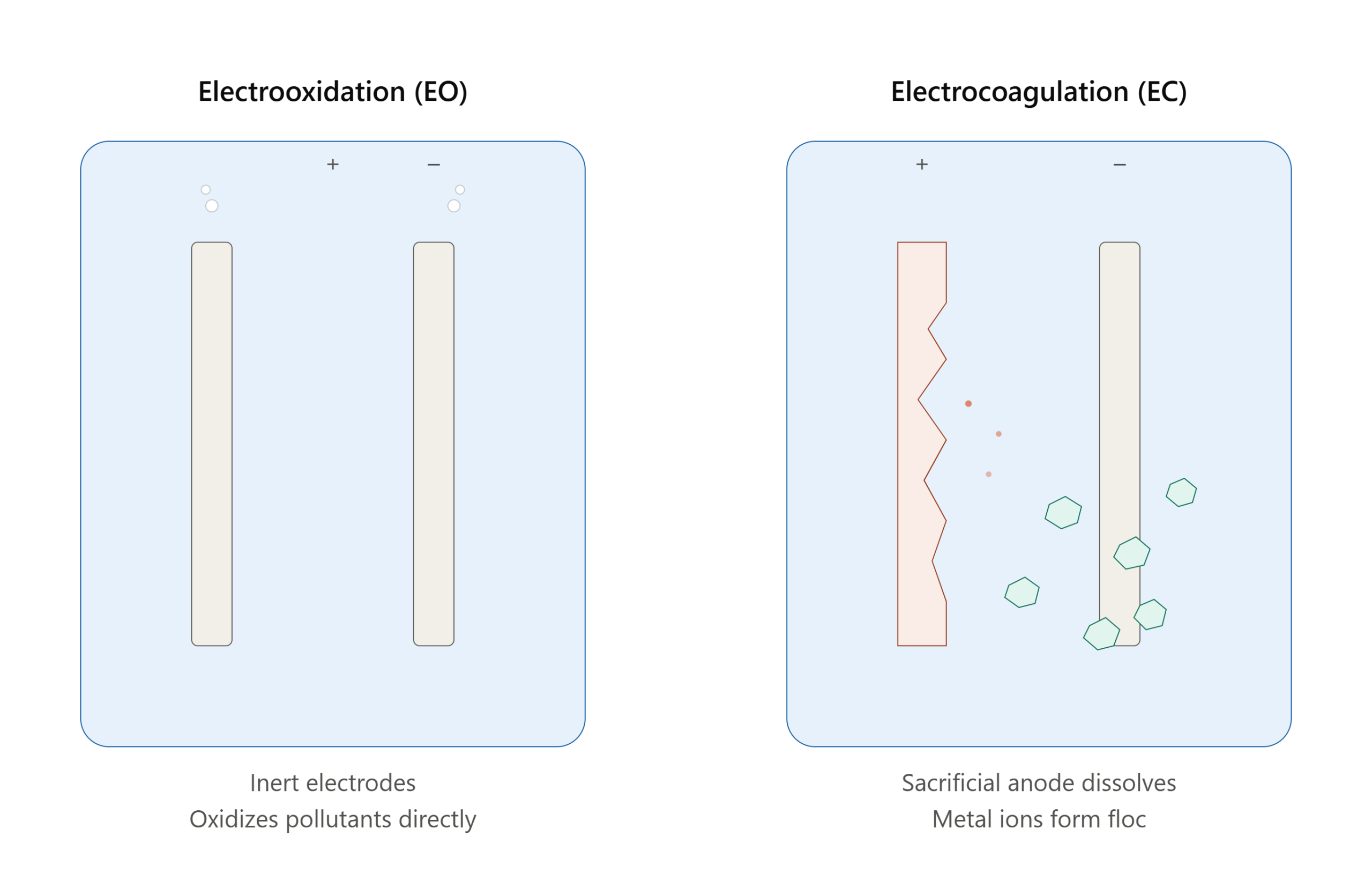
Electrocoagulation uses a sacrificial anode — typically aluminum or iron — that dissolves under applied current to generate metal ions, which hydrolyze into coagulant flocs that destabilize suspended particles, emulsified oils, and some dissolved metals so they can be removed by settling or flotation. Nothing is chemically destroyed; the pollutant load is concentrated into a sludge that still needs disposal. Electrochemical oxidation runs on the opposite principle: an inert or catalytic electrode (BDD, MMO) doesn’t dissolve, and the applied current instead drives oxidation reactions that break pollutants down, ideally to CO₂ and water, rather than moving them into a separate solid phase.
What each is actually good at
Different pollutant classes, different jobs
Electrocoagulation is well suited to suspended solids, emulsified oil and grease, and heavy metals that can be precipitated as hydroxides — it’s a physical-chemical separation technology at heart, closer in function to conventional coagulation/flocculation than to an oxidation process. EO’s strength is dissolved, recalcitrant organic load and specific compounds that resist biological treatment — exactly the contaminant classes that pass straight through an electrocoagulation stage untouched, since there’s no oxidation happening there at all.
Engineering note
These two are frequently paired rather than competing: electrocoagulation ahead of an EO stage removes solids, oil, and metals that would otherwise foul the EO electrode surface, letting the EO stage focus entirely on the dissolved organic load it’s actually good at destroying.
Operating and consumable differences
Sludge generation vs. energy consumption
Electrocoagulation consumes its sacrificial anode as a genuine operating cost, and generates a metal-hydroxide sludge stream that requires dewatering and disposal — a real waste-handling cost that doesn’t show up on an EO system, which produces minimal solid waste when run with an inert electrode. EO’s operating cost instead concentrates almost entirely in electrical energy consumption, which scales with the organic load and target removal rather than with treated volume the way sludge generation does.
- Choose electrocoagulation for suspended solids, emulsified oils, or metals removal via precipitation
- Choose EO for dissolved, recalcitrant organic destruction that electrocoagulation can't touch
- Consider both in sequence — electrocoagulation as pretreatment protecting the EO electrode surface — on streams carrying both solids and dissolved recalcitrant organics
Pollutant-by-pollutant comparison
How EO and Electrocoagulation perform on the pollutants that matter
Ratings reflect typical performance patterns reported across industrial-scale applications, not a substitute for bench testing on your specific matrix.
| Pollutant | EO | Electrocoagulation | Engineering take |
|---|---|---|---|
| Emulsified oil & grease | Limited — not a primary target | Excellent | EC is the right tool for this specific load; EO alone won’t address it efficiently |
| Suspended solids / turbidity | Not applicable | Excellent | Pair EC ahead of EO to protect electrode surfaces from fouling |
| Hexavalent chromium (Cr⁶⁺) | Indirect only | Good — reduction + precipitation | EC’s sacrificial iron anode directly reduces Cr(VI) to Cr(III) for precipitation |
| Dissolved COD / recalcitrant organics | Excellent | Limited — enmeshment only, not destruction | This is EO’s core strength and EC’s clearest gap |
| General heavy metals (precipitable) | Not applicable | Good to excellent | EC’s coagulant chemistry is built for this; EO isn’t the right tool here |
Chromium spotlight
Hexavalent chromium is where electrocoagulation does something EO structurally can’t: the sacrificial iron anode directly reduces Cr(VI) to the far less toxic, far more readily precipitated Cr(III), combining reduction and removal in a single step. EO has no equivalent reduction pathway — its oxidizing environment works against chromium reduction chemistry rather than for it. A stream with meaningful hexavalent chromium loading is one of the clearest cases where electrocoagulation, not EO, is the right primary technology.
PFAS spotlight
Electrocoagulation can concentrate PFAS into floc or foam through physical capture, but it does not break the carbon-fluorine bond — the PFAS ends up in a solid waste stream rather than being destroyed, which shifts disposal liability rather than eliminating it. EO with a BDD electrode is one of the few technologies capable of direct PFAS destruction, which is why the two are sometimes paired: EC for bulk solids and floatables, EO for actual contaminant destruction on the clarified stream.
Related technology comparisons
Where this decision connects to others
Grounded in the literature
This comparison reflects published research, not just our own field data
The mechanisms and performance patterns described on this page are consistent with the peer-reviewed environmental engineering literature — journals including Water Research, Chemosphere, the Journal of Hazardous Materials, Environmental Science & Technology, and the Chemical Engineering Journal regularly publish comparative studies on electrochemical and competing treatment technologies. Our engineering team tracks this literature as part of how we validate bench and pilot results against the broader research base, and can provide specific citations relevant to your stream on request.
Working through a stream that might need both EO And EC technologies?
Send us your stream data and we’ll respond with an engineering read — no obligation.