Engineering Services: Extended Engineering Support
Maintenance and Repair Toward EO Units
Electrode life and system uptime are both predictable when maintenance is scheduled against actual operating data, rather than a calendar interval that ignores how hard the system has actually been running.
Explore how Evoaeo engineering team deliver maintenance and repair support to slash your downtime, and keep the treatment running.
Reviewed for technical accuracy by Janeczka Kowalski, Process / Electrochemical Engineering. Figures and ranges on this page are engineering starting points — verify against your own pilot or vendor data before finalizing a design. Given the truth that our clients are scattered in different countries and regions, therefore our maintenance and repair engineering services are high likely to be offered by remote instructing. The content is created by the Evoaeo engineering team led by Janeczka, All rights reserved.
Scheduled service
What a maintenance visit covers
Routine service covers electrode inspection and cleaning, seal and gasket condition checks on the recirculating loop, probe calibration verification, and a review of logged operating data against expected performance trends. Service intervals are set from your specific matrix and duty cycle: a system running continuously on a high-chloride stream typically warrants quarterly inspection, a moderate-duty stream on a semi-annual interval, and a low-duty or intermittent system on an annual interval — these are starting points adjusted against your own trending data, not fixed rules.
Predictive maintenance
Reading the trend before the failure
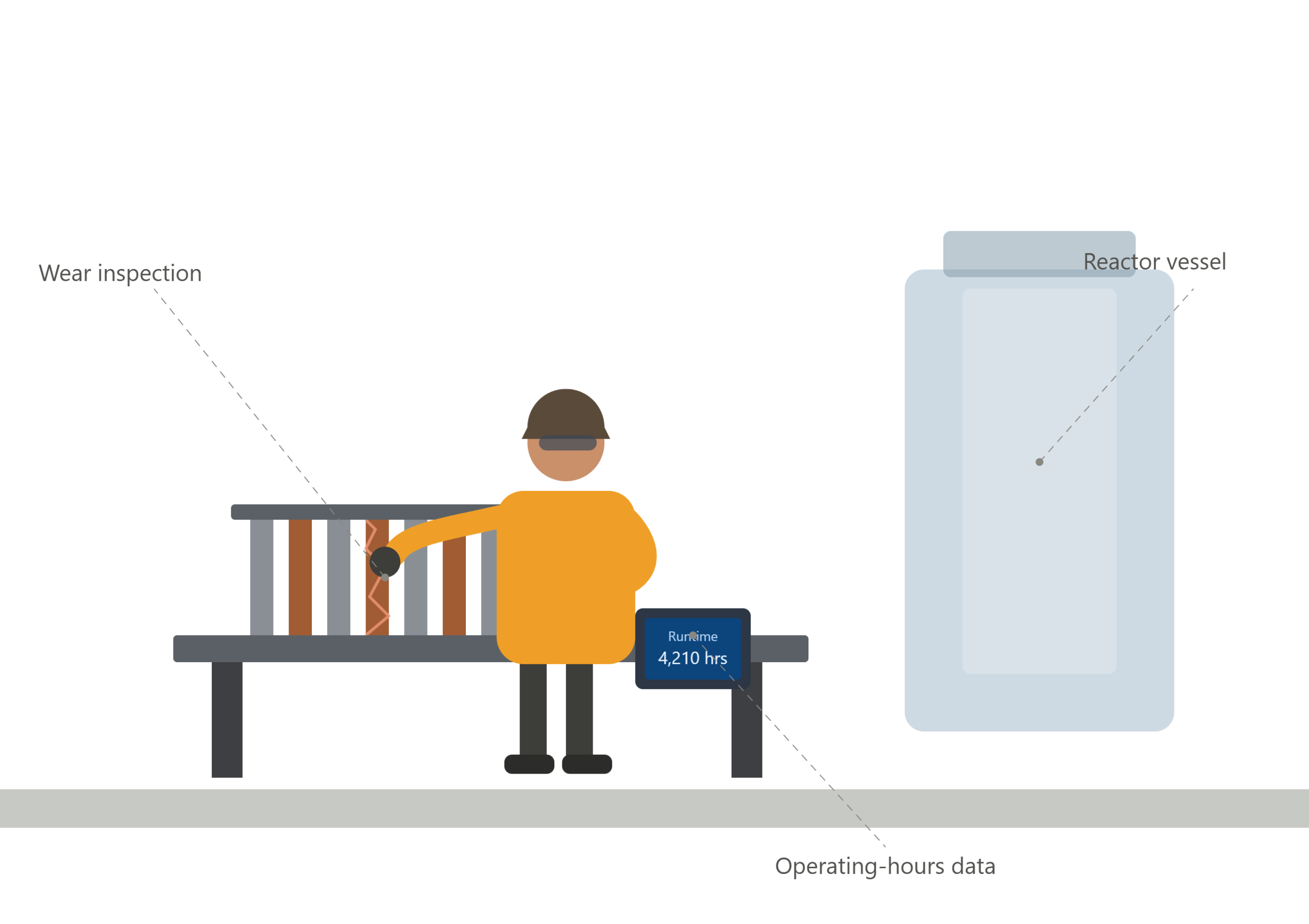
Cell voltage at fixed current density is the clearest early indicator of electrode wear or fouling, and tracking that trend over time is standard practice on any system with logging capability. As a general guide, a sustained cell-voltage increase of more than roughly 15% above the system’s established baseline at the same current density is the threshold that typically triggers a scheduled inspection ahead of the normal service interval — catching that trend early is what lets a cleaning or replacement happen proactively rather than after a performance drop is already visible in effluent quality.
BDD electrodes wear on a fundamentally different mechanism than MMO, and the maintenance approach has to account for that difference. There’s no catalytic coating being consumed the way ruthenium and iridium oxides are on an MMO surface, so BDD life isn’t rated in amp-hours per unit of coating mass — the diamond film itself doesn’t get used up by normal operation. What actually limits BDD service life is the integrity of the diamond-film-to-substrate interface: edge exposure, thermal cycling, or sustained operation above the electrode’s rated current density window can trigger film delamination at that boundary, which tends to present as a comparatively sudden performance change rather than the gradual, trackable slope MMO’s coating thinning produces.
Engineering note
MMO coating consumption is typically rated in milligrams per amp-year rather than a fixed calendar life, which translates to a working range of roughly 20,000–40,000 amp-hours of service life depending on current density and matrix chemistry — logged data is what lets us give you an honest remaining-life estimate within that range instead of a generic figure.
Application note
Properly specified and operated BDD electrodes commonly reach 8,000 to 15,000-plus operating hours, and well-controlled industrial installations sometimes report meaningfully longer service life — but because BDD failure is interface-driven rather than consumption-driven, that estimate depends far more on your specific current density, matrix chemistry (fluoride content in particular is known to attack niobium and silicon substrates), and mechanical handling during service than on elapsed operating hours alone. This is also why BDD systems benefit from periodic edge and interface inspection during scheduled service, not just cell-voltage trend monitoring.
Repair and replacement
When something fails outside a scheduled visit
Unscheduled repairs are triaged the same way as a technical support case, with a spares kit (where stocked) covering common failure points. Electrode replacement, when it’s due, is handled as a planned changeout scheduled around your production calendar rather than an emergency, provided the trending data gave enough lead time — which is the outcome the predictive approach above is built to produce. A typical planned electrode changeout on a commercial-scale reactor takes one working day including removal, inspection of the reactor internals, and installation of the replacement stack.
Questions About Maintenance and Repair of Electro Oxidation Equipment?
Scheduling a maintenance visit or reporting an issue? Reaching out right away. *All maintenance and repair services shall be subject to the terms, conditions, and schedules set within your contract with Evoaeo.