Technology Comparison: EO vs. Thermal Oxidation
EO vs. Incineration & Thermal Destruction
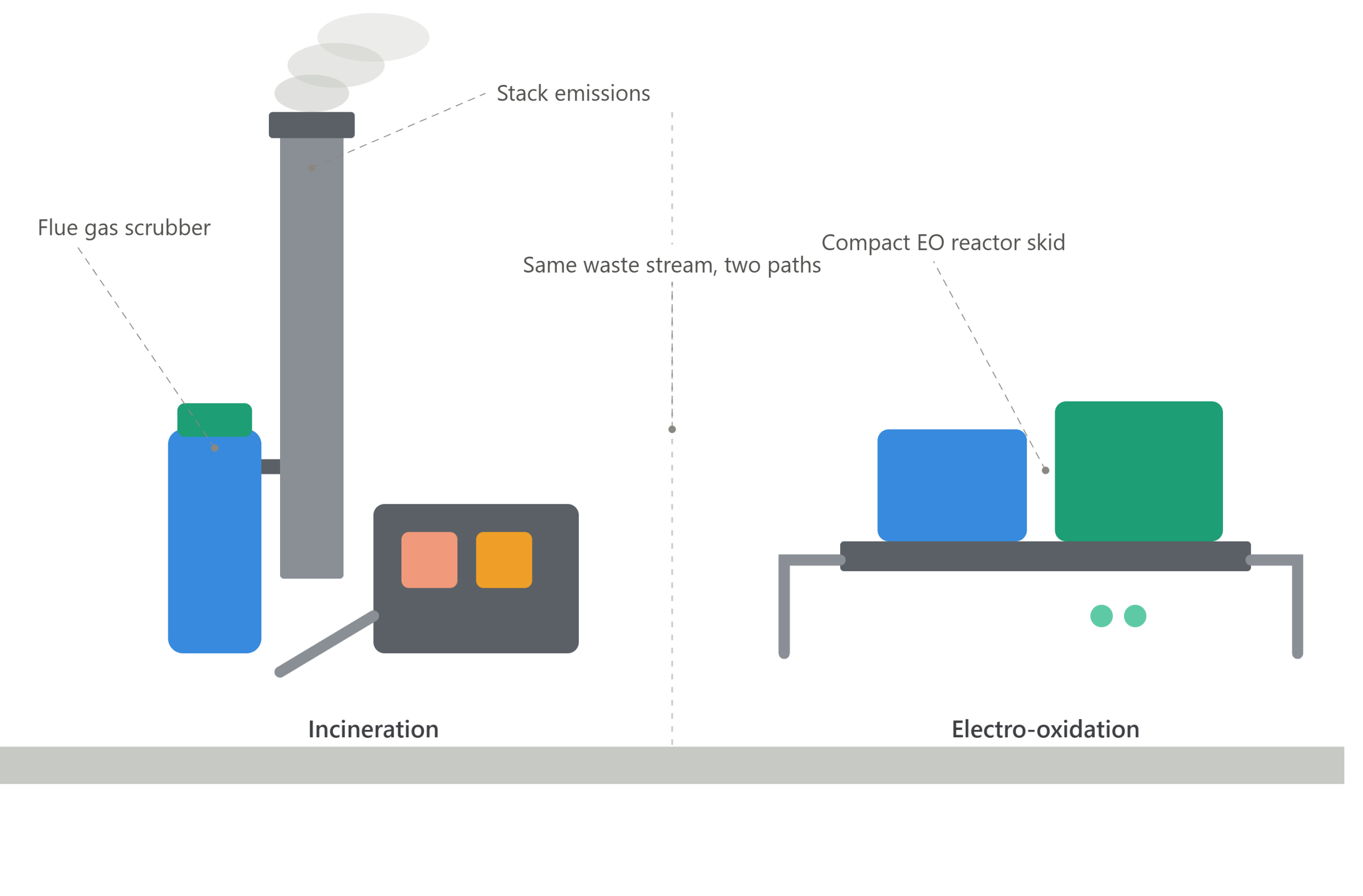
Incineration is the standard industrial form of thermal destruction, so this page treats the two as one comparison rather than splitting them — the underlying question is the same: destroy in the aqueous phase, or burn it
Reviewed for technical accuracy by Janeczka Kowalski, Process / Electrochemical Engineering. Figures and ranges on this page are engineering starting points — verify against your own pilot or vendor data before finalizing a design. The content is created by the Evoaeo engineering team led by Janeczka, All rights reserved.
Combustion vs. aqueous-phase oxidation
Why burning water is the core economic problem
Incineration destroys waste through high-temperature combustion, typically above 850°C, achieving essentially complete destruction of organic compounds along with generating air emissions that require flue gas scrubbing and a separate air-quality permitting pathway distinct from a water discharge permit. The economics work well for concentrated, largely non-aqueous hazardous waste — solvents, still bottoms, hazardous sludges — but fall apart quickly for dilute aqueous industrial wastewater, since incinerating a stream that’s mostly water means spending enormous auxiliary fuel just to evaporate water content that carries little to no combustible value.
This is precisely the gap EO and other aqueous-phase oxidation technologies exist to fill: treating the organic load directly within the water it’s dissolved in, without first needing to evaporate the water away.
Regulatory pathway differences
Air permit vs. water discharge permit
Incineration sits under an air-quality regulatory framework, with its own permitting, monitoring, and flue-gas emission limits entirely separate from a water discharge permit. EO stays within the water discharge regulatory framework throughout, though smaller-scale hydrogen and chlorine off-gas ventilation requirements still apply at the equipment level — a meaningfully lighter regulatory footprint for a facility already managing water discharge compliance rather than adding an air-permitting process on top of it.
Where incineration still wins
Concentrated, highly hazardous, or destruction-certified waste
Incineration remains the right choice for genuinely concentrated organic waste streams, hazardous sludges unsuitable for any aqueous treatment, and situations requiring destruction documented to a formal hazardous-waste destruction and removal efficiency (DRE) standard that liquid-phase treatment technologies, EO included, generally aren’t certified against in the same regulatory sense. For the much larger category of dilute-to-moderate concentration aqueous industrial wastewater that most facilities actually generate, EO’s ability to treat the stream directly — without the fuel cost of evaporating water first — makes it the more economical and more directly applicable choice.
Pollutant-by-pollutant comparison
How EO and Incineration perform on the pollutants that matter
Ratings reflect typical performance patterns reported across industrial-scale applications, not a substitute for bench testing on your specific matrix.
| Pollutant | EO | Incineration | Engineering take |
|---|---|---|---|
| PFAS (all forms) | Excellent for aqueous streams | Effective only at sufficiently high, sustained temperature | Incineration’s PFAS destruction is under active regulatory scrutiny over incomplete combustion risk at insufficient temperatures |
| Concentrated hazardous solvents | Limited — not the right tool | Excellent | This is squarely incineration’s home turf |
| Dilute aqueous organic load | Excellent | Poor — fuel-inefficient to evaporate mostly-water streams | The core economic argument for EO over incineration on typical industrial wastewater |
| Cyanide | Excellent | Excellent | Both fully capable; selection depends on whether the stream is aqueous or requires thermal handling regardless |
| Halogenated organics | Good | Good with proper flue-gas scrubbing | Incineration requires dioxin/HCl control measures; EO stays within water discharge permitting |
PFAS spotlight
PFAS destruction via incineration is genuinely effective only at sufficiently high and sustained combustion temperatures, and regulatory bodies in multiple jurisdictions have raised concern about incomplete destruction and products of incomplete combustion when those conditions aren’t reliably met — this is an active, ongoing regulatory and scientific discussion, not a settled question. EO operating on the aqueous stream directly avoids the air-emissions pathway entirely, which is a genuine advantage for facilities wary of PFAS incineration’s regulatory uncertainty.
Grounded in the literature
This comparison reflects published research, not just our own field data
The mechanisms and performance patterns described on this page are consistent with the peer-reviewed environmental engineering literature — journals including Water Research, Chemosphere, the Journal of Hazardous Materials, Environmental Science & Technology, and the Chemical Engineering Journal regularly publish comparative studies on electrochemical and competing treatment technologies. Our engineering team tracks this literature as part of how we validate bench and pilot results against the broader research base, and can provide specific citations relevant to your stream on request.
Questions About Electro Oxidation, Incineration & Thermal Destruction?
Further questions about treatment efficiency of incineration, thermal destruction toward pollutants? Ask our engineering team now.