Home › Products › EO Trial Modules
Electro Oxidation EO Trial Modules
This is where we demonstrate electro oxidation EO trial modules we build, ready to take you from treatability checking to bench check, then pilot skid. Each one runs the same core chemistry, direct anodic oxidation plus electro-generated oxidants, but they differ in flow capacity, electrode configuration, and how much control instrumentation comes standard. Compare the lineup below, or work through the guides further down if you’re not sure which configuration fits your wastewater yet.
Flow range across the line: 0.5–50 L/min · Electrode options: BDD, DSA/MMO, Ti-based · Control: manual or PLC/HMI controlled· Built for: bench screening through pilot-scale validation, there are different types of electro oxidation EO trial modules available, in this case, feel free to reaching out to us if you have any questions regarding available products and their application ranges, specifications, etc.,
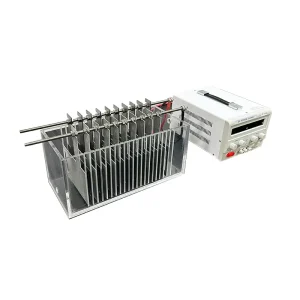
EO Trial Module — Standard
Swappable BDD/DSA-MMO electrodes · manual control The general-purpose unit most treatability programs start with. Covers the majority of industrial wastewater screening and short bench testing.
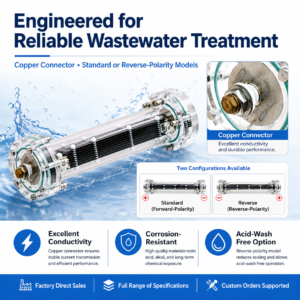
EO Trial Module — Tube
MMO electrodes · manual control
Built for scale-up validation once bench data looks promising and you need continuous-flow performance numbers to size a full installation.
How the Models Compare
| Model | Flow Range / Electrode Gap / Rectifier Output / Best For |
|---|---|
| Bench | 0.5–5 L/min · 1–5 mm · 0–20 VDC / 0–10 A · First-pass screening |
| Standard | 1–20 L/min · 1–10 mm · 0–60 VDC / 0–50 A · General treatability studies |
| Pilot Flow | 10–50 L/min · 1–10 mm · 0–60 VDC / 0–100 A · Scale-up validation |
| High Current Density | 1–10 L/min · 1–3 mm · 0–80 VDC / 0–150 A · High-strength effluent, short contact time |
*Dual to constant technical update with our electrochemical oxidation wastewater treatment products, the data and information within the comparison table might not necessarily reflect the actual product parameters of our electro oxidation EO trial modules, in this case, please do contact our sales and engineering team for the available products, we reserve the rights to release or demonstrate all the product information.
Engineering Views
Drawing conventions stay consistent across the whole line, so if you’ve worked with our EO trial modules, the documentation for another won’t feel unfamiliar.
- General arrangement drawings: every model ships with a GA drawing showing skid footprint and nozzle schedule, scaled to that unit’s actual dimensions
- P&ID tagging: flow path, sensor tags, and control loop numbering follow the same ISA-style convention across the line, so operators moving between models aren’t relearning drawings
- Electrode stack assembly views: exploded drawings showing plate count, spacer thickness, and gasket material, specific to each model’s stack configuration
- Electrical single-line diagrams: rectifier sizing, distribution, and grounding/isolation points, scaled to each model’s power draw
- Instrumentation and control architecture: shows where conductivity, pH, ORP, and cell voltage/current sensors tie into the panel, and how PLC/HMI options integrate on models that carry them
Full drawing packages are available on request once you’ve identified a candidate model. For modules still in the placeholder stage above, ask engineering team for a preliminary GA and we’ll confirm dimensions once your flow and current requirements are set.
Application Views
Electrochemical oxidation performs differently depending on what’s in the water. Here’s how the technology generally behaves across the wastewater types we see most often. These are starting points based on published Electrochemical advanced oxidation processes (EAOPs) research and field experience, not guarantees — every matrix behaves a little differently, which is exactly why a bench-scale trial exists.
Landfill Leachate
High COD and ammonia loads typically need biological treatment or ammonia stripping ahead of electro oxidation processes. Used as a polishing step after that pretreatment, oxidation performance is usually more predictable and energy costs come down.
Disinfection and Pathogen Reduction
Electro-generated oxidants provide broad-spectrum disinfection, similar in principle to chlorination but generated on site rather than stored and dosed.
Phenolic and Pharmaceutical Streams
COD reduction and removal of disinfection byproduct precursors both tend to perform well, though effectiveness varies quite a bit by specific compound. Screen your particular constituents rather than assuming class-wide behavior.
Cyanide-Bearing Wastewater
Electrochemical oxidation can convert cyanide to cyanate under controlled conditions, but pH and current density need to stay within a tight window to avoid forming more toxic intermediates. This is one of the applications where close supervision during the trial matters most.
PFAS and Related Compounds
Direct anodic oxidation on boron-doped diamond anodes is one of the few processes that can break carbon-fluorine bonds. Treatment time and energy consumption run higher than for most other contaminant classes, so sizing a PFAS application without bench data first is not something we recommend.
Textile and Dye Wastewater
Color removal through active-chlorine mediated oxidation tends to work well when chloride is already present in the feed. Some dye chemistries are more chlorate-sensitive than others, so it’s worth checking the specific dye class before committing to a chloride-mediated pathway.
Purchase Decision Guide
Picking the right EO trial modules usually comes down to five questions. Work through them roughly in this order and you’ll land on a sensible starting configuration.
- What are you actually trying to learn? A two-week screening exercise and a multi-month pilot validation call for different equipment. Get clear on the goal before looking at flow rates.
- Characterize your wastewater. pH, conductivity, chloride and bromide levels, COD/TOC, suspended solids, and temperature all matter. Run through the Go/No-Go screening notes on an individual module page before going further.
- Match flow rate and residence time to your test plan. The comparison table above will usually point you to a starting model once you know roughly how much water you need to move.
- Choose electrode chemistry based on your target contaminants and chloride availability. BDD gives the strongest oxidation and handles PFAS-type work; DSA/MMO costs less and leans on chlorine-mediated pathways when chloride is present.
- Decide how much control automation you actually need. Manual constant-current control is fine for early screening. PLC/HMI automation earns its cost once you’re running longer campaigns or need logged data for a report.
- Confirm budget and lead time with our engineering team. This is the point to get a firm quote rather than guess at numbers from a spec sheet.
This guide is meant to help you ask the right questions, not to replace a conversation with our process engineers or your own EHS and procurement teams. Confirm final unit selection against your safety, budget, and regulatory requirements before purchase.
Practical Application Guide
Once a module is on site, running a treatability study well is mostly about discipline: prepping properly, staying safe, and sampling in a way that actually produces usable data.
- Confirm site utilities before delivery. Check that your power supply matches the rectifier spec, that there’s ventilation for off-gas, and that floor drainage or containment is in place.
- Run a safety review before startup, with your EHS team involved. Identify electrical isolation points, set a lockout-tagout procedure, confirm PPE (safety glasses, chemical-rated gloves), and set up hydrogen monitoring if the installation calls for it.
- Collect a baseline sample before running anything. You’ll need a representative feed characterization to calculate removal efficiency later.
- Start conservative and watch the trend, not just the number. Begin at a modest current density and track cell voltage over time — a rising trend usually points to scaling or electrode fouling before it becomes an obvious problem.
- Sample by charge dose, not just elapsed time. Oxidation is driven by charge passed through the cell, so pulling samples at set charge-dose intervals gives you more useful data than sampling on a clock.
- Check for byproducts if chloride or bromide are present. Test for chlorate, perchlorate, or bromate before considering discharge or reuse of the treated water.
- Normalize your results to specific energy consumption. Reporting kWh per unit of contaminant removed is what actually lets the numbers translate into a full-scale cost estimate.
- Shut down and dispose of waste streams properly. Drain and depressurize the unit safely, and dispose of spent electrolyte or electrode rinse water according to your local discharge permit.
Safety and Regulatory Notes
This equipment generates hydrogen and oxygen gas and operates at voltages and currents that can cause injury. Only trained, qualified personnel should operate it, following your facility’s electrical safety program and applicable OSHA or local equivalent requirements.
Regulatory limits on chlorate, perchlorate, and bromate vary by jurisdiction and by what the treated water is used for afterward — reuse applications generally carry stricter limits than industrial discharge. Confirm requirements with your regulatory authority before finalizing a treatment approach.
This guide reflects general engineering practice. It doesn’t substitute for a site-specific HAZOP, an electrical safety review by a qualified engineer, or a conversation with whoever issues your discharge permit.
Frequently Asked Questions
Mainly flow capacity, electrode gap, and rectifier size. The comparison table above breaks down the specifics side by side.
Yes, and that’s actually how most treatability programs go. Bench-scale screening data usually informs which pilot-scale configuration makes
sense next.
BDD electrode, DSA/MMO, and titanium-based electrodes fit across the line, though the largest pilot units may need custom plate sizing. Check the individual product page for exact compatibility.
Usually, but it depends entirely on your local authority and what’s inthe water. Confirm with your regulator before discharging any trial effluent.
Start with the Go/No-Go screening notes to figure out if electrochemical oxidation fits you or not , or or work through the purchase decision guide above. A short bench jar test is the most reliable way to confirm before committing to a larger trial.
Trained personnel only, following your site’s electrical safety and PPE requirements. See the safety notes in the practical application guide above
Talk to Our Process Engineering Team
Not sure which module fits, or want a firm quote on one you’ve already picked? Tell us about your wastewater and timeline and someone from engineering will follow up.
Everything on this page is engineering and product information written for process engineers, environmental professionals, and technical buyers. It isn’t a substitute for a site-specific engineering review, a safety assessment from your own EHS team, or advice from a licensed professional engineer in your jurisdiction. Wastewater characteristics, electrical codes, and discharge permit requirements vary by location, so confirm suitability and compliance before specifying or installing any unit.
Reviewed for technical accuracy by Janeczka Kowalski, Process / Electrochemical Engineering. Figures and ranges on this page are engineering starting points — verify against your own pilot or vendor data before finalizing a design.