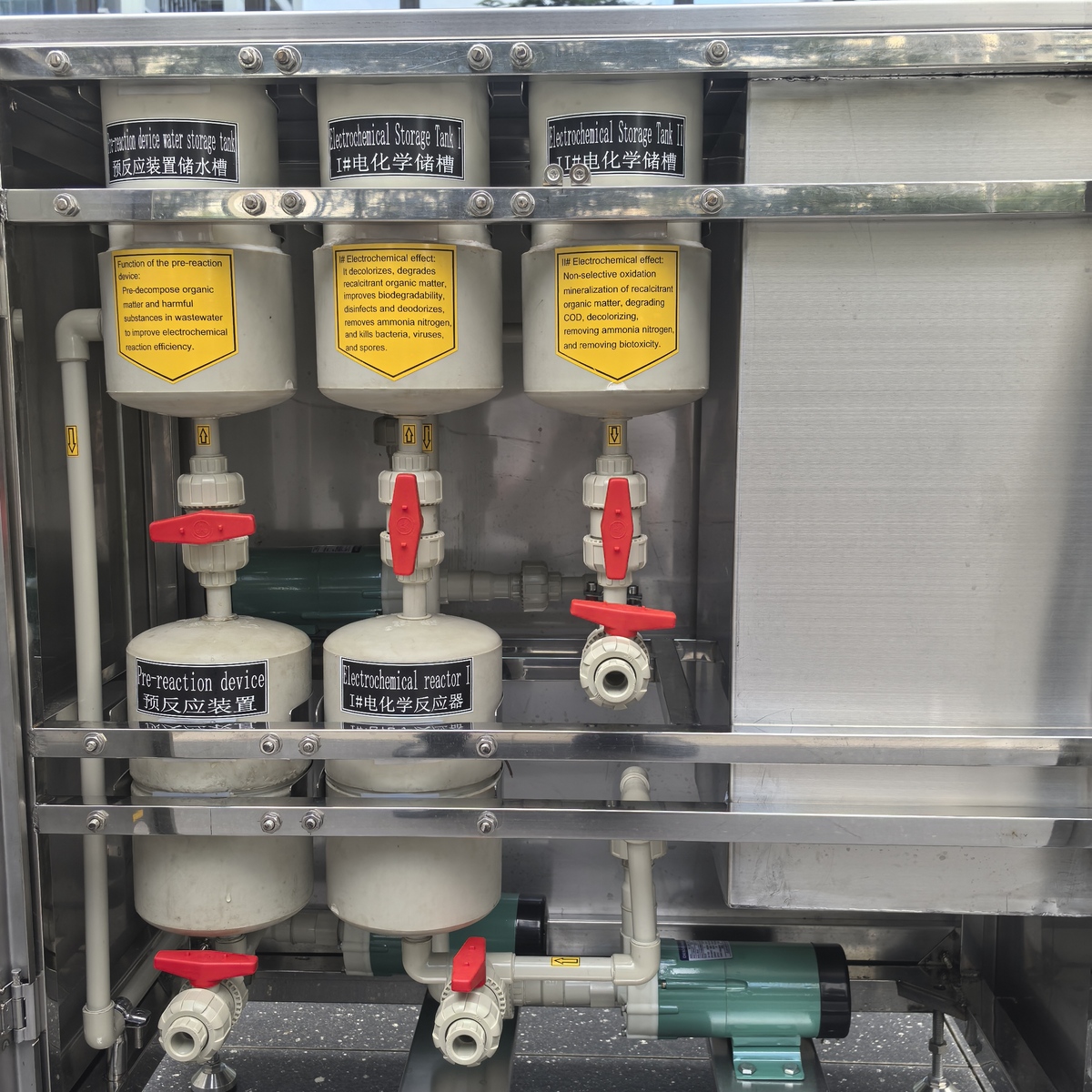
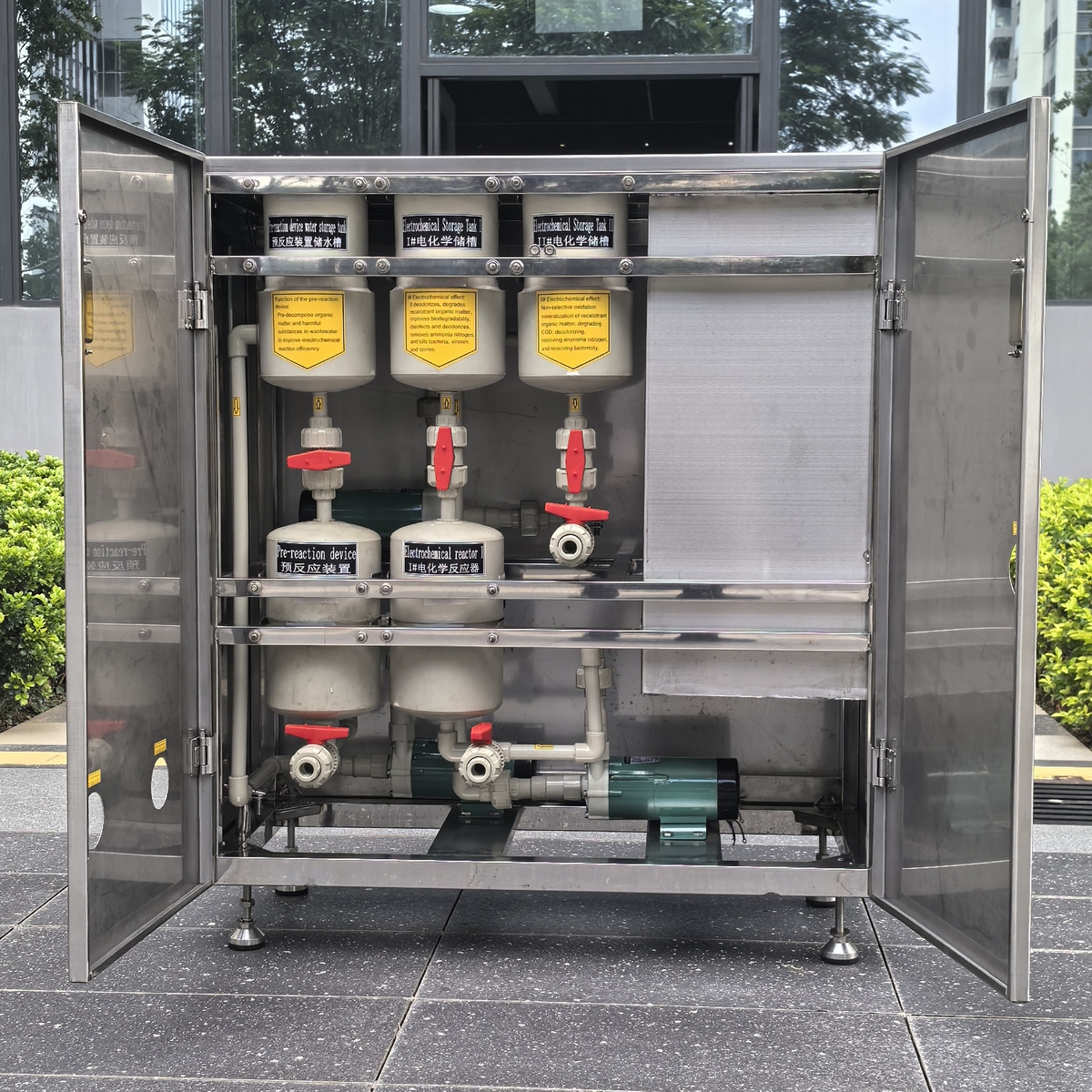
Three Stages, One Skid
Pre-reaction conditioning and two independent electrochemical reactors, each individually valved, pumped, and powered.
Route Flexibility on Demand
Run any of four standard process sequences without re-plumbing — isolate, chain, or bypass stages as your test plan requires.
Field-Ready Footprint
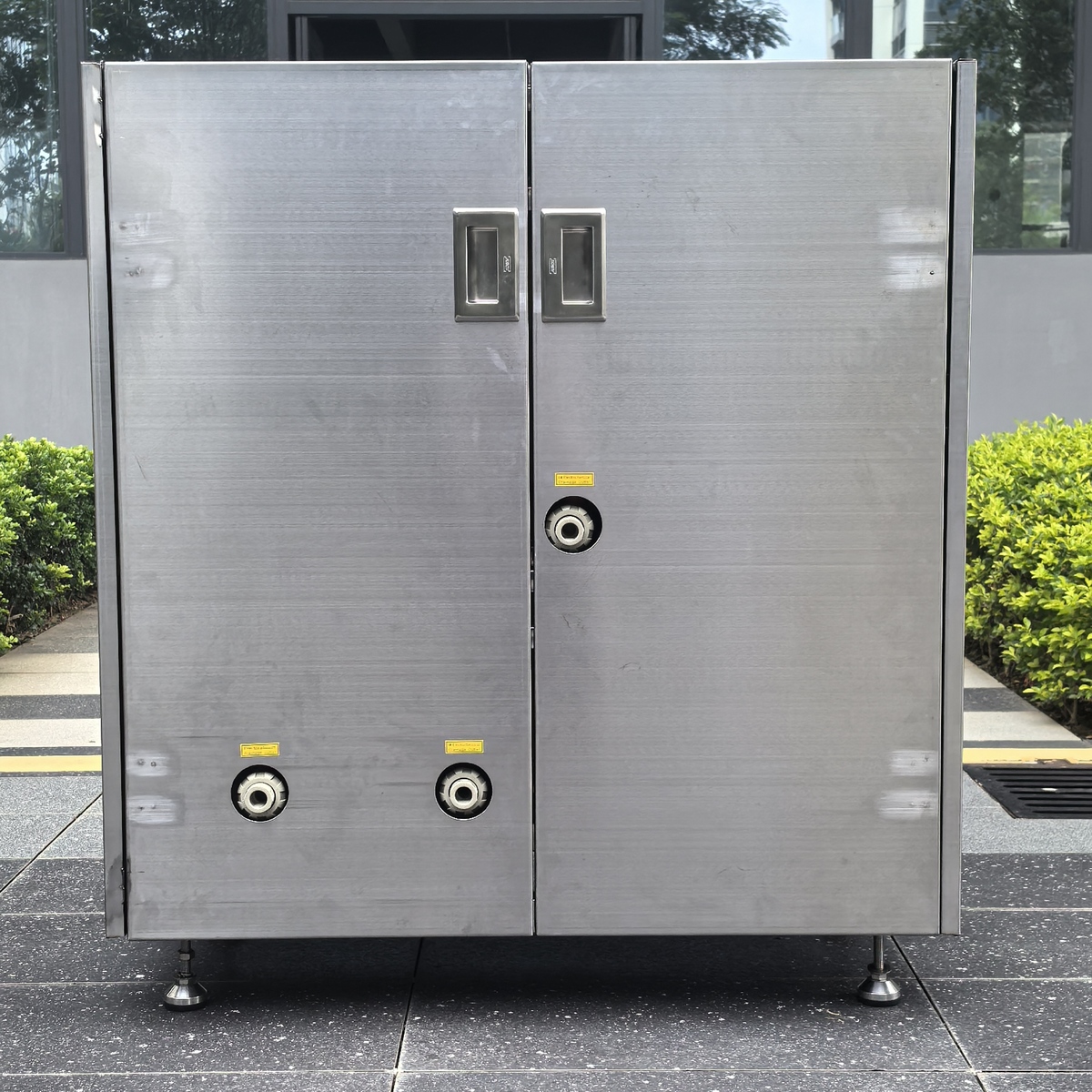
A 1000 × 480 × 900 mm stainless enclosure at roughly 50 kg — compact enough for a lab bench or a site trailer.
THE CHALLENGE
Recalcitrant organics don't respond to conventional treatment
Biological treatment is built for biodegradable load – it struggles withrecalcitrant COD, persistent color bodies, and ammonia nitrogen thatresist microbial breakdown. Left untreated, these fractions carrythrough to discharge, limiting reuse options and risking non-compliance.
Before committing capital to a full-scale process, operators need realdata: which reaction sequence actually degrades the specific pollutantload in front of them, how long each stage needs to run, and what it will
cost per cubic meter to get there.
How It Works
A staged reaction path, not a single pass
Rather than forcing all pollutants through one reaction mechanism, the unit separates the work into three purpose-built stages that can run alone or in sequence, so the process route can be matched to the wastewater — not the other way around.
Pre-Reaction Stage
Pre-decomposes organic matter and harmful substances in the raw feed, lifting biodegradability and easing the load on the electrochemical stages downstream.
Stage I Reactor
Decolorizes and degrades recalcitrant organics, disinfects and deodorizes the stream, strips ammonia nitrogen, and inactivates bacteria, viruses, and spores.
Complete Mineralization
Non-selective oxidation drives remaining recalcitrant organics toward mineralization — further COD reduction, decolorizing, and removal of residual biotoxicity.
Send us your influent characteristics and treatment target, and we'll suggest a starting process route and current settings to trial first.
Product Specifications
Electrochemical Oxidation Wastewater Treatment Unit — Specifications
Voltage, frequency, and current are configurable to local standards. Electrical requirements and power consumption of this bench scale electrochemical oxidation wastewater treatment unit are set as 220 V / 50 Hz / 600 W by default. For regions running 110–120 V / 60 Hz, three-phase supply, or a different target current range for Stage I / Stage II, the power supply and control panel can be configured to match — confirm your region’s electrical requirements with our engineering team at the time of order.
Physical & Electrical Specifications
Overall Dimensions (L × W × H)
1000 mm × 480 mm × 900 mm
Weight
≈ 50 kg
Enclosure
Stainless-steel cabinet with lockable double doors, adjustable leveling feet
Standard Power Supply
Customizable to local electrical standards (see note above)
Stage I Operating Current
Typical set point 20 A (constant-current mode, adjustable within 0.5–6.0 hr treatment window)
Stage II Operating Current
Typical set point 10 A (constant-current mode, adjustable within 0.5–6.0 hr treatment window)
Control Mode
Constant-current electrochemical power supplies, touch-screen control panel
Grounding Resistance
< 4 Ω (required)
Influent Water Quality Requirements
Water / Reaction Temperature
10–60 °C
pH Range
3–12 (narrower range applies per process mode — see operator manual)
Fluoride (organic + inorganic)
< 3 mg/L
Bromide
< 100 mg/L
Suspended Solids (SS)
< 200 mg/L
Total Dissolved Salt Content
< 70% of saturation
Hydrogen Sulfide (H₂S)
Must not be present
Operating Parameters
Stage I Effective Treatment Time
0.5–6.0 hours per batch
Stage II Effective Electrolysis Time
0.5–6.0 hours per batch
Technical Overview
One skid, three purpose-built treatment stages
This unit is a self-contained, three-stage bench/pilot-scale electrochemical treatment skid for testing and optimizing electrochemical oxidation process routes on a target wastewater stream. It combines a pre-reaction (pretreatment) module with two independent electrochemical reactor stages (Stage I and Stage II), each with its own storage tank, circulation pump, and DC power supply.
Stages can be run individually or chained together in different sequences, letting operators identify the most effective and economical treatment route before committing to full-scale design.
Process Flexibility
Four configurable process routes
Because each module of this bench-scale electrochemical oxidation wastewater treatment unit can be isolated and run independently, the unit supports four standard process routes, letting operators determine which sequence best fits a given wastewater before committing to full-scale design.
Intended Use
Bench-scale process testing, not continuous commercial implements
This bench scale electrochemical oxidation wastewater treatment unit is designed to generate the data needed to evaluate treatment feasibility, determine optimal retention times per stage, characterize achievable effluent quality, size the electrode modules and power supply needed for a full-scale electrochemical oxidation wastewater treatment system, identify required auxiliary equipment, and estimate operating cost per unit volume of wastewater treated.
Applications
Where the bench unit earns its keep
The unit has been used to scope treatment routes across a range of test scenarios, including:
- Screening process sequences before full-scale reactor sizing
- Benchmarking achievable COD, ammonia, color, and SS reduction
- Validating pretreatment requirements ahead of biological polishing
- Determining hydraulic retention time per stage for a specific effluent
- Estimating energy consumption (kWh/m³) at candidate current settings
- Generating the data package needed to size a multi-electrode full-scale array
FREE TREATABILITY CONSULTATION
Tell us what's in your wastewater
- Engineering review of your influent profile
- Treatability trial scoped to your pollutant load
- Process-route recommendation before you commit to design
Benefits
Why teams run trials on this unit before scaling up
- Right-size before you build Determine the number of electrode modules and the power supply your full-scale plant actually needs, based on measured removal per module rather than a vendor estimate.
- Four process routes, no re-plumbing Isolation valves on every module let you test pre-reaction-first, electrochemical-only, or any combination in between, all on the same skid.
- Constant-current, repeatable runs Both electrochemical stages hold a fixed current through the run, so results from one trial can be compared cleanly against the next.
- Compact enough to travel At ~50 kg in a sealed stainless cabinet, the unit moves between labs or out to a site trial without a rigging crew.
- Built-in safety interlocks Enforced startup/shutdown sequencing and dry-run protection reduce the chance of an electrode or pump failure mid-trial.
- Data you can defend Per-stage observation logging (color, turbidity, foam, scaling) gives you a documented basis for the process route you ultimately recommend.
Why We Built It This Way
Testing should look like the plant it's predicting
"A trial that doesn't mirror how the full-scale system will actually run just produces numbers you can't trust at scale."
Janeczka Kowalski, Lead Technical Consultant & Senior Electrochemical Engineer
Bench trials are only useful if the data transfers. That's why every stage on this unit — pre-reaction, Stage I, Stage II — uses the same valving, constant-current control, and manual transfer logic an operator would use on a production skid, just at a volume small enough to run a dozen trials in a week instead of one.
Full Procedures Inside
Download the complete Operator Manual
- Step-by-step procedures for all four process routes
- Influent water-quality limits and startup/shutdown sequencing
- Operating limits, safety requirements, and electrode maintenance
Ready to see what your wastewater actually needs?
Book a trial slot and we’ll help you scope a process route before you commit to full-scale design.
Evoaeo EOB Unit
Bench-scale electrochemical oxidation platforms for wastewater treatability testing and process-route scoping.
Bench-Scale Electrochemical Oxidation Wastewater Treatment Unit © 2026 Evoaeo, advanced oxidation processes for waste water treatment.
Operator manual and other contents are available as downloadable PDF