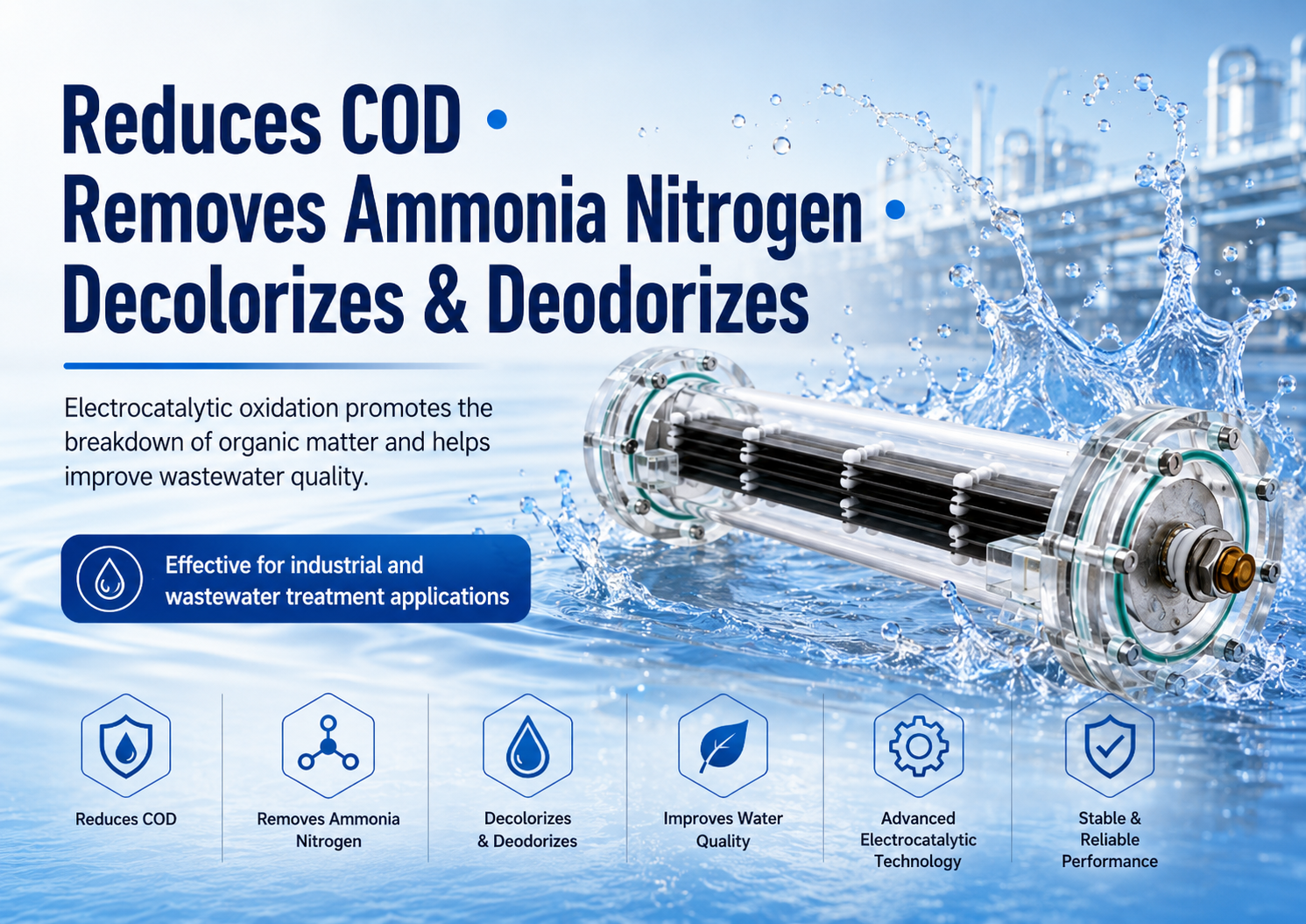
Engineering Overview
Electrochemical treatment starts with the duty, not the catalogue model.
- Electrochemical oxidation and related treatment duties where water chemistry is compatible
- Continuous-flow polishing or process-stage integration after screening and equalization
- Projects requiring configurable electrode materials, reactor volume, ports or DC power
- Pilot, laboratory and industrial-scale duties that need repeatable operating data before scale-up
- Systems where inspection, cleaning access and electrode serviceability matter
Define the operating window before choosing the reactor.
- Wastewater source, composition, COD / NH3-N / color target and expected variability
- Flow rate, hydraulic retention time and recirculation strategy
- Conductivity, chloride, hardness, pH, suspended solids and temperature
- Available DC voltage/current, current density target and electrical protection
- Scaling tendency, cleaning method, service interval, installation space and local compliance requirements
Engineering View / Reactor Architecture
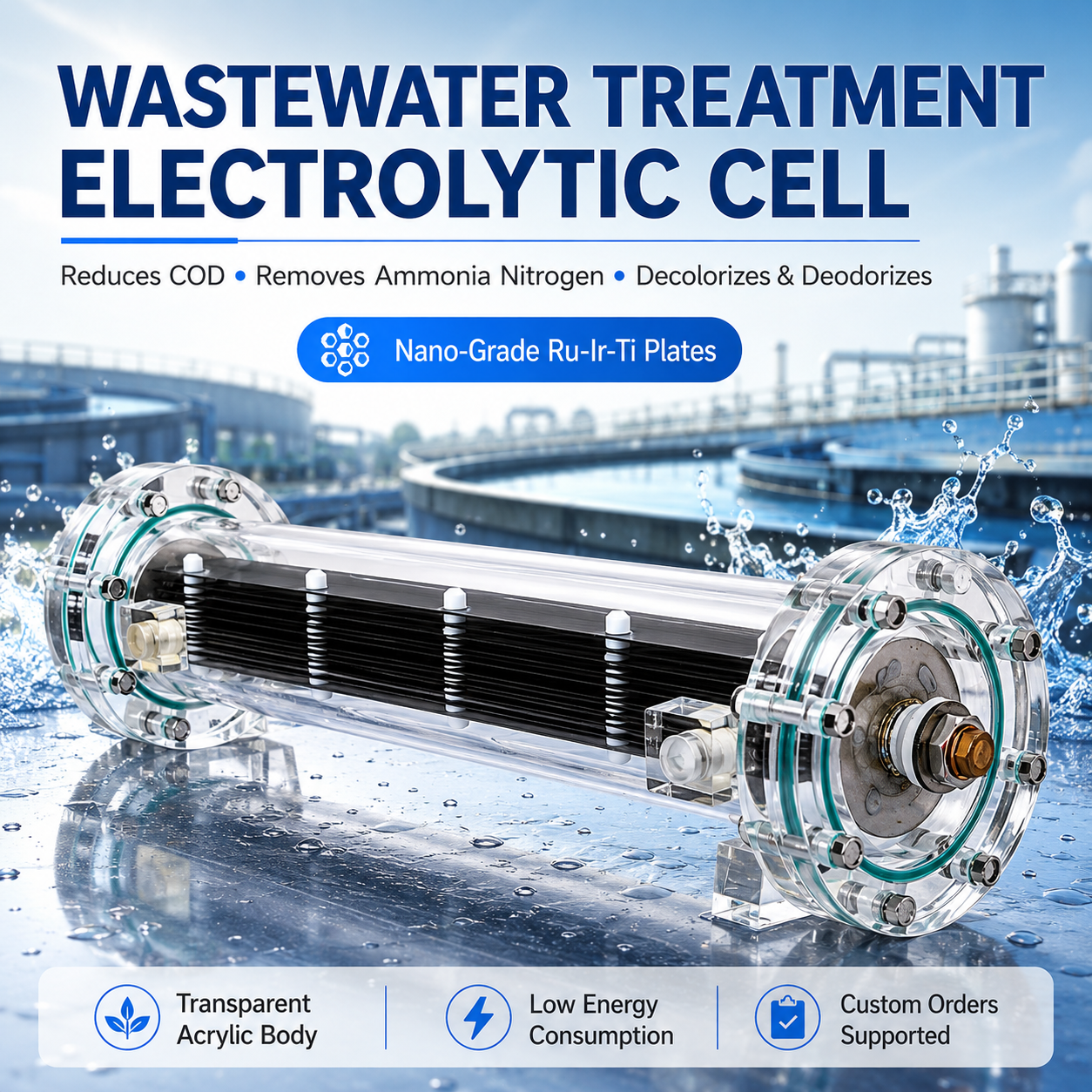
A serviceable reaction zone with accessible hydraulic and electrical interfaces.
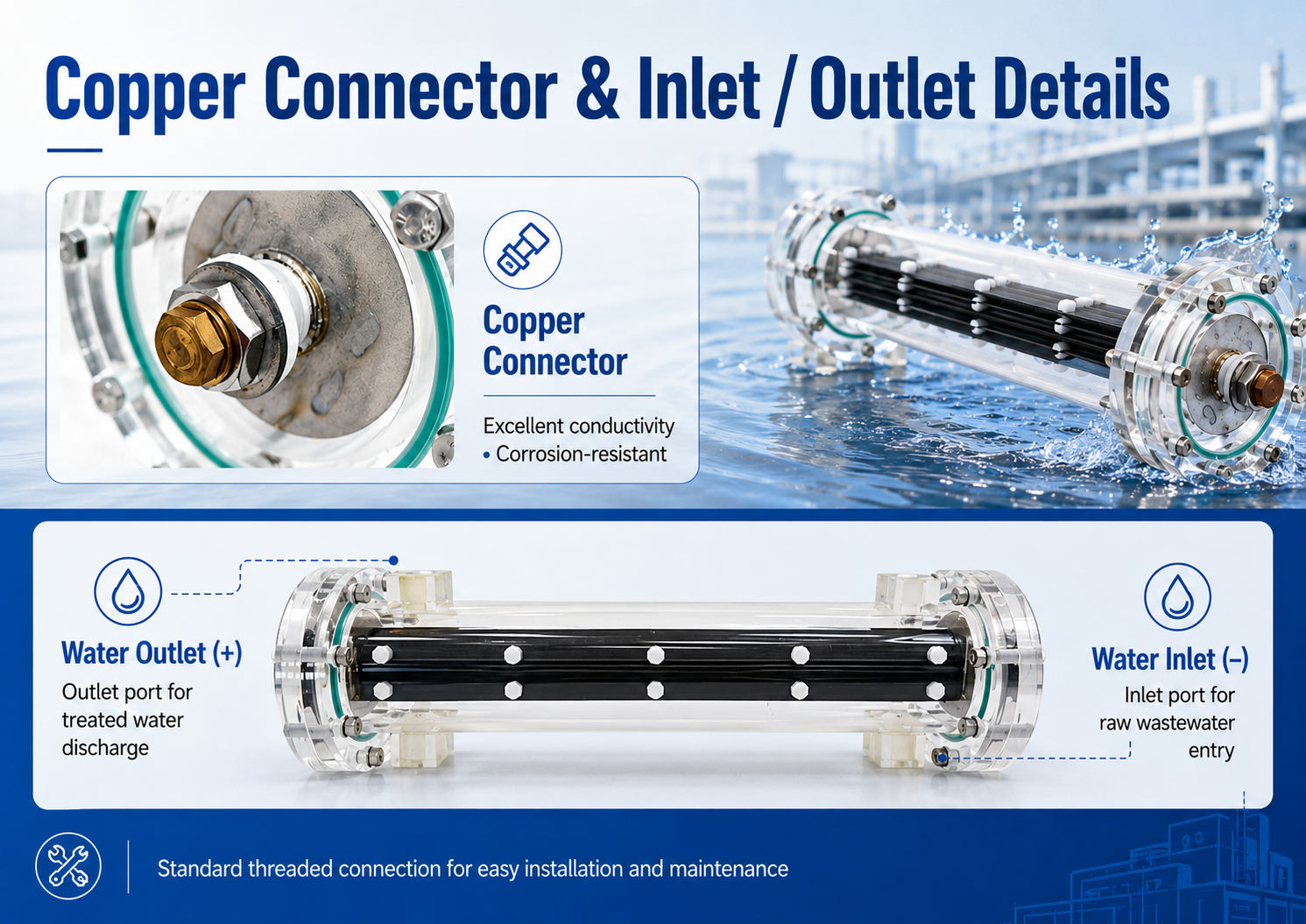
- Defined inlet and outlet orientation for hydraulic commissioning
- Low-resistance electrical terminals sized for the selected current range
- Electrode spacing and active area matched to the intended current density
- Serviceable end connections for inspection, cleaning and electrode replacement
How and when does an electrochemical reactor get involved
01 · Characterize the water
Measure the parameters that affect electrochemistry: pollutant load, conductivity, chloride, hardness, pH, solids and temperature.
02 · Define hydraulic duty
Set design flow, retention time, recirculation and pressure-drop limits before selecting reactor volume and port size.
03 · Set the electrical window
Choose electrode chemistry, active area, current density, DC voltage/current range and polarity strategy for the treatment objective.
04 · Commission and observe
Verify flow direction, leaks, gas release, current stability, temperature and scaling behavior under controlled startup conditions.
05 · Validate with samples
Confirm treatment performance, energy use, by-products and discharge indicators using representative influent and effluent data.
Hydraulics
Configured by residence time, pressure drop, and mass-transfer target.
Operation
Supports process development and repeatable scale-up recipes.
Integration
Matched to rectifier, interlocks, data logging, and skid controls.
Cell Format
Select around reaction pathway, membrane demand, and product separation.
Active Area
Defined per electrode side or total projected area.
Electrode Gap
Optimized for ohmic drop, mixing, gas removal, and serviceability.
A Reactor Platform Built Around Electrochemical Interfaces
Electrochemical reactor performance is governed by more than electrode material alone. The reaction environment is defined by electrode spacing, electrolyte conductivity, flow distribution, interfacial area, current distribution, membrane transport, bubble management, heat removal, and power-supply behavior. The contents covering electrode stack, separator system, flow field, current collector, compression package, gasket chemistry, instrumentation, and control scheme.
Technical positioning
Use this page body for electrochemical oxidation cells, CO₂ reduction flow reactors, hydrogen / oxygen evolution test cells, electrosynthesis hardware, electro-Fenton modules, disinfection reactors, membrane-separated electrolysis cells, and custom electrode-stack assemblies.
Engineering outputs
• Cell configuration drawing
• Bill of materials by wetted material
• Electrode and membrane specification
• Operating envelope
• Power-supply sizing
• Commissioning and maintenance notes
Compact, Flexibility with All Elements Covered
Configurable electrode system
Select substrate, coating chemistry, active area and polarity strategy according to the electrochemical duty and water matrix.
Compact reaction-zone design
High electrode surface utilization can support compact equipment layouts where footprint and modularity are important.
Serviceable construction
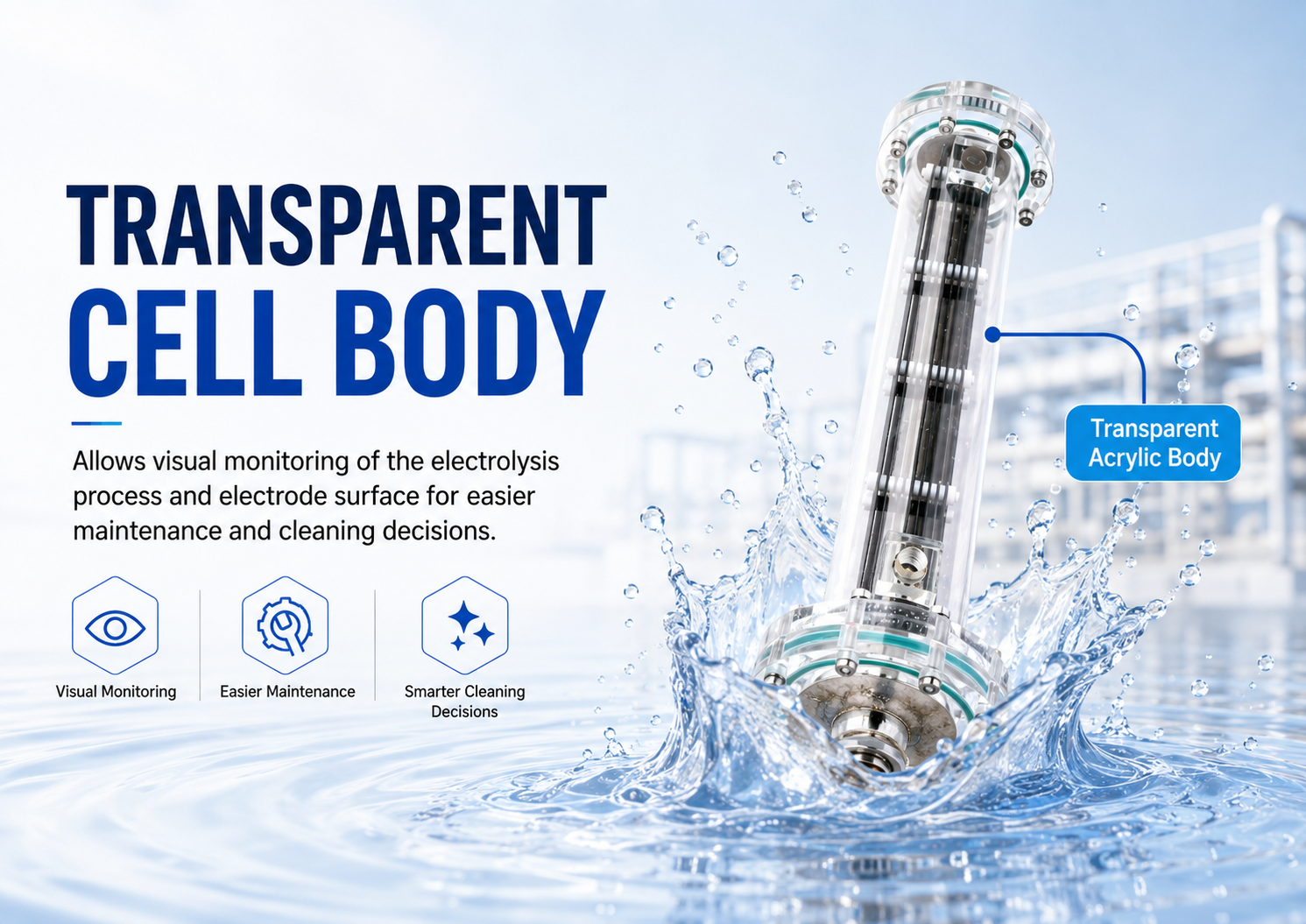
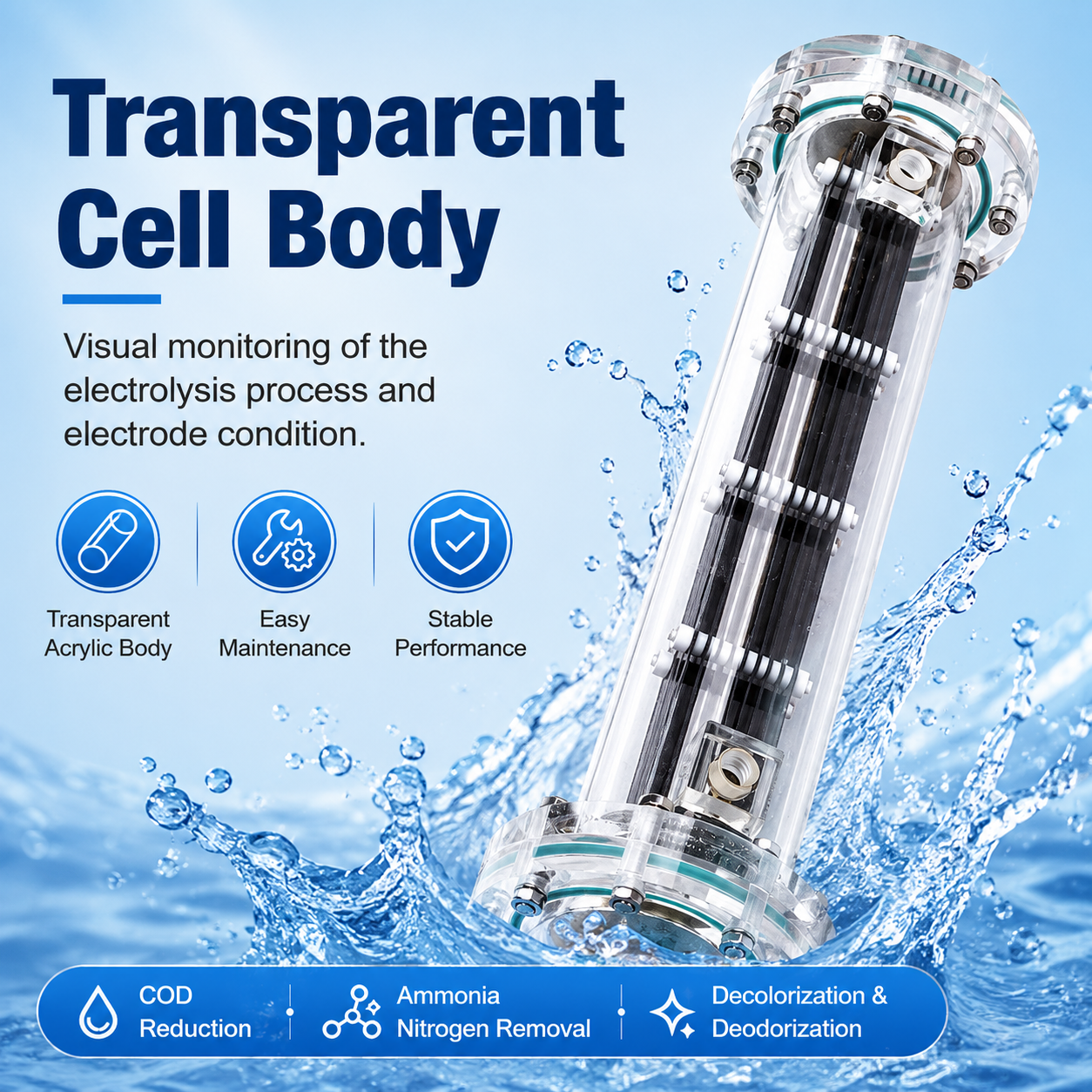
Accessible terminals, removable assemblies and visible flow paths simplify inspection, cleaning and planned maintenance.
Operation and Applications Oriented Design
Scalable model range
Use laboratory or pilot data to move toward larger flow duties while preserving the required electrical and hydraulic operating window.
Project-specific interfaces
Port size, reactor dimensions, electrode pack, cable set, power supply and mounting details can be reviewed against site constraints.
Operational visibility
Inspectable reactor construction supports faster troubleshooting of gas release, scaling, fouling and hydraulic distribution during operation.
Aimed to Tackle Challenges with Your Waste Streams
Organic-load reduction
Electrochemical oxidation can contribute to COD and color reduction for suitable wastewater. Actual removal depends on matrix composition, current input and residence time.
Nitrogen-related treatment
Ammonia conversion may be supported in compatible water chemistry, particularly where chloride-mediated reactions are present. By-products and residual oxidants must be evaluated.
Polishing and difficult streams
Electrochemical treatment can be used as a pretreatment, polishing step or targeted process stage when conventional treatment alone does not meet the project objective.
Featuring Reversing Polarity Function for Better Performances
Straightforward operation where scaling is manageable
- Appropriate where hardness and scale formation are controlled by pretreatment or periodic cleaning
- Simpler DC control and commissioning logic
- Cleaning interval should be based on current drift, pressure drop and visual inspection—not a fixed calendar alone
Useful where cathodic scale accumulation is an operating concern
- Polarity reversal may reduce persistent mineral deposition on one electrode surface
- Electrode coating and power-control architecture must be suitable for reversal duty
- Reversal interval should be validated from hardness, current stability, scale behavior and electrode specification
Design for inspection before maintenance becomes urgent.
An inspectable reaction chamber gives operators a direct view of gas evolution, fouling, scale formation, flow distribution and electrode condition. Visual evidence should be combined with electrical trends, pressure data and water-quality results to plan cleaning and maintenance.
Visual condition checks
Observe gas accumulation, deposits, discoloration and abnormal flow behavior during routine rounds.
Trend-based maintenance
Use current, voltage, pressure drop and treatment results to decide when cleaning or electrode inspection is required.
Commissioning verification
Confirm flow direction, full wetting, leak tightness, terminal condition and stable DC operation before increasing load.
G-Series reference range for preliminary selection
Typical duties where electrochemical treatment may be evaluated
- Industrial wastewater polishing and difficult-to-oxidize organic streams
- Aquaculture, livestock and agricultural wastewater after solids management
- Municipal or decentralized wastewater polishing
- Pharmaceutical, chemical and process wastewater requiring bench or pilot validation
- Color, odor or residual-organic reduction where electrochemical chemistry is suitable
Provide these data for a defensible selection
- Water source, process description and representative laboratory analysis
- Average / peak flow and required operating hours per day
- Treatment target and downstream process or discharge requirement
- Conductivity, chloride, hardness, pH, temperature and suspended solids
- Available DC power, installation envelope, piping standard and control requirements
- Expected maintenance practice, cleaning chemicals, service-life target and validation data if available
Mechanical checks
Verify support, piping alignment, flow direction, valves, leak tightness, venting, drain access and compatibility of all wetted materials.
Electrical checks
Confirm polarity, cable sizing, terminal torque, grounding, insulation, DC limits, interlocks and over-current / over-temperature protection.
Controlled startup
Start at a conservative hydraulic and electrical load, record baseline voltage/current/temperature, inspect gas behavior, then increase duty stepwise while sampling.
Routine monitoring
Trend flow, inlet/outlet quality, voltage, current, temperature, pressure drop and visible deposit formation at a consistent operating condition.
Cleaning strategy
Select flushing, chemical cleaning or polarity-control procedures based on deposit chemistry, material compatibility and the electrode supplier’s limits.
Electrode lifecycle
Track normalized performance and electrical demand. Inspect coating condition and connections when current efficiency falls or voltage rises without another process explanation.
Gas and oxidant management
Electrolysis can generate gases and oxidizing species. Provide appropriate ventilation, gas release paths, monitoring and materials compatible with the expected chemistry.
By-product review
Chloride, bromide, nitrogen species and organics can form secondary products under some conditions. Evaluate residual oxidants and relevant by-products during validation.
Compliance is site-specific
Do not infer discharge compliance from reactor specifications alone. Confirm final water quality with representative sampling and the regulations applicable to the installation location.
Information that supports procurement, installation and operation
- General arrangement / dimensional drawing and connection orientation
- Electrode material and configuration statement
- Recommended operating electrical window and startup checklist
- Maintenance / cleaning guidance and spare-parts recommendations
- Available quality, inspection or material documentation by project requirement
Adjust the reactor around the process—not the other way around
- Reactor dimensions, active volume and mounting arrangement
- Inlet/outlet size, thread/flange standard and flow orientation
- Electrode substrate, coating, active area, spacing and polarity strategy
- Power supply, cable set, controls, sensors and integration signals
- Pilot units, modular parallel trains and project-specific packaging
Can a model be selected from flow rate alone?
No. Flow is only one input. Water chemistry, target removal, conductivity, electrode area, current density, residence time and maintenance strategy can change the required configuration.
Can a fixed removal percentage be guaranteed from the catalogue?
A defensible guarantee requires representative water testing and agreed operating conditions. Catalogue specifications describe equipment capability, not universal treatment performance.
When is polarity reversal useful?
It can be considered where mineral scaling is significant and the electrode/power architecture supports reversal. The interval and benefit should be validated for the actual water.
What data are most useful for scale-up?
Stable pilot data: flow, influent/effluent quality, voltage, current, temperature, conductivity, energy use, electrode area, cleaning interval and observed by-products.
How should electrode life be discussed?
Service life depends on coating system, current density, water chemistry, polarity, temperature, cleaning practice and operating hours. Define the duty before quoting a life figure.
Can the reactor be integrated with existing treatment?
Yes, where process interfaces are engineered correctly. Common positions include pretreatment, side-stream treatment, recirculation loops and polishing after biological or physicochemical stages.
Matched Reactor, Power Supply, Sensors, Safety Logic
For pilot and production work, the reactor should be treated as part of a controlled electrochemical package. The page should describe power electronics, sensor ports, interlocks, sampling strategy, and maintenance access with the same clarity as the wetted hardware.
Available integration blocks
- Programmable DC rectifier or potentiostat interface
- Voltage, current, temperature, flow, pressure, conductivity, pH, and ORP logging
- Hydrogen / oxygen venting and gas-liquid separation
- Leak detection, over-temperature shutdown, dry-run protection, and emergency stop
- Skid-mounted pump, tank, heat exchanger, filter, and recirculation loop
- Manual, semi-automatic, or PLC recipe-based operation
Design Considerations Before Selecting a Reactor
Mass transfer: confirm whether reaction rate is limited by electron transfer, diffusion, gas availability, or surface coverage. Channel geometry and flow velocity should be selected to maintain a stable concentration boundary layer.
Ohmic drop: electrolyte conductivity, membrane thickness, electrode gap, current collector design, and terminal contact resistance directly affect cell voltage and heat generation.
Current distribution: manifold symmetry, bus-bar connection, edge sealing, electrode flatness, and compression uniformity influence local over-current zones and long-term stability.
Scale-up path: preserve unit-cell geometry wherever possible. Increase capacity by active area, stack count, or number of parallel modules rather than changing all parameters at once.
Required project inputs
- Target reaction or treatment objective
- Feed chemistry and conductivity
- Desired conversion, removal, or production rate
- Required throughput and operating schedule
- Preferred electrode and membrane materials
- Available power supply and site utilities
- Safety classification and venting requirements
Technical Downloads
Product Datasheet
Full model range, active area options, wetted materials, operating envelope, connection details, sensor ports, and ordering code.
Installation & Operation Manual
Assembly, gasket replacement, membrane handling, wiring, pump-loop setup, commissioning, shutdown, and routine maintenance.
Process Evaluation Form
Feed chemistry, target reaction, throughput, current-density estimate, safety requirements, and site utility details for engineering review.
Components Commonly Specified With the Reactor
BDD Diamond Electrode
High-overpotential anode option for advanced oxidation, refractory wastewater, and demanding electrochemical interface applications.
MMO / DSA Titanium Electrode
Dimensionally stable titanium anode for chlorine evolution, hypochlorite generation, COD reduction support, and general electro-oxidation service.
Programmable DC Rectifier
Constant-current / constant-voltage power source with recipe control, remote monitoring, data logging, current ramping, and safety interlock inputs.
Send the water data. Size the electrochemical reactor around the actual duty.
- Preliminary model and reactor-volume recommendation
- Electrode and polarity strategy for engineering review
- DC power range and interface considerations
- Customization options for ports, dimensions, controls and installation
- Validation items to confirm before performance commitments
Request sizing support
From water data to a serviceable electrochemical reactor configuration.
Share the water analysis, flow, treatment target and site constraints for model selection, electrode configuration, power-range review and customization.