Application: Pharmaceutical & PPCP
Electrochemical Oxidation for Pharmaceutical Wastewater
Destruction of APIs, antibiotics, hormones, and personal care product residues — driven by EU UWWTD micropollutant provisions and growing AMR policy pressure on pharmaceutical and hospital wastewater discharge.
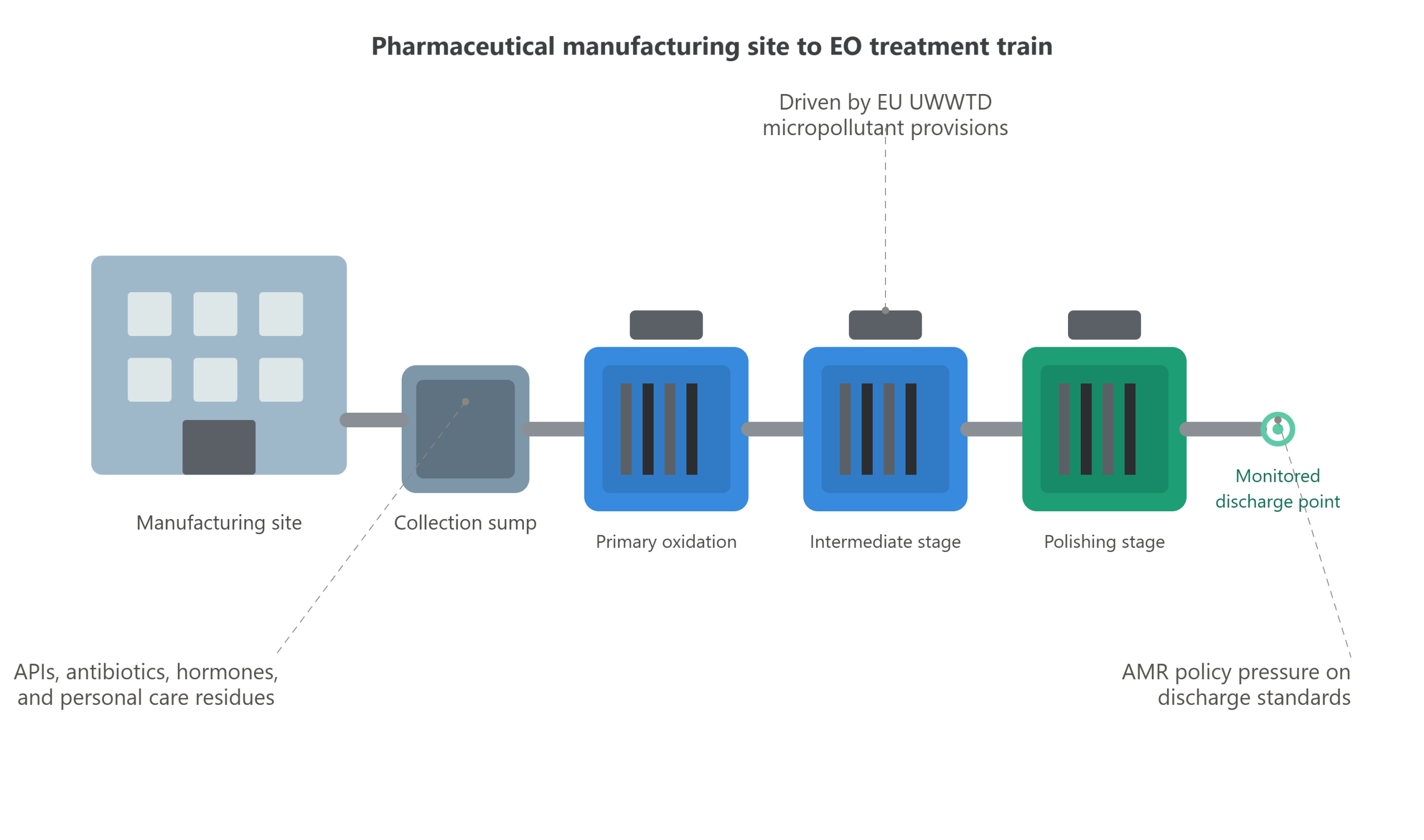
What this application covers
API and antibiotic destruction, not just removal
Pharmaceutical manufacturing wastewater and hospital effluent contain active pharmaceutical ingredients (APIs), antibiotics, hormones, and metabolite residues at concentrations that are not effectively addressed by conventional biological treatment. The concern is not acute toxicity — it is chronic environmental exposure driving endocrine disruption and antimicrobial resistance (AMR). EO’s hydroxyl radical mechanism attacks a wide range of pharmaceutical structures non-selectively, making it effective across heterogeneous pharmaceutical matrices. See Regulatory Watch for the EU UWWTD and AMR policy context.
Reviewed for technical accuracy by Janeczka Kowalski, Process / Electrochemical Engineering. Figures and ranges on this page are engineering starting points — verify against your own pilot or vendor data before finalizing a design. The content is created by the Evoaeo engineering team led by Janeczka, All rights reserved.
Where this wastewater actually comes from
Sources of pharmaceutical manufacturing wastewater
Before evaluating treatment options, it’s worth being specific about where pharmaceutical wastewater originates — the source shapes what’s actually in the stream.
- Manufacturing process — synthesis, formulation, and packaging of pharmaceutical products, including production of APIs and other chemical compounds
- Facility cleaning — water generated cleaning manufacturing equipment, containers, and surfaces, typically carrying trace APIs and organic contaminants
- Research and development — wastewater from experiments and analytical testing within laboratories, usually carrying chemicals and microorganisms at varying concentrations
- Quality control — testing and quality analysis conducted to ensure product safety and efficacy, wastewater from this process may also contain APIs and related compounds
What’s actually in the stream
Composition of pharmaceutical wastewater
Composition varies by product and production process, but pharmaceutical effluent typically falls into three contaminant categories:
- Organic compounds — APIs, surfactants, solvents, and other organic chemicals
- Inorganic compounds — heavy metals, acids, alkalis, and salts, often originating from raw materials and process chemicals
- Microorganisms — viruses, bacteria, and similar biological agents that can pose a threat to the environment and human health if discharged untreated
Why EO fits pharmaceutical wastewater
Why electrochemical oxidation suits pharmaceutical treatment
Wide pharmaceutical class coverage
Hydroxyl radical attack is non-selective — antibiotics, hormones, cytostatics, and analgesics are all susceptible regardless of molecular class.
No sludge containing active compounds
Biological treatment concentrates pharmaceutical residues in sludge, creating a secondary disposal concern. EO mineralises them in the aqueous phase.
EU UWWTD compliance pathway
The UWWTD micropollutant provisions require quaternary treatment at large urban wastewater plants — EO is one of the enumerated technology options.
AMR positioning
Facilities that can demonstrate antibiotic destruction rather than removal are positioned ahead of emerging AMR discharge requirements — see Regulatory Watch.
Bench testing
What pharmaceutical bench testing must establish
Real pharmaceutical wastewater matrices are more complex than single-compound synthetic solutions used in most published research. A real effluent bench test must establish removal rates for the actual pharmaceutical compound mix, the effect of matrix complexity (BOD/COD co-load, suspended solids, pH) on effective oxidant availability, and the byproduct profile — some pharmaceutical degradation intermediates require their own monitoring. Do not extrapolate from published single-compound studies to real effluent design.
- Removal rates for actual pharmaceutical compounds in the real effluent matrix
- Matrix complexity effect: how co-present BOD/COD reduces pharmaceutical removal efficiency
- Byproduct profiling — partial degradation products of antibiotics and cytostatics
- Energy consumption in the complex matrix vs. synthetic solution
- Endpoint definition: UWWTD requires defined treatment efficiency, not just removal confirmation
Key parameters
Pharmaceutical wastewater operating parameters
The matrix complexity of real pharmaceutical effluent is the dominant operating variable. High co-present BOD/COD competes with pharmaceutical compounds for available hydroxyl radical — pre-treatment to reduce bulk organics before EO polishing is often the most energy-efficient configuration for high-COD streams. For low-volume, high-pharmaceutical-concentration manufacturing streams, direct EO without biological pre-treatment may be appropriate.
- Matrix BOD/COD competes with pharmaceutical targets for available oxidant
- BDD preferred for recalcitrant pharmaceutical classes; MMO suitable for some simpler structures
- Pre-treatment to reduce bulk COD is cost-effective for high-COD pharmaceutical streams
- pH affects both pharmaceutical compound solubility and hydroxyl radical efficiency
- Cytostatics and other high-risk compounds require specific bench monitoring — not a general proxy
Regulatory context
EU UWWTD and AMR regulatory drivers
The recast EU Urban Wastewater Treatment Directive (in force January 2025) requires quaternary treatment at urban wastewater treatment plants above 150,000 population equivalent by 2033, and above 10,000 p.e. by 2039. Pharmaceutical companies contribute to the extended producer responsibility (EPR) financing mechanism. Separately, WHO and national health agencies are increasing attention to antibiotic discharge from pharmaceutical manufacturing — AMR policy is moving from research to regulatory expectation.
- UWWTD requires quaternary treatment at defined scale thresholds by 2033 and 2039
- Pharmaceutical EPR contribution is mandatory under UWWTD — destruction technology is the enabling step
- AMR policy: no harmonised antibiotic discharge limit yet, but the direction is toward destruction proof
- Hospital wastewater: increasing national attention as a point source for AMR and cytostatic discharge
Related resources
Related resources
Pollutants
The contaminant-level mechanism and performance context for this application.
Industry Solutions
The industry context behind this application and its regulatory driver.
Case Studies
Deployed system results from this application area.
Literature
Peer-reviewed research on EO for this specific contaminant class.
Common questions
Electrochemical Oxidation for Pharmaceutical Wastewater Treatment FAQ
Compound-specific bench testing
Pharmaceutical bench tests cover the actual compound mix in real effluent — not synthetic proxies.
UWWTD-current
Regulatory content is reviewed against EU Parliament and member state implementation documents.
AMR-aware
AMR policy developments are tracked separately from UWWTD — see Regulatory Watch for the current position.
Start with the wastewater and the required endpoint
Request a Pharmaceutical Wastewater EO Review
Share the named active ingredients, intermediates, solvents, COD/TOC range, conductivity, flow pattern, existing biological treatment, and required discharge or pretreatment endpoint. Compound-specific analysis is required before a treatment claim can be made.
Submitting this form does not schedule testing or establish treatment performance. Uploaded files are used to review application fit and define the next technical step. Replace the placeholder email, webhook, privacy-policy link, and retention settings before publication.
Facing a UWWTD compliance deadline or pharmaceutical discharge challenge?
Tell us the effluent type, the pharmaceutical compounds of concern, and the regulatory driver — we will design a bench test that establishes performance against the actual UWWTD marker compounds or your specific permit targets.
Don’t want to fill the blanks and submit the form above, it’s ok, simply discuss your Pharm application with our engineering team, we will get back to you ASAP.
Include in your request
- Effluent type: pharmaceutical manufacturing, hospital, or municipal with pharmaceutical load
- Compounds of concern: antibiotics, hormones, cytostatics, or full profile
- EU UWWTD timeline and your plant size (p.e.) if applicable
- Current treatment and where the pharmaceutical removal gap exists