Electrochemical oxidation engineering guide
Wastewater Electrolysis by Electrochemical Oxidation
How direct electron transfer, electrogenerated oxidants, reactor hydraulics, and anode selection determine whether a wastewater stream is a credible candidate for electrochemical oxidation. BDD and MMO are not interchangeable product grades. They are different anode families with different surface chemistry, oxidant pathways, byproduct profiles, and lifecycle constraints. The correct choice is established through representative-water testing—not by electrode name alone.
Engineering determination
Define the treatment duty before discussing the electrode
“Wastewater electrolysis” describes an electrically driven reactor, not a guaranteed treatment result. A defensible application starts with a measurable duty: destroy a named compound, reduce toxicity, improve biodegradability, remove color, control odor, disinfect a defined stream, or polish a concentrate to a specified endpoint.
Bulk COD removal alone is not enough to select an anode. The same COD value can represent readily biodegradable organics, refractory aromatics, solvents, surfactants, chelants, reduced sulfur, or inorganic oxygen demand. Each matrix places a different current demand on the reactor.
Scope note,: This page is an engineering screening resource, not a final design, permit determination, performance guarantee, or substitute for bench and pilot testing on representative wastewater. Byproduct limits, electrical classification, gas handling, materials compatibility and local discharge requirements require project-specific review.
Process chemistry
What actually happens inside an electrochemical oxidation cell
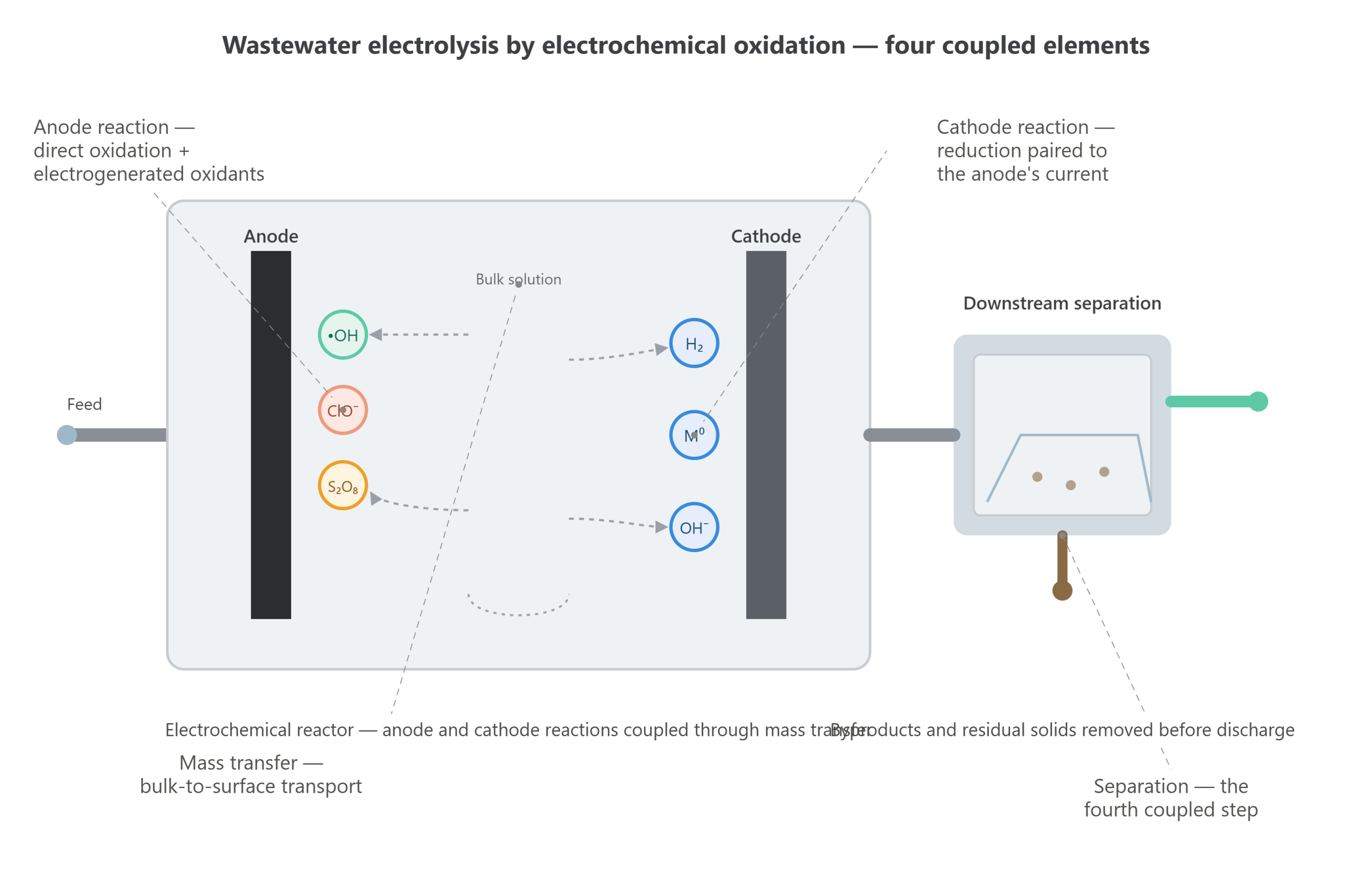
The treatment mechanism is a coupled electrochemical and transport problem. Electricity does not “split pollutants” directly in every case. Performance can arise from surface electron transfer, surface-bound reactive oxygen species, mediated oxidants generated from chloride or other ions, and subsequent reactions in the bulk liquid.
Representative half-reactions—not a complete mechanism:
Acidic anode oxygen evolution: 2H₂O → O₂ + 4H⁺ + 4e⁻
Alkaline anode oxygen evolution: 4OH⁻ → O₂ + 2H₂O + 4e⁻
Cathodic hydrogen evolution: 2H₂O + 2e⁻ → H₂ + 2OH⁻
Chloride-bearing wastewater may also generate active chlorine species. This can improve oxidation or disinfection, but it also creates a specific need to evaluate chlorate, perchlorate, halogenated organics, corrosion, and chlorine-containing off-gas.
1. Current crosses the cell
The rectifier drives current between anode and cathode. Measured cell voltage includes electrode potentials, solution resistance, contact losses, gas coverage and mass-transfer polarization.
2. Oxidation begins at the anode
Pollutants may exchange electrons at the surface or react with surface-bound and dissolved oxidants generated from water, chloride or other electrolyte species.
3. Transport determines useful charge
Hydraulics, electrode gap, conductivity, turbulence, temperature, solids and fouling determine how much supplied charge reaches the intended reaction rather than a competing pathway.
4. Reduction occurs at the cathode
Hydrogen evolution is common. Oxygen reduction, metal deposition and other cathodic reactions may also occur, depending on water chemistry and cathode construction.
Anode engineering
BDD versus MMO: select by reaction pathway and lifecycle duty
Both families can support electrochemical oxidation, but they should not be reduced to a simple “premium versus economical” comparison. Anode composition changes surface adsorption, oxygen evolution, selectivity, mediated-oxidant formation, coating life and the analytical risks that must be managed.
BDD-led test
Lead with BDD when the duty is refractory-organic destruction or polishing, chloride is low or tightly constrained, byproduct limits are strict, and the project can justify a high-severity oxidation route.
MMO-led test
Lead with a defined MMO coating when the stream is conductive and chloride-bearing, mediated oxidation or disinfection is acceptable, and chlorine utilization, off-gas and oxychlorine byproducts can be measured and controlled.
Test both under equal charge
Use a side-by-side comparison when chloride is variable, the endpoint mixes conversion and mineralization, coating chemistry is uncertain, or lifecycle cost could outweigh a modest performance difference.
Bench-test routing
Which anode should be tested first?
Use the decision paths below as a test-planning framework. When the water chemistry does not support a defensible desktop choice, the correct engineering response is a controlled BDD-versus-MMO comparison.
Path A · BDD-led test
Start here when the treatment duty is refractory-organic destruction, mineralization-oriented polishing, or a strict byproduct boundary with limited reliance on active chlorine.
- Track the named target, COD and TOC; do not use COD alone.
- Report kWh per cubic metre and per mass of target, COD or TOC removed.
- Inspect coating integrity, scale and cathode deposits after each charge point.
Path B · MMO-led test
Start here when a defined MMO coating is intended for a conductive chloride-bearing stream, disinfection duty, or conversion pathway where mediated oxidants are acceptable.
- Measure free and total chlorine, chlorate, perchlorate and relevant halogenated organics.
- Document pH, temperature, gas capture and residual oxidant handling.
- Confirm coating composition, substrate, current-density envelope and polarity limits.
Path C · Side-by-side test
Use this route when the matrix is incompletely characterized, chloride is moderate or variable, the endpoint is mixed, or electrode lifecycle economics could change the decision.
- Use the same representative wastewater batch.
- Hold active area, gap, current, charge, mixing and temperature limits constant.
- Build charge-response curves and compare byproducts and electrode condition, not removal alone.
Characterization gate: before any electrode comparison, establish conductivity, chloride, alkalinity, pH, COD fractions, suspended solids, hardness, metals, target compounds, fouling potential, byproduct analytes and the required treatment endpoint.
Reactor engineering
Six design domains that control scale-up
Electrode material is only one component of the system. A favorable vial test can fail at pilot scale when current distribution, mass transfer, gas blanketing, solids deposition, heat rise or cleaning access are not reproduced.
Hydraulics and mass transfer
Define batch, recirculating batch or continuous flow; mixing regime; residence-time distribution; gas disengagement; electrode orientation; superficial velocity and solids management.
Electrical basis
Record current, current density, cell voltage, specific charge, conductivity, active electrode area, gap, contact losses and rectifier efficiency.
Water-chemistry envelope
Use representative minimum, typical and maximum pH, chloride, alkalinity, conductivity, COD or TOC, suspended solids, hardness, metals and target concentration.
Reaction endpoint
Separate target conversion, partial oxidation, toxicity reduction, biodegradability improvement and mineralization. These are different engineering outcomes.
Byproduct and gas control
Evaluate hydrogen, oxygen and chlorine-containing off-gas; chlorate or perchlorate; halogenated organics; pH drift; foam; precipitates and destruction or purge requirements.
Electrode lifecycle
Track coating wear, substrate exposure, passivation, scale, cleaning recovery, allowable polarity, replacement interval and disposal or refurbishment route.
Evidence plan
Minimum defensible treatability-test sequence
Reporting rule: show raw influent and effluent data, analytical detection limits, duplicate or replicate variability, charge passed, energy measured at the rectifier, and all operating conditions. A removal percentage without these fields is not a scale-up basis.
Credible application patterns
Where electrochemical oxidation can earn a place
- Segregated, conductive industrial streams with refractory or toxic organics.
- RO concentrate, brine or side-stream polishing where residuals transfer is undesirable.
- Pretreatment to reduce inhibition and recover biological treatability.
- Final polishing for a named micropollutant, color, odor or disinfection endpoint.
- Batch waste treatment where variable flow favors modular operation.
- On-site destruction where chemical storage, transport or sludge generation creates a larger lifecycle burden.
Frequent no-fit conditions
Where another treatment step usually belongs first
- Ordinary biodegradable BOD removal at large municipal flow.
- High suspended solids, oils or scale-forming load without pretreatment.
- Very dilute bulk-organic removal where mass transfer and background current dominate.
- Unknown chloride and unknown byproduct constraints.
- A project justified only by conductivity or COD, without a named endpoint.
- No provision for hydrogen, oxygen or chlorine-containing gas management.
Lifecycle economics
Price the treatment train, not the electrode plate
The meaningful comparison is EO against the least-cost treatment train that reaches the same endpoint on the same wastewater. Include pretreatment, rectifier losses, pumping, cooling, gas handling, cleaning, analytical monitoring, electrode replacement, downtime, residuals, operator labor, and any downstream polishing that remains necessary.
Energy denominator
Report both kWh per cubic metre and kWh per mass of target, COD or TOC removed. A low volumetric energy number can still hide poor current efficiency.
Electrode life
Use warranted or demonstrated service conditions, including coating, substrate, cleaning method, current-density range, polarity and downtime for replacement.
Capacity basis
Size on peak contaminant load, conductivity, temperature and fouling condition—not average hydraulic flow alone.
Residual cost
Include gas treatment, precipitates, spent cleaning solution, concentrates, residual oxidants, analytical verification and downstream polishing.
Technical FAQ
Questions that should be resolved before pilot design
Technical governance
Required project records and review boundaries
For publication and procurement, identify the page author, technical reviewer, review date, applicable industries, analytical methods, source documents, and any commercial relationship to the electrodes discussed. Do not publish anonymous performance ranges or laboratory outcomes without test conditions.
Recommended record set: wastewater source and sampling dates · laboratory accreditation and methods · electrode manufacturer and construction · active area and cell geometry · current, voltage and charge · hydraulic conditions · temperature and pH · raw analytical results · byproduct panel · cleaning history · deviations · reviewer approval.
Related engineering resources
Continue the feasibility assessment
Use the site’s go/no-go checklist, compatibility score and feasibility assessment after the treatment duty and analytical envelope are defined. These tools should support—not replace—representative-water testing.