Limitation: High BOD Streams
EO Is the Wrong Technology for High-BOD Wastewater
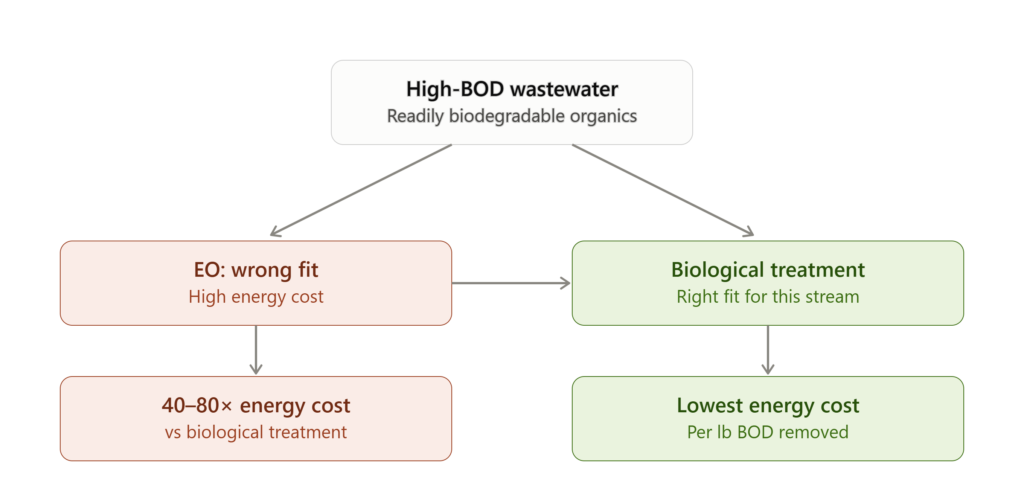
If your primary parameter is biochemical oxygen demand from readily biodegradable organics, electrochemical oxidation will treat it — at approximately 40–80× the energy cost of biological treatment for the same removal. This page explains why and what to do instead.
Why this rules EO out
The core problem
Electrochemical oxidation generates its oxidant from applied current, and every electron that goes into a molecule biology would have degraded anyway is an electron you paid for at your electricity rate instead of at the cost of blowing air through an aeration basin. Above a BOD:COD ratio of roughly 0.5, most of your organic load is readily biodegradable — exactly the substrate a conventional biological process handles well and cheaply.
Running EO against that load doesn’t fail technically — the electrode will happily oxidise biodegradable organics right alongside refractory ones. It fails economically, because you’re paying premium electrochemical cost per kilogram of COD for load that aeration would have removed at a small fraction of that cost.
The energy mismatch
Biodegradable COD and the wrong oxidation mechanism
Electrochemical oxidation mineralises organic compounds through hydroxyl radical attack — a powerful but energy-intensive pathway. Biological oxidation mineralises biodegradable organics through enzymatic catabolism — a process that uses chemical energy stored in the organic compounds themselves, with a modest electrical energy input for aeration in aerobic systems. The energy input required to mineralise one kilogram of biodegradable COD is 0.3–1.0 kWh by biological treatment and 20–80 kWh by electrochemical oxidation. That factor of 40–80x is not a technology immaturity gap that will close with time — it reflects a fundamental thermodynamic difference in how the two mechanisms operate.
The energy comparison
Why the arithmetic eliminates EO for primary BOD treatment
A food processing plant generating 500 m³/day of wastewater at 3,000 mg/L BOD has a daily BOD load of 1,500 kg. Biological treatment of that load requires approximately 450–750 kWh/day for aeration. Electrochemical oxidation of the same load requires approximately 30,000–120,000 kWh/day. At industrial electricity rates of $0.08–0.12/kWh, the biological option costs $36–90/day in electrical energy. The EO option costs $2,400–14,400/day for the same result on the same parameter. There is no regulatory driver, no capital cost consideration, and no site constraint that makes those numbers competitive for the biodegradable COD fraction.
- Aerobic biological treatment: 0.3–1.0 kWh/kg COD removed
- EO treatment of biodegradable COD: 20–80 kWh/kg COD removed
- Energy cost ratio: 40–80× higher for EO on the same parameter
- The ratio is thermodynamic, not a technology maturity gap
- Correct EO position in a high-BOD system: after biological treatment, treating the recalcitrant fraction that biology leaves
Where the line actually sits
The numbers behind this limit
As a rough guide: a BOD:COD ratio above about 0.5 usually means biological treatment is the cheaper answer outright. Between roughly 0.3 and 0.5 is a genuine gray zone — worth checking against toxicity and treatability data before assuming either technology wins. Below about 0.3, the load is predominantly refractory, and that’s the band where EO’s case starts to look strong.
These are starting points for your own analysis, not universal constants — confirm them against a treatability study on your actual stream rather than a BOD:COD number alone, since a low ratio can also simply mean a sample was taken after biological treatment already ran.
Where EO belongs in a high-BOD system
The correct position in the treatment train
High-BOD wastewater often contains a recalcitrant fraction alongside the biodegradable load — melanoidins and tannins in winery and brewery effluent, surfactant residues in food processing, pesticide residues in agricultural produce wash water. After biological treatment reduces the biodegradable COD to the permit threshold, the recalcitrant fraction may still be failing a colour limit, a specific compound limit, or a micropollutant requirement. That residual is the EO application case — a fraction of the original load, at lower concentration, treated at much lower charge density than the raw influent.
- Biological treatment reduces BOD from 3,000 mg/L to 80 mg/L (typical secondary effluent)
- Residual recalcitrant COD fraction: 40–80 mg/L — resistant to further biological treatment
- EO charge density required on secondary effluent: 10–20× lower than on raw influent
- Energy cost on secondary effluent: 2–8 kWh/m³ vs. 60–120 kWh/m³ on raw BOD stream
- Correct system architecture: biological primary + EO polishing = permit compliance at viable operating cost
What this looks like
In practice
A food and beverage processing wastewater with a BOD:COD ratio of 0.7 is a textbook example: sugars, starches, and fats that a conventional activated sludge system will consume readily. Running that stream through EO instead would mean paying electrochemical rates to oxidise molecules an aeration blower would have handled for the cost of electricity to run a compressor — typically an order of magnitude or more cheaper per kilogram of COD removed.
The more common real-world pattern isn’t choosing EO instead of biological treatment outright — it’s discovering, after biological treatment is already in place, that a small refractory fraction survives it. That fraction, not the original high-BOD stream, is what EO is actually being asked to treat.
The actual next step
What to do instead
- Route the stream to biological treatment first — activated sludge, SBR, or an anaerobic process depending on strength and flow
- Reserve EO, if needed at all, for the refractory fraction that survives biological treatment — not the full incoming load
- Compare the two mechanisms directly on eo-vs-biological-treatment
- Re-check your BOD:COD ratio after biological treatment, not before — that's the number that actually matters for an EO decision
Common questions
High BOD Limitation FAQ
It will still oxidise the load — the electrode chemistry doesn’t distinguish biodegradable from refractory organics. The problem is purely economic: you’d be paying electrochemical rates for destruction that biological treatment provides far more cheaply.
That’s a real constraint, but it changes the cost comparison rather than removing it — run the numbers on operating cost at your actual flow and concentration before assuming EO is the cheaper path just because it avoids a capital project.
In principle, but it’s rarely the efficient design — you’d be applying full electrode capacity to a load most of which biology would remove for free downstream. Sequencing biological treatment first is almost always the better economic order.
Biology-first principle
The high-BOD limitation is not a competitive claim against biology — it is a recognition that biology evolved to do exactly this work efficiently.
Arithmetic-based
The energy comparison is arithmetic, not opinion. The numbers are stated with the matrix and assumption basis that produced them.
Redirects to fit
Every limitation page redirects to the correct treatment approach — not just to EO alternatives.
Level 1 Decision Gate
Where does this take you next?
Every page in the Decision Layer routes to one of three outcomes. Choose the path that matches where you are.
→ Yes — EO is a fit
Your contaminant is recalcitrant, your regulatory driver requires destruction, and the matrix is compatible. Move to treatability testing.
→ Not sure yet
You have answered some of the fit questions but not all. Use the Go / No-Go Checklist to work through the remaining decision variables.
→ No — EO is not the right fit
The contaminant is biodegradable, the scale is too large, or the driver does not require destruction. Review the alternatives.