Comparison: EO vs Membranes
EO vs Membrane Filtration
Nanofiltration and reverse osmosis are the installed base for PFAS removal in many facilities. This page explains exactly why membranes and EO are not competitors — and why membrane operators are the fastest-growing EO customer segment.
Quick verdict
Which one actually fits your stream
Choose EO when
- The pollutant needs to be destroyed, not relocated — a membrane's reject stream still contains everything it rejected, now concentrated
- You already have an RO or NF concentrate with nowhere to discharge, and refractory organics are part of what's concentrated in it
- Fouling from organic or biological load on membrane surfaces is a recurring operational cost
- Dissolved salts aren't the primary target — organic destruction is
Choose membrane filtration when
- The target is dissolved solids, hardness, or salinity reduction for reuse or discharge — a job EO doesn't do at all
- You need a barrier for pathogens, particulates, or specific charged species with high rejection reliability
- Water reuse quality (near-distillate) is the actual specification
- You can manage the concentrate stream's disposal or further treatment as part of the overall design
Where membranes create the EO case
The concentrate disposal problem
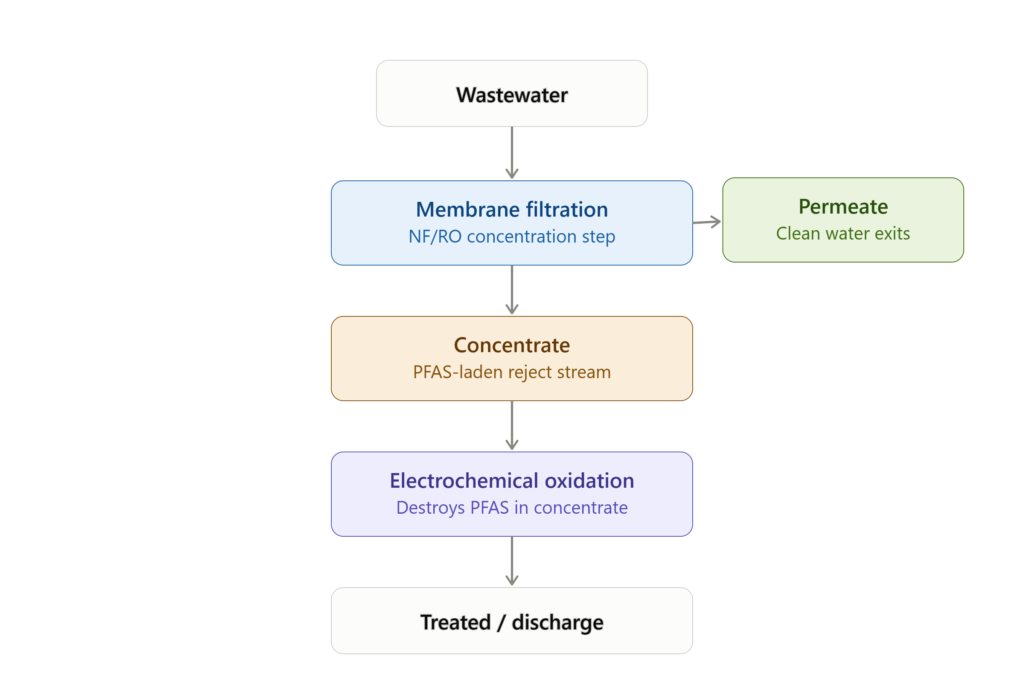
Membrane treatment of PFAS-contaminated streams has created a new problem set: high-concentration PFAS in a small-volume reject stream that must go somewhere. Before CERCLA designation, many facilities injected this concentrate into deep disposal wells or sent it to industrial wastewater treatment. Those options are narrowing: some states have restricted deep well injection of PFAS concentrate; industrial wastewater treatment plants are declining to accept high-PFAS streams as their own permits tighten. The remaining options are thermal treatment (high cost for aqueous streams) or electrochemical oxidation of the concentrate. EO applied to the concentrate treats a fraction of the total flow at high concentration — typically 10–20% of the feed volume at 5–10× the feed PFAS concentration — which is often more cost-effective than EO treating the full feed.
- NF/RO permeate: PFAS below detection limit — discharge compliant
- NF/RO concentrate: PFAS at 5–10× feed concentration — requires destruction or disposal
- Deep well injection options narrowing as state regulators add PFAS to injection permit conditions
- Industrial WWTP acceptance of PFAS concentrate declining as permits tighten
- EO on concentrate: treats 10–20% of total flow volume at elevated concentration — more economical than full-flow EO
- Combined system capital: membrane + EO is often more cost-effective than EO alone on the full flow
When membranes alone are sufficient vs when EO is needed
The concentrate disposal question resolves the comparison
The decision is not EO or membranes — it is whether concentrate disposal is solved without EO.
✓ EO is likely a fit when:
- Concentrate disposal is unresolved: deep well injection not permitted, WWTP acceptance declining, evaporation cost prohibitive
- CERCLA liability exposure: concentrate containing PFAS creates ongoing liability as a PFAS-concentrated stream
- State-level destruction verification requirement: some permits now require destruction documentation, not just removal to threshold
- Future-proofing: concentrate disposal cost will increase as regulatory options narrow further
- Existing membrane system already in place — EO for concentrate is an add-on step, not a replacement
✕ EO is likely not a fit when:
- Concentrate disposal is established and permitted: injection well with valid permit, accepted by licensed treatment facility
- No CERCLA or regulatory liability concern for the concentrated stream at current permit conditions
- Membrane installation is recent and capital is not yet amortised — adding EO now is premature
- The facility is in early evaluation — concentrate disposal solution not yet needed
Underneath the verdict
How they actually differ
A membrane doesn’t change the pollutant — it uses pressure to force water through a barrier fine enough to reject dissolved or suspended species, which means everything rejected has to go somewhere: a concentrate or brine stream, smaller in volume but higher in concentration than the feed. That’s a completely different mechanism from EO, which breaks chemical bonds and doesn’t produce a second waste stream to manage.
The two aren’t actually competing for the same job as often as they’re compared — reverse osmosis is solving a dissolved-solids and water-quality problem, EO is solving an organic-destruction problem. Cost-wise, membranes scale with volume treated (pumping energy against osmotic pressure), while EO scales with mass of oxidant demand (COD load), which is exactly why EO tends to fit membrane concentrate — a lower-volume, higher-concentration stream — far better than it fits the original bulk flow.
Not always either/or
Can they work together?
The combination architecture
How membrane + EO systems are engineered as an integrated treatment train.
System integration design
Common questions
EO vs Membrane Filtration FAQ
No — EO doesn’t remove dissolved salts or provide the pathogen/particulate barrier reuse specifications usually require. It destroys organics; it doesn’t desalinate.
Only by relocating them, not destroying them. A membrane will reject many refractory organics into the concentrate stream, but that stream still needs a destruction or disposal pathway — often EO, incineration, or deep-well injection.
Electrodes experience their own version of performance decline — surface fouling or scaling on the cathode — but it’s a different mechanism from membrane fouling and is generally more forgiving to manage.
Membrane-complementary
The framing is that membranes and EO solve adjacent problems — membrane operators are the target audience for this page.
CERCLA-current
Concentrate disposal options are described in the context of current CERCLA liability and permit trends, not historical practice.
Concentrate-sized
Every sizing reference on this page is for the concentrate stream, not the full feed — a critical distinction for capital cost estimation.
Level 1 Decision Gate
Where does this take you next?
Every page in the Decision Layer routes to one of three outcomes. Choose the path that matches where you are.
→ Yes — EO is a fit
Your contaminant is recalcitrant, your regulatory driver requires destruction, and the matrix is compatible. Move to treatability testing.
→ Not sure yet
You have answered some of the fit questions but not all. Use the Go / No-Go Checklist to work through the remaining decision variables.
→ No — EO is not the right fit
The contaminant is biodegradable, the scale is too large, or the driver does not require destruction. Review the alternatives.