Engineering Advanced Oxidation for Organic Pollutants via Photocatalytic Wastewater Treatment
Recalcitrant organic pollutants (ROPs) sit as a treatment ceiling in modern industrial wastewater management — molecular structures deliberately or incidentally resistant to biological and physical-chemical treatment. Photocatalytic treatment is an Advanced Oxidation Process that moves beyond simple separation: rather than transferring contaminants into a sludge cake, it mineralizes complex organics into harmless byproducts at the molecular level.
Reviewed for technical accuracy by Janeczka Kowalski, Process / Electrochemical Engineering. Figures and ranges on this page are engineering starting points — verify against your own pilot or vendor data before finalizing a design. The content is created by the Evoaeo engineering team led by Janeczka, All rights reserved.
Engineering view
The mechanism: band gap, electron-hole pairs, and a race against recombination
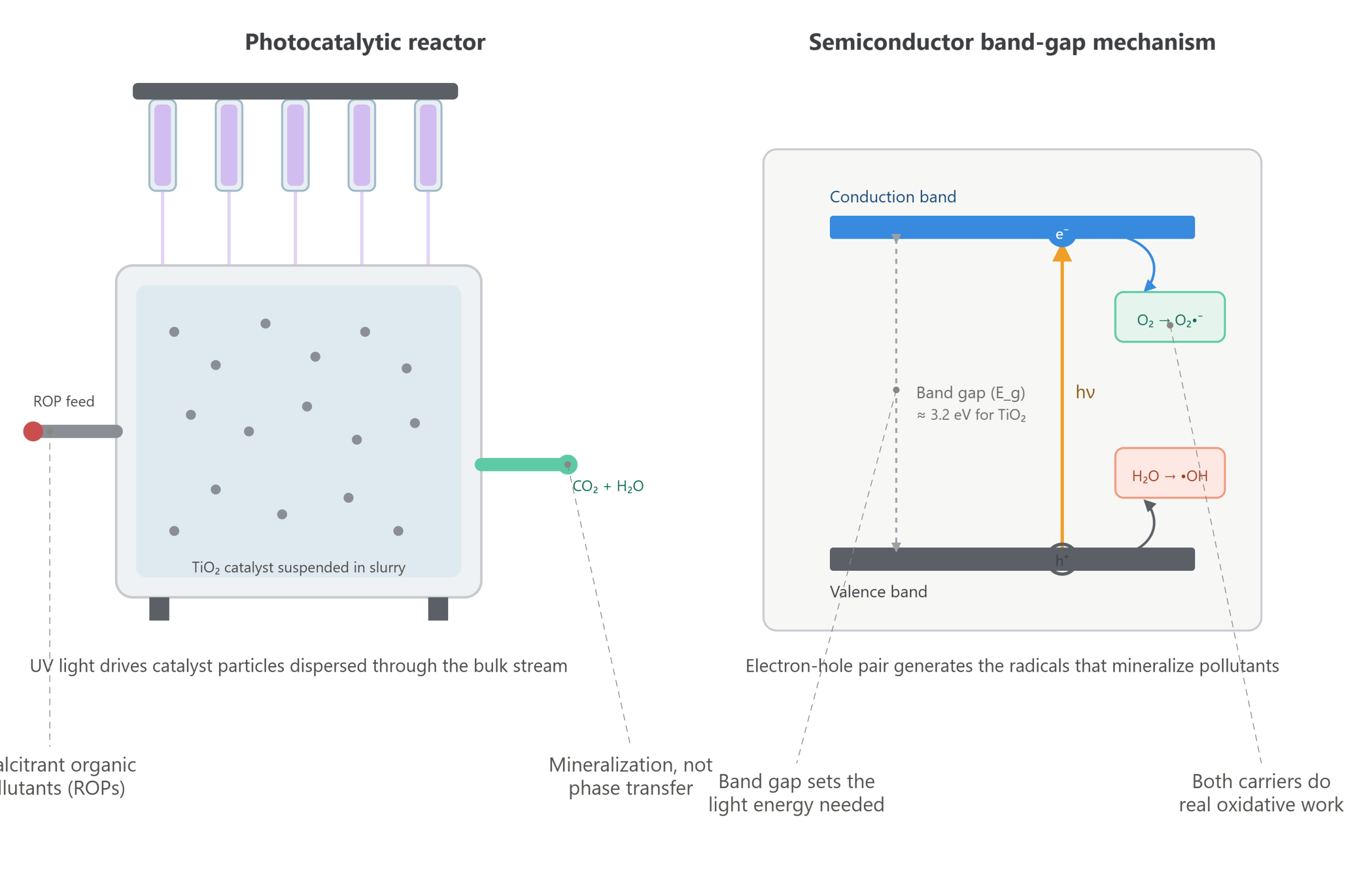
Photocatalysis uses UV or visible light energy combined with a semiconductor catalyst — typically titanium dioxide (TiO₂) or zinc oxide (ZnO) — to generate reactive species in the electrolyte. A semiconductor carries a band gap: the energy void between its filled valence band and empty conduction band. When a photon strikes the catalyst with energy equal to or greater than that band gap, an electron is excited into the conduction band, leaving behind a positively charged hole in the valence band.
That electron-hole pair is a powerful redox couple, but a fleeting one — if not consumed almost immediately, the pair recombines and releases the absorbed energy as heat, contributing nothing to treatment. The holes react urgently with water molecules or adsorbed hydroxide ions to generate superoxide and hydroxyl radicals, the actual working oxidants that attack organic pollutants. This recombination race is the central design constraint behind everything else on this page: any factor that slows the hole from finding a water molecule — poor light distribution, insufficient catalyst surface area, low pollutant concentration — directly reduces treatment efficiency.
Application view
Where photocatalysis actually gets deployed
Photocatalysis excels specifically at trace organic contaminants (TrOCs) — endocrine disruptors, pharmaceuticals such as carbamazepine, and pesticide residues persisting in secondary effluent at ppb concentrations that activated sludge simply can’t reach. This trace-level tertiary polishing role, rather than primary high-strength treatment, is where the technology is genuinely competitive.
Application note
Pure photocatalysis rarely survives contact with real industrial applications on its own — suspended catalyst recovery, frequent UV lamp replacement, and electricity consumption make it impractical as a standalone process at scale. This is why hydrogen-peroxide-based Photo-Fenton and ozone-based Photocatalytic Ozonation exist as hybrid variants, most often deployed on municipal effluent for microplastic and trace-organic removal rather than on high-strength industrial streams.
Advantages and disadvantages, stated plainly
Major advantages
- Genuine destruction rather than phase transfer — unlike activated carbon or reverse osmosis, photocatalysis leaves almost zero secondary sludge or brine
- Non-selective reactive oxidants attack diverse pollutants across complex, mixed waste streams
- Lower thermal requirement and solar-compatibility reduce both OPEX and carbon footprint
- Ambient operating conditions — no high-pressure or high-temperature risk — simplify compliance and reduce insurance exposure
Major disadvantages
- UV lamp intensity degrades over time, requiring regular maintenance and replacement that raises OPEX
- Certain catalysts (ZnO specifically) dissolve under light exposure, causing metal leaching and photocorrosion
- Uniform light distribution becomes nearly impossible at large tank scale, driving reactor geometry complexity and high CAPEX
- Partial oxidation can generate intermediates more toxic than the parent compound, risking toxicity discharge permit failure
Engineering note
The light-distribution problem is the real scale-up barrier, not a minor implementation detail — a bench-scale reactor with uniform illumination doesn’t predict commercial-scale performance, since large-tank geometry inherently creates dark zones where recombination dominates over productive oxidation. Reactor geometry has to be solved before charge-dose assumptions from bench data can be trusted at scale.
Choosing between the two
Photocatalysis vs. electrochemical oxidation for real wastewater
| Factor | Photocatalysis | Electrochemical Oxidation (EO) |
|---|---|---|
| Initial COD removal | Fast for simple aromatics; slow for complex chains | Rapid across most persistent organic structures; scales with current density |
| Mineralization depth | Often stalls at intermediate organic acids | Can mineralize fully to CO₂ and water |
| Energy medium | Photons / indirect electricity consumption | Direct electric power (electrons) |
| Typical energy use | Often exceeding 100 kWh/m³ | Commonly 1–20 kWh/m³ |
| Scale-up energy impact | Energy cost grows with treatment volume | Reaches stable energy use with modular deployment |
| Best-fit target | Ppb-level trace organic contaminants, tertiary polishing | High-strength COD (over 1,000 mg/L), saline industrial streams |
For complex, high-strength waste streams above roughly 1,000 mg/L COD, EO is generally preferred for its throughput and direct electron transfer — and can exploit high salinity as an operating advantage rather than a liability, since conductivity boosts current density. Photocatalysis is the better fit specifically for on-site, high-sensitivity treatment of ppb-level trace contaminants as a tertiary polishing step. Choosing between them is a strategic decision balancing upfront investment against long-term operational performance — not a question of which technology is universally superior.
For the full head-to-head comparison format used across our Technology Comparison cluster, see our EO vs. Photocatalysis page — this page provides deeper mechanism and engineering detail as a companion resource, not a replacement.
Grounded in the literature
This comparison reflects published research, not just our own field data
The mechanisms and performance patterns described on this page are consistent with the peer-reviewed environmental engineering literature — journals including Water Research, Chemosphere, the Journal of Hazardous Materials, Environmental Science & Technology, and the Chemical Engineering Journal regularly publish comparative studies on electrochemical and competing treatment technologies. Our engineering team tracks this literature as part of how we validate bench and pilot results against the broader research base, and can provide specific citations relevant to your stream on request.
Weighing photocatalysis against electrochemical oxidation for your stream?
Share your COD range, target pollutants, and treatment objective and we’ll give you an honest read on which approach — or which combination — actually fits.