EO Engineering Service
Electro Oxidation Engineering Service
A methodical path from raw wastewater characterization to a running, commissioned plant — twelve phases across four stages, each covered in full technical depth on its own page. Effective wastewater treatment engineering is rarely plug-and-play; it requires a deliberate transition from initial concept to full-scale deployment, and this page is the map of that transition.
Reviewed for technical accuracy by Janeczka Kowalski, Process / Electrochemical Engineering. Figures and ranges on this page are engineering starting points — verify against your own pilot or vendor data before finalizing a design. This page indexes our engineering process; it does not carry the full technical depth of any single phase. Each phase below has its own dedicated page covering methodology, typical parameters, and what a real engagement actually involves. The content is created by the Evoaeo engineering team led by Janeczka, All rights reserved.
Phase 1 — Feasibility & Design
From influent profile to a design basis
Every project starts with understanding your actual wastewater, not a generic assumption — characterization, process design, and reactor engineering together establish the technical basis a proposal can be evaluated against.
Wastewater Characterization & Treatability Studies
Lab analysis and bench-scale treatability testing to determine electrochemical oxidation kinetics for your specific effluent.
Conceptual & Process Design
Treatment flow chart, hydraulic and mass-loading assessment, and facility design ahead of detailed engineering.
Reactor Engineering & Electrode Design
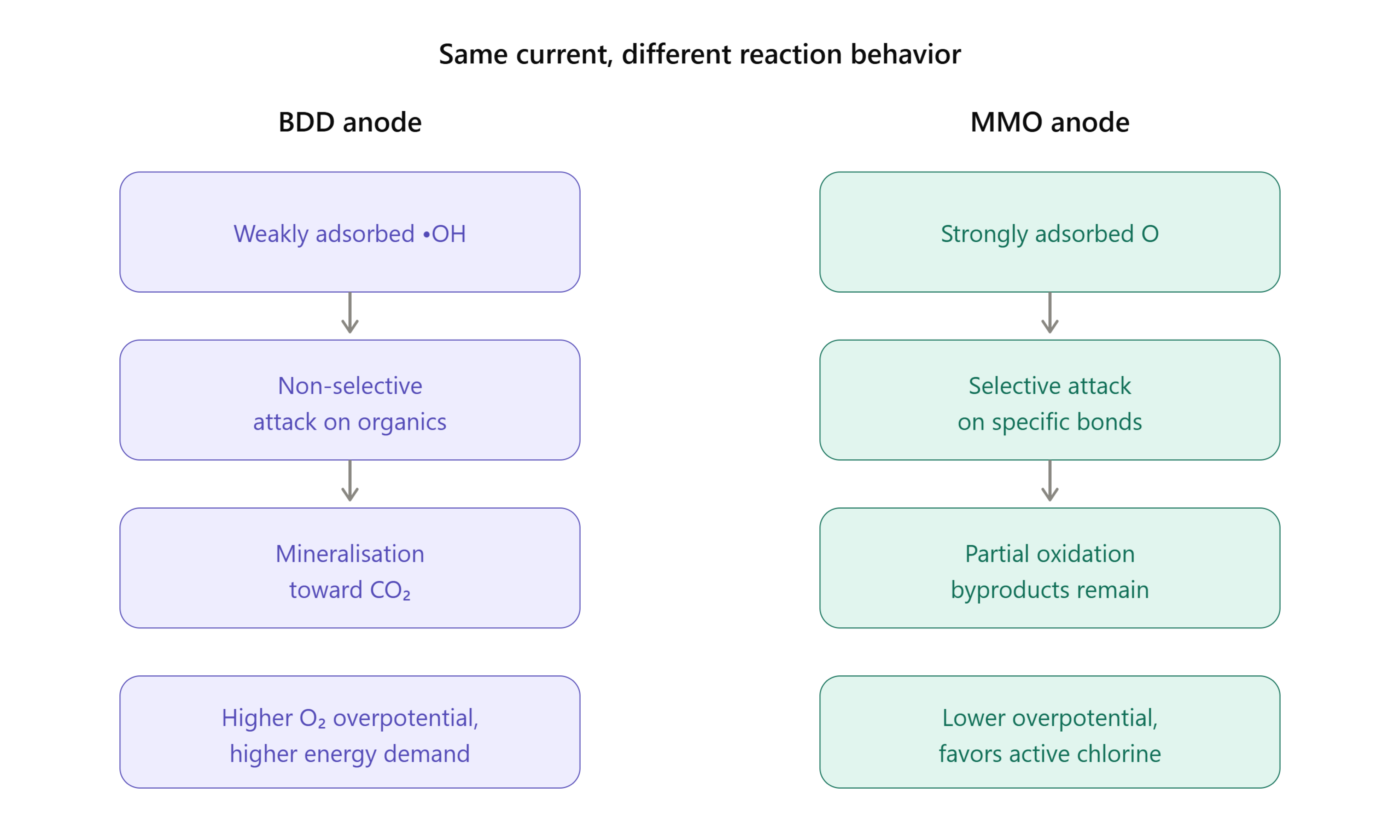
Catalyst coating ratio customized to your target pollutant’s optimal OEP, and CFD-modeled reactor geometry that eliminates dead zones for uniform electrode contact.
See also: the full Electrode Materials catalog →
EO Engineering Consultation
Direct technical advisory on treatment technology suitability, capital and operating cost estimates, and regulatory fit.
Phase 2 — System Development
From design basis to commissioned hardware
Skid-mounted pilot units validate performance under real fluctuations in COD, TDS, and pH before committing to full-scale design — then automation, power, and control systems get built around that validated basis.
Bench, Pilot & Commercial System Design
Skid-mounted, mobile pilot units for on-site validation, generating the CAPEX/OPEX data a full-scale proposal depends on.
System Integration & Automation
PLC-based control architecture including automated polarity reversal for scale prevention and integrated heat management.
Power Supply & Electrical Integration
Electrical system design, installation, and maintenance matched to your site’s actual power quality and voltage.
Phase 3 — Implementation
Getting commissioned hardware into the ground
Installation and commissioning close the gap between a validated design and an operating system on your site.
Installation and Setup
On-site installation, piping, electrical wiring, and system startup, handled by the same team that specified the design.
Phase 4 — Service & Support
Keeping a running plant running
A commissioned system is the start of the relationship, not the end of it — training, support, maintenance, and updates continue for the life of the equipment.
Training Programs
Operator training and specialized courses so your team can run and safely maintain the system independently.
Technical Support
Ongoing technical assistance and troubleshooting for daily operational questions.
Maintenance and Repair
Scheduled maintenance and electrode-life management — reading cell voltage rise as an early warning before it becomes a failure.
Software & Hardware Updates
Firmware, control system, and hardware updates that keep pace with evolving requirements without disrupting operation.
★ The full scope, under one contract
Custom EPC Delivery
All twelve phases above can be delivered as separate engagements — or as one continuous scope where design, equipment procurement, and construction sit under a single accountable team. Evoaeo can be your sole source for catalyst electrode materials, electrochemical reactors, and portable through commercial-scale electro oxidation systems, meaning a facility with an evolving treatment need has one point of contact rather than three separate vendors to coordinate.
How a project actually moves forward
A safer path from wastewater sample to EO module design
1. Send sample and objective
Share COD, TOC, pH, conductivity, chloride, target pollutants, flow, treatment target, and process constraints.
2. Select electrode format
Match plate, foam, stack, active area, substrate, and connection style to the testing objective.
3. Run treatability test
Screen current density, residence time, removal trend, energy demand, pH drift, and byproduct concerns.
4. Scale with evidence
Use lab and pilot data to define reactor geometry, power supply, hydraulics, maintenance, and integration assumptions.
Looking for a solution built for your industry or your compound?
Engineering services describe how we build your system. If you want to see how EO applies to your industry or your specific pollutant first, start there instead.
Ready to start with your water profile?
Send us your effluent characteristics and treatment objective — we’ll recommend which phase to start from and what a realistic timeline looks like.